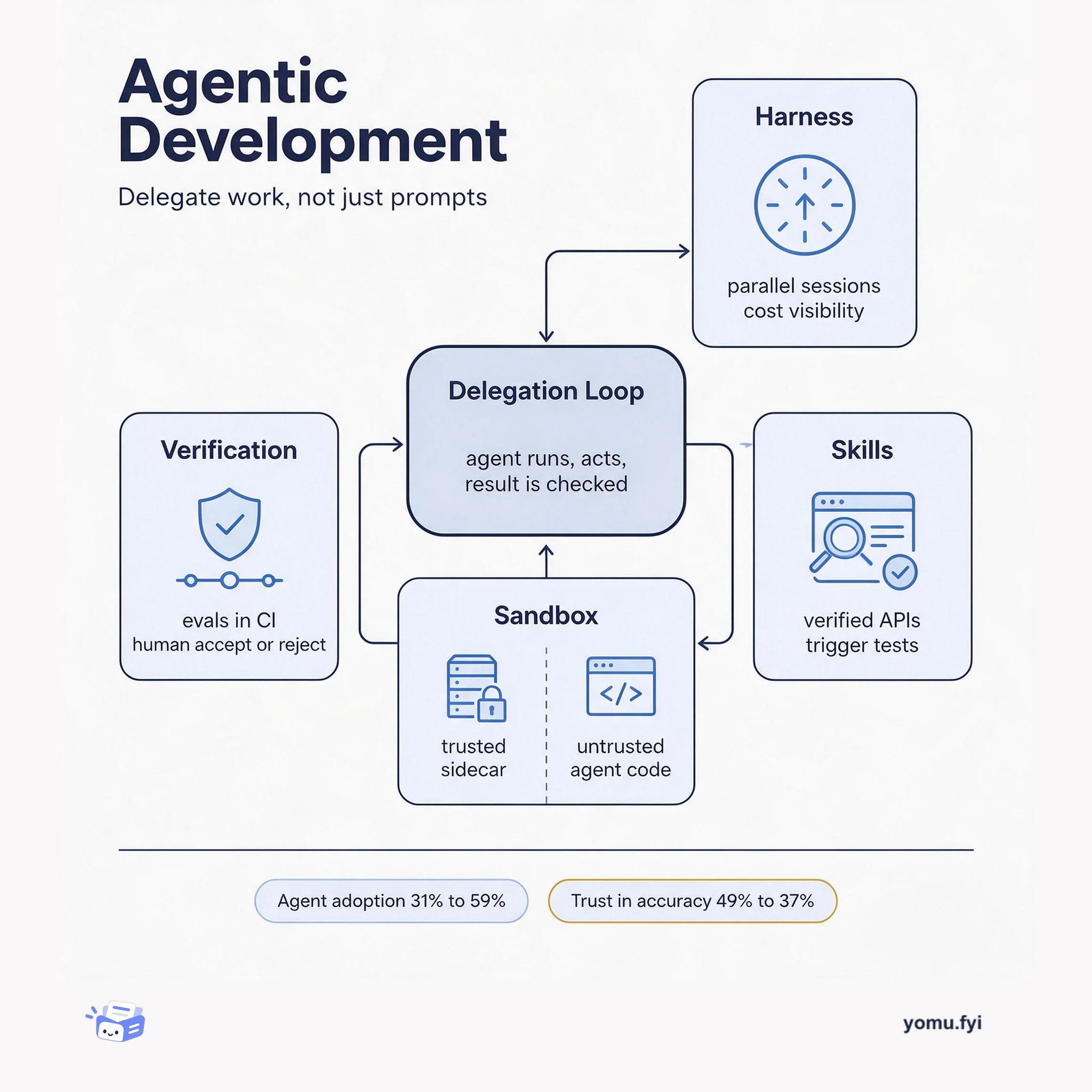
Agentic Development: The Four Parts of a Delegation Loop
Agentic development turns AI assistance into delegated work: a harness runs the agents, skills supply domain knowledge, a sandbox bounds execution, and evals verify the result.
 DatabricksJulia Powell, Sirui SunProblem & solution
As agentic applications move from answering questions to taking actions, enterprises risk AI sprawl from duplicated integrations, inconsistent policies, and fragmented context. Databricks asserts scaling requires three pillars: choice across models and tools, context grounded in governed enterprise data and business semantics, and control through consistent permissions, policies, observability, and cost management. Its platform provides Agent Bricks for unified agent fleet building and governance, Omnigent as a common layer above agent harnesses, and Unity Gateway as a centralized control plane for models, agents, and tools. Context is shared via Unity Catalog for data and AI asset governance and Genie Ontology for common business concepts, letting teams reuse governed context across applications. Control uses Unity Gateway for access policies, budgets, and traces and Databricks Sandbox for isolated execution, with MLflow enabling evaluation and workflow inspection to maintain reliability as agents scale.
AI agents are becoming easier to build but scaling them across an enterprise introduces AI sprawl, requiring shared infrastructure for choice, context, and control.
Databricks leverages Agent Bricks as a unified platform for building and governing agent fleets, Omnigent for cross-harness composition, and Unity Gateway as a centralized control plane, with Unity Catalog and Genie Ontology for shared context and Databricks Sandbox for isolated execution.
Enterprise agent scaling requires shared infrastructure that provides choice (flexible model, tool, and harness selection), context (governed enterprise data and business semantics), and control (consistent permissions, policies, observability, and cost management).
Context should be shared rather than rebuilt per application; Unity Catalog and Genie Ontology let teams reuse governed business concepts and data access across different agent workflows, reducing duplication.
Control must span all agent interactions including actions; Unity Gateway provides centralized policies, budgets, rate limits, and traces, while Databricks Sandbox offers isolated execution with down-scoped access, and MLflow enables evaluation and debugging of agent behavior.
Databricks prevents AI sprawl by providing shared infrastructure—Agent Bricks, Omnigent, and Unity Gateway—that centralizes governance, context, and control across agent fleets. This avoids the duplication and fragmentation that occurs when each team independently integrates models, tools, and policies.
Unity Gateway centralizes the control plane for models, agents, and tools, providing consistent access policies, budget and rate limits, and telemetry across all AI interactions. It ensures that the same governance and observability apply as applications scale.
Context is shared through Unity Catalog, which governs data and AI assets, and Genie Ontology, which provides a common understanding of business concepts. This allows teams to reuse the same governed business definitions and data access across multiple agent workflows.
Summaries are generated from the original by a language model. Check the original before relying on it.
See the idea
Agentic development turns AI assistance into delegated work: a harness runs the agents, skills supply domain knowledge, a sandbox bounds execution, and evals verify the result.
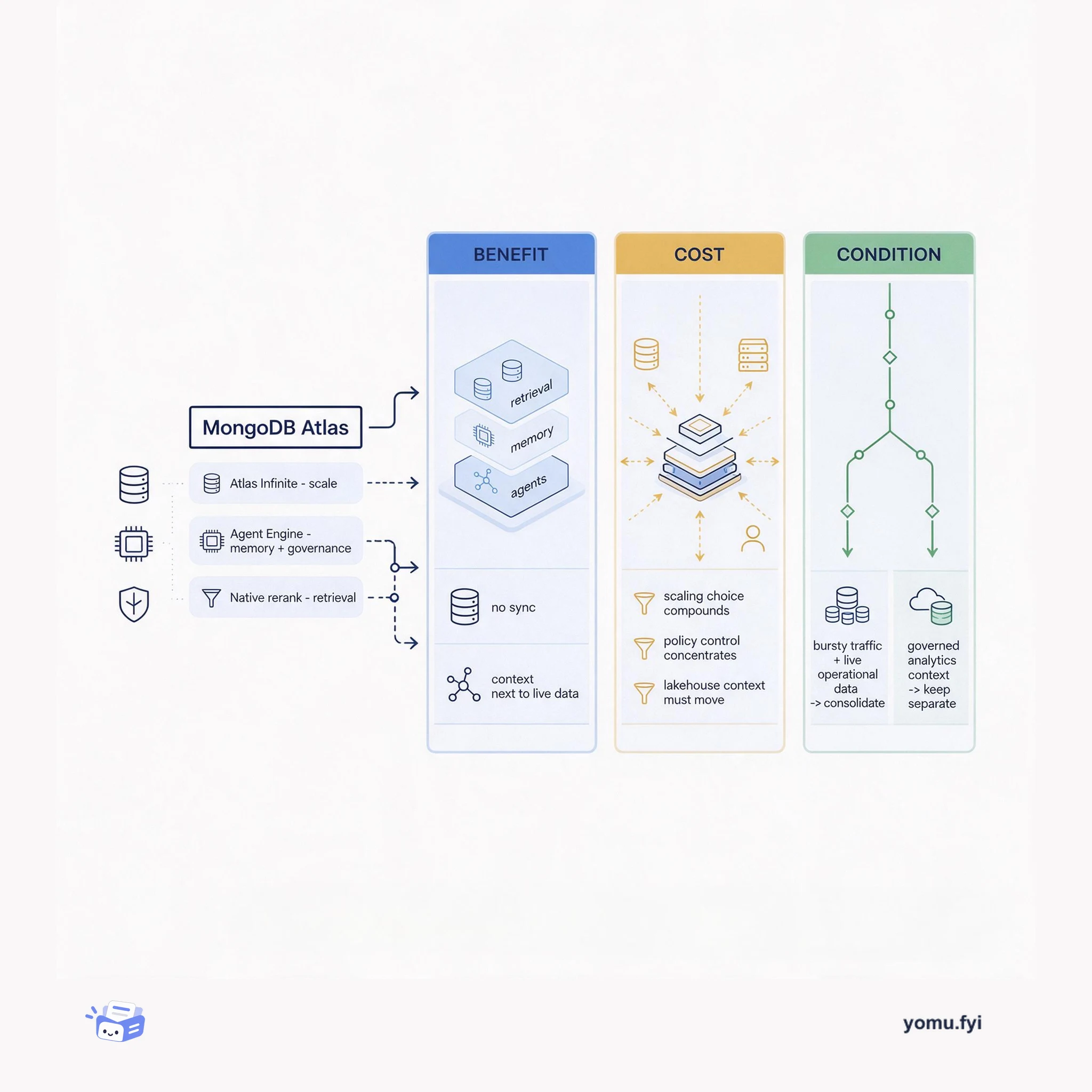
Consolidating agent memory, retrieval, and governance onto MongoDB Atlas removes sync and vendor layers, but ties scaling and control to one platform. This trade-off view shows the payoff, the cost, and the condition that decides it.
Keep reading
The Good Stuff
Paid picks we use ourselves. Links carry a referral code — a subscription through one earns us a commission at no extra cost to you.
One useful email. Unsubscribe anytime.