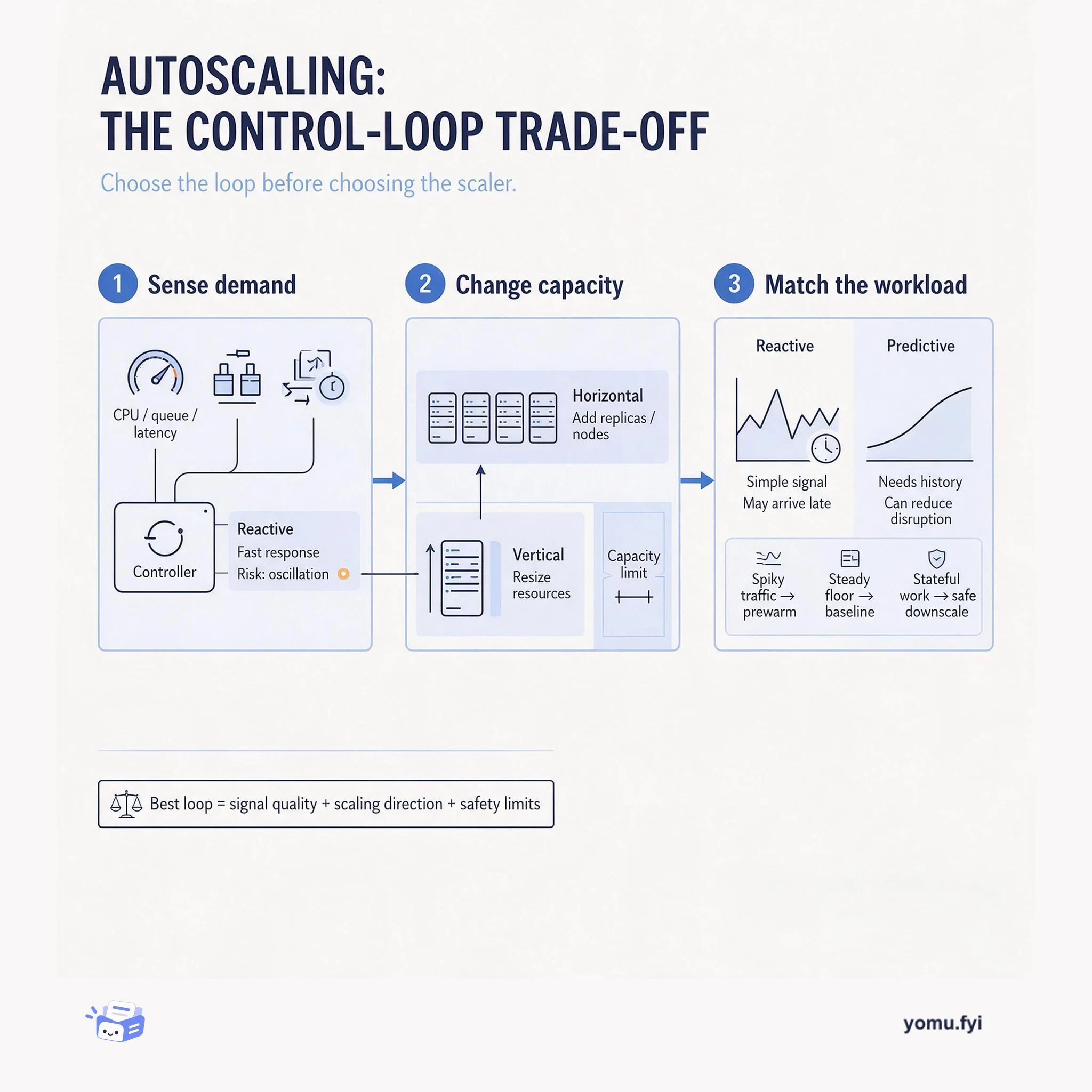
Autoscaling Is a Control Loop, Not a Button
Autoscaling trades responsiveness, stability, and cost: this explainer shows how signal choice, scaling direction, and capacity limits shape the right control loop for a workload.
 GrabMinh Nhat NguyenProblem & solution
Grab’s Flink platform saw application count grow 2.5 times, making cost-effective, self-service CPU provisioning difficult for users who often relied on trial and error and over-provisioned resources. Reactive autoscaling with Adaptive Scheduler, Kubernetes HPA, and metrics such as CPU usage or consumer latency caused restart spikes, scaling spirals, fluctuations, and additional constraints when connectors such as Kafka reached fixed partition parallelism. Predictive Resource Advisor instead uses vertical scaling and predictive, deterministic CPU decisions, automatically collecting data, training models, and applying configuration changes. The source says applications using it experienced fewer autoscaling-related disruptions, adapted to workload growth and surges, and averaged more than 35% cloud infrastructure cost savings. It also reports simpler default-configuration deployment, while planned work includes memory tuning, improved burst handling, and more efficient model training.
Flink application growth and broader self-service adoption made CPU configuration difficult for users with different backgrounds. Trial-and-error tuning often led to over-provisioning, while changing application logic and data patterns invalidated earlier configurations. Reactive autoscaling also produced restart spikes, scaling spirals, fluctuations, and limits caused by fixed connector parallelism, especially for Kafka-backed workloads.
Predictive Resource Advisor focuses on vertical CPU scaling for Flink applications sourcing data from message-bus systems. It is designed to make predictive, deterministic, and accurate scaling decisions by automatically collecting workload data, training autoscaling models, and applying configuration changes, allowing applications to use default deployment configurations without manual fine-tuning.
Flink restarts reprocess records from the last checkpoint and handle newly backlogged records, causing temporary CPU and consumer-latency spikes after scaling events.
Kafka’s fixed topic partitions limit horizontal consumer parallelism; once that limit is reached, increasing CPU or memory per instance becomes necessary to raise throughput.
Applications using Predictive Resource Advisor averaged more than 35% savings in cloud infrastructure cost, with CPU provisioning aligned more closely to requirements during low-traffic periods.
Summaries are generated from the original by a language model. Check the original before relying on it.
See the idea
Autoscaling trades responsiveness, stability, and cost: this explainer shows how signal choice, scaling direction, and capacity limits shape the right control loop for a workload.
Keep reading
The Good Stuff
Paid picks we use ourselves. Links carry a referral code — a subscription through one earns us a commission at no extra cost to you.
One useful email. Unsubscribe anytime.