NVIDIA Kumo Relational is a pre-trained relational foundation model that makes predictions directly on enterprise databases without requiring task-specific training, feature engineering, or table flattening. Given a predictive query, it gathers up to 10,000 historical examples as context and produces outcomes such as churn or demand in a single forward pass. Across 41 tasks on 15 databases, it outperforms supervised relational deep learning models and gradient-boosted tree pipelines; on the SAP SALT benchmark it surpasses AutoGluon ensembles by 8% in mean reciprocal rank. The model scales to databases with over 500 billion rows and is available through NVIDIA’s open-source structured-data-models library or as an NVIDIA NIM. It reasons within tables using column and row attention and across tables using graph attention over foreign keys, avoiding quadratic cost.
Context
Traditional predictive modeling on relational databases requires weeks of feature engineering, task-specific training, and flattening of tables into single rows, which loses structural signals and demands significant effort.
Approach / What changed
Kumo Relational is a pre-trained relational foundation model that uses automatic context generation from historical database states, reasons within tables via column and row attention, and reasons across tables via graph attention over primary-key/foreign-key relationships, interleaved with cross-sample attention. It is pre-trained on synthetic relational data and adapts through in-context learning with up to 10,000 examples, requiring no task-specific training.
Takeaways
1
Kumo Relational achieves superior accuracy compared to supervised learning pipelines on relational data without any task-specific training, using only in-context examples from the database.
2
The model operates directly on relational databases, preserving foreign-key relationships and timestamps, which avoids the information loss associated with flattening tables into single rows.
3
It scales to databases with over 500 billion rows via memory-mapped I/O at up to 5 GB/s and can be deployed as a GPU library or as a containerized NVIDIA NIM service.
FAQ
Does Kumo Relational require training on my data?
No, it uses in-context learning with up to 10,000 historical examples from your database, so no task-specific training is needed. Fine-tuning is optional for maximum accuracy.
How does Kumo Relational handle multiple related tables?
It reasons within each table using column and row attention, then across tables using graph attention over primary-key/foreign-key relationships, avoiding the need to flatten data.
Can agents use Kumo Relational for predictions?
Yes, it offers a Predictive Query Language (PQL) interface that agents can call to ask predictive questions, such as which customer will churn, and act on the results.
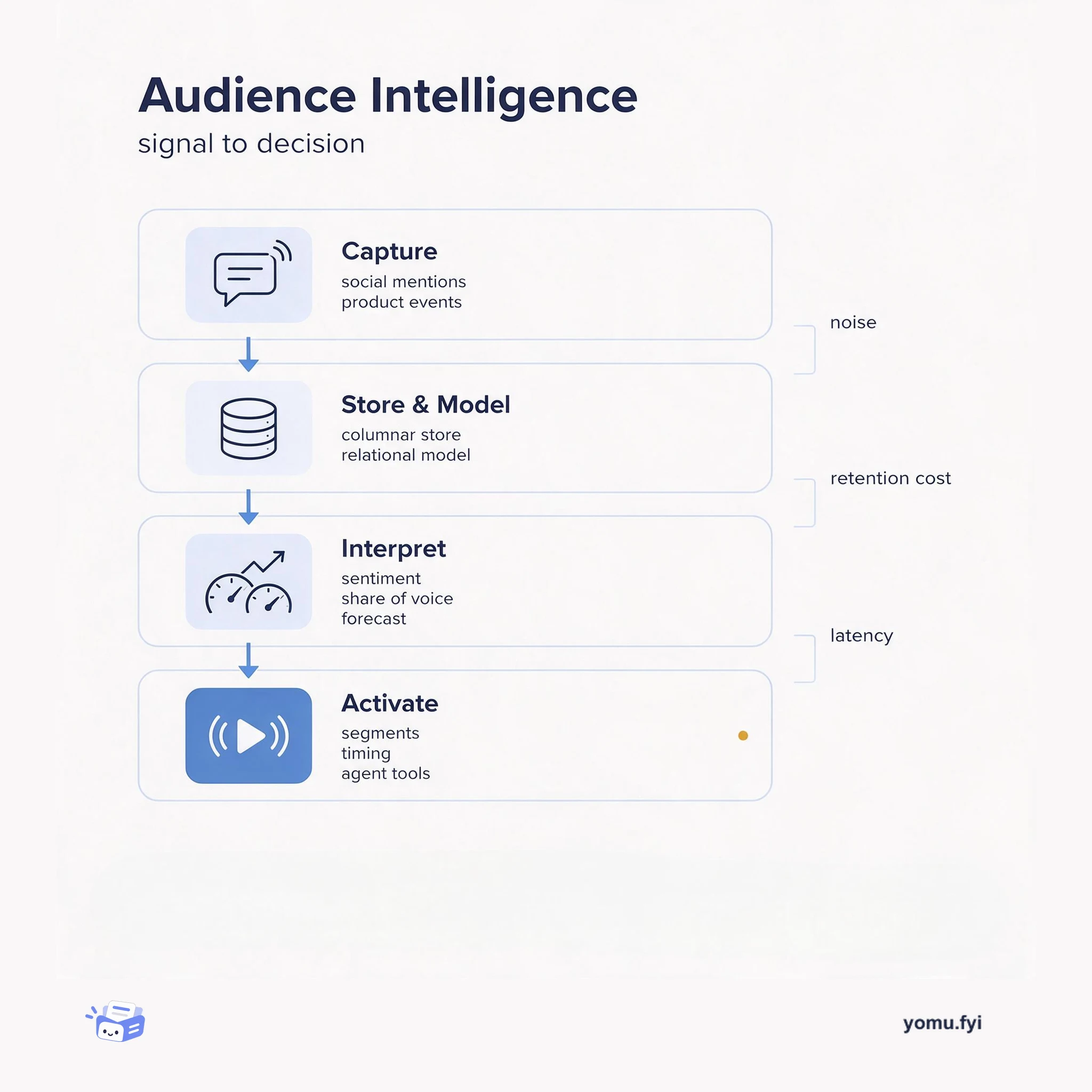
Audience Intelligence turns scattered social and behavioral signals into decisions about who to reach and when. This architecture map shows the four layers, what each owns, and where the trade-offs land.
Keep reading
Related reading
The Good Stuff
Paid picks we use ourselves. Links carry a referral code — a subscription through one earns us a commission at no extra cost to you.