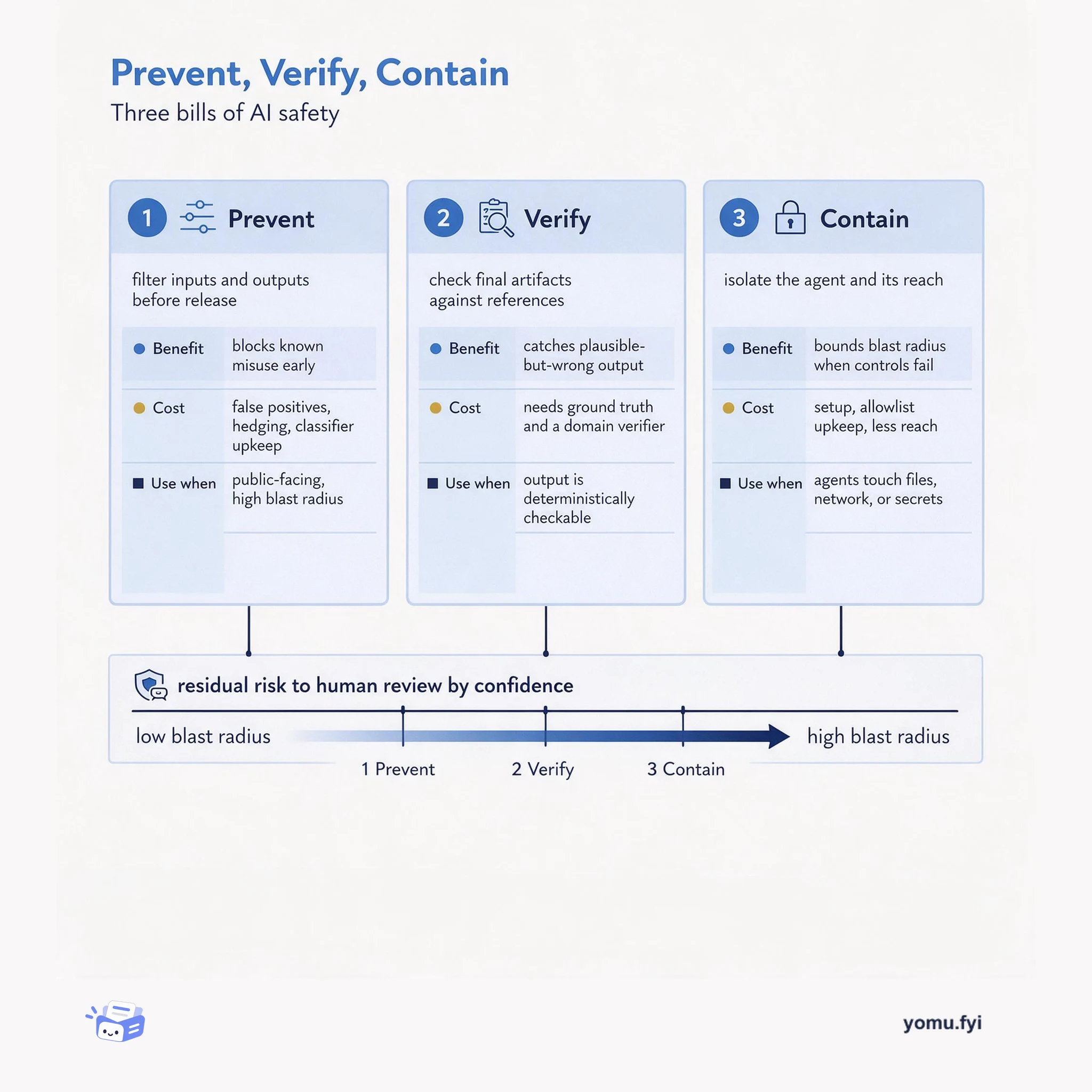
Prevent, Verify, Contain: The Three Bills of AI Safety
AI safety is a budget: prevention, verification, and containment each buy different protection at a different cost. This map shows what each control costs and when it pays off.
 DatabricksArchika Dogra, Jane Zhang, Zachary Wang, Nihit DesaiAnnouncement
Databricks announces General Availability of Document Intelligence REST APIs for real-time document parsing, extraction, and classification, with the ai_decide API for routing in beta. These synchronous APIs eliminate the manual bottleneck of reading documents by transforming unstructured contracts, invoices, and insurance claims into structured insights in real time. The ai_parse_document API converts tables and figures into structured text with citation bounding boxes, while ai_extract pulls specified fields with optional citations and confidence scores for verification. The ai_classify API assigns labels using a business taxonomy with optional rationales, and ai_decide uses content to route or flag documents for review. Developers can integrate these APIs into Databricks Apps for human-in-the-loop workflows, such as a contract intake flow where a lawyer uploads an agreement and sees key terms prefilled, or into custom agents on Agent Bricks.
Enterprise customers receive millions of documents daily, but extracting structured data from unstructured documents like contracts, invoices, and insurance claims requires manual reading and data entry, creating a bottleneck that slows downstream decisions and increases costs as volume grows.
Databricks provides synchronous REST APIs (ai_parse_document, ai_extract, ai_classify, and ai_decide in beta) that transform unstructured documents into structured insights in real time, enabling automated parsing, extraction, classification, and routing. Developers can integrate these APIs into Databricks Apps or custom agents built on Agent Bricks.
The Document Intelligence REST APIs are now Generally Available for parsing, extraction, and classification, with the decisions API in beta.
The ai_extract API pulls specified fields with optional citations and confidence scores, allowing humans or agents to verify values against the source.
These APIs can be integrated into Databricks Apps for human-in-the-loop workflows or into custom agents on Agent Bricks to automate document-driven decisions.
The GA APIs include ai_parse_document for reading files and converting tables and figures into structured text with citation bounding boxes, ai_extract for pulling specified fields with optional citations and confidence scores, and ai_classify for assigning labels using a business taxonomy with optional rationales and confidence scores. The ai_decide API for document routing is in beta.
Developers can call the REST APIs from Databricks Apps to build interactive human-in-the-loop workflows, such as a contract intake flow where a lawyer uploads an agreement and sees key terms prefilled. They can also call the APIs from custom agents built on Agent Bricks.
The ai_decide API uses document content to choose what happens next, such as routing the document to a workflow or flagging it for review, making it suitable for document routing decisions.
Summaries are generated from the original by a language model. Check the original before relying on it.
See the idea
AI safety is a budget: prevention, verification, and containment each buy different protection at a different cost. This map shows what each control costs and when it pays off.
Keep reading
The Good Stuff
Paid picks we use ourselves. Links carry a referral code — a subscription through one earns us a commission at no extra cost to you.
One useful email. Unsubscribe anytime.
