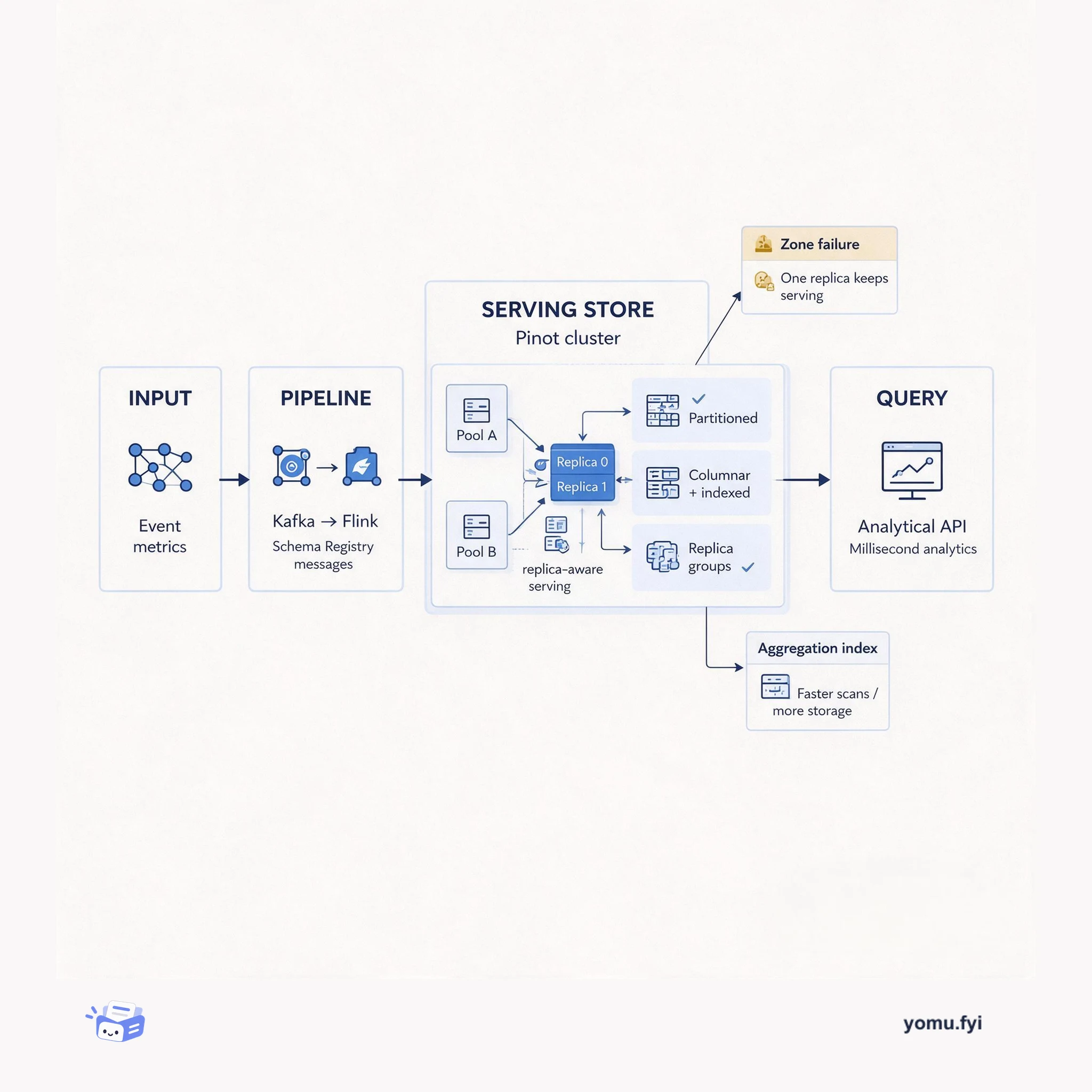
Partner Gateway needed low-latency analytics for API traffic and response-time metrics across intervals from one hour to 30-day retrospectives, with a particular dataset potentially reaching approximately 6.8 billion rows in a 30-day period. Apache Pinot was selected as a distributed real-time OLAP datastore, using high-throughput ingestion and columnar, indexed, partitioned data for millisecond analytical queries. Initial aggregation queries on datasets over 150GB timed out for 20- to 30-day periods, exceeding 10 seconds and threatening a 300-millisecond SLA. The implementation routes metrics through Kafka and Apache Flink, then ingests Schema Registry-compatible messages into Pinot, while partitioning by metric name and adding aggregation-focused optimizations. For one metric, query latency fell from 5,072 to 35 milliseconds; Star-tree indexing improved speed but raised 30-day storage from 192GB to 373GB, with the additional AWS EBS cost described as minor.
Context
Partner Gateway required real-time API performance metrics and low-latency analytical queries over intervals ranging from one-hour snapshots to 30-day retrospectives. Aggregation queries over datasets larger than 150GB frequently exceeded 10 seconds for 20- to 30-day periods, putting the 300-millisecond query SLA at risk.
Approach / What changed
The implementation uses Apache Pinot for real-time OLAP, with metrics routed through Kafka, transformed by Apache Flink, and serialized for ingestion using Protobuf and Confluent Schema Registry-compatible metadata. The table is optimized through partitioning by metric name, aggregation-interval columns, and Star-tree indexes.
Takeaways
1
Metrics include client ID, partner ID, status code, endpoint, metric name, timestamp, and value; they are uploaded to Datadog before being converted into Kafka messages.
2
Partitioning Kafka data by metric name improves data locality and query pruning, while allowing relevant metrics to be processed in parallel across Pinot nodes.
3
Star-tree indexing increased 30-day storage from approximately 192GB to 373GB, while the extra AWS gp3 EBS cost was estimated at $14.48 per month.
Apache Pinot is a distributed real-time OLAP datastore for low-latency analytics. This architecture view shows how streams, processing, partitioning, indexed storage, and replica-aware serving fit together.
Keep reading
Related reading
The Good Stuff
Paid picks we use ourselves. Links carry a referral code — a subscription through one earns us a commission at no extra cost to you.