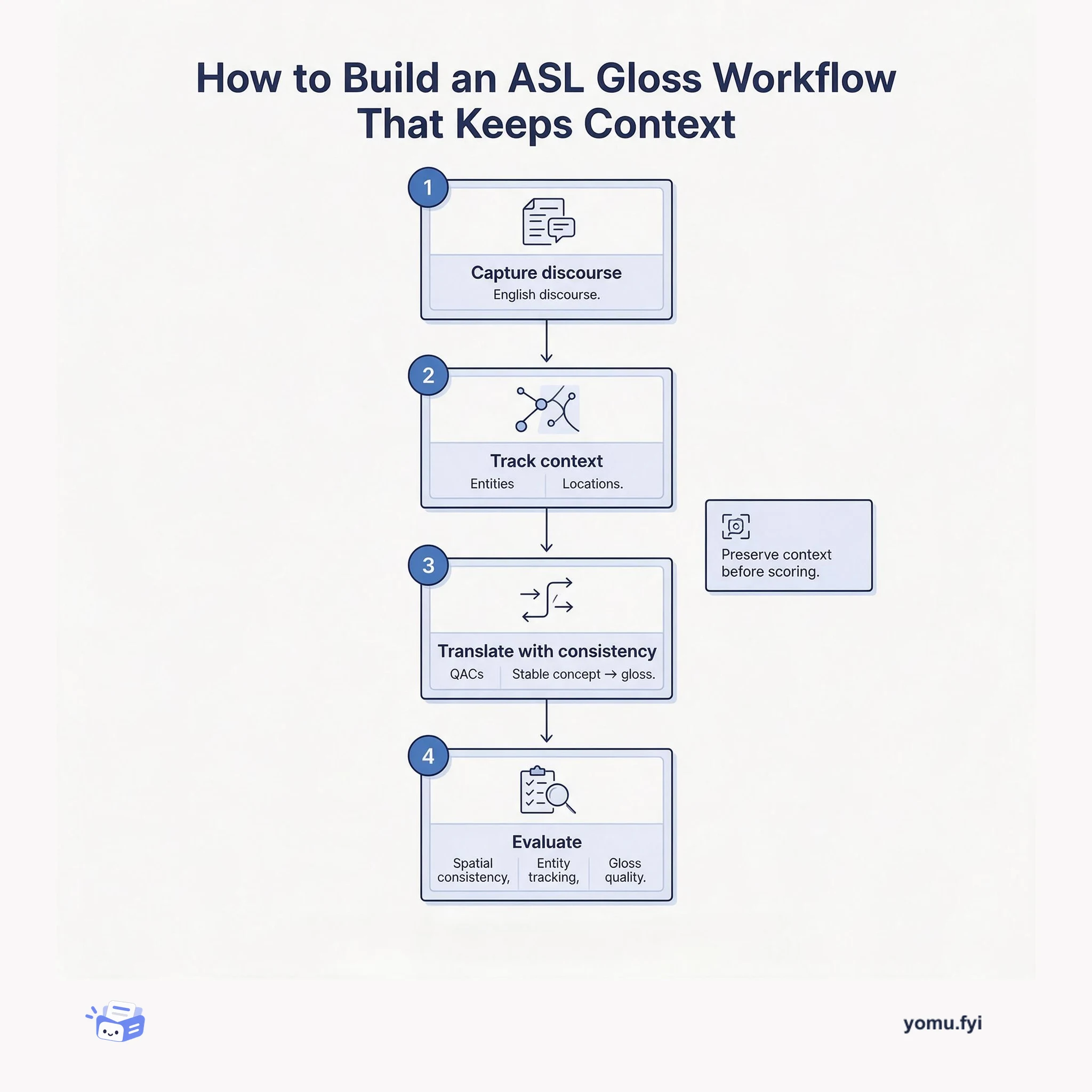
How to Build an ASL Gloss Workflow That Keeps Context
Learn a practical workflow for translating English discourse into ASL gloss while preserving spatial references, question-answer structure, and consistent concept-to-gloss mappings.
 AppleBenchmark
Evaluating video captions is difficult because reference-matching metrics can penalize valid descriptions that use different wording or focus on different visual content, while offering little fine-grained diagnosis. The paper reframes quality around information fidelity: captions should cover salient visual information and remain factually accurate. It introduces CapQuiz, a reference-free benchmark that tests caption utility through human-verified, fine-grained multiple-choice questions derived from videos, organized into 10 Descriptive and Inferential question types across 24 domains. It also proposes CapF1, which combines CapP for factuality with CapR for coverage; extensive experiments report significantly stronger correlation with human judgments than existing metrics and interpretable insight into model performance.
Existing video-caption evaluation metrics mainly match generated captions against ground-truth references. This can penalize high-quality captions because video description has a one-to-many nature, and these metrics provide limited fine-grained analysis of caption quality.
CapQuiz evaluates captions through their utility in answering human-verified, fine-grained multiple-choice questions derived from videos. It covers 10 question types in Descriptive and Inferential categories across 24 video domains, while CapF1 combines CapP for factuality and CapR for coverage.
CapQuiz is reference-free and evaluates caption information fidelity through multiple-choice questions derived from the associated video.
Its taxonomy contains 10 question types spanning Descriptive and Inferential categories across 24 diverse video domains.
CapF1 combines CapP, which measures factuality, with CapR, which measures coverage; experiments report significantly better correlation with human judgments than existing metrics.
Summaries are generated from the original by a language model. Check the original before relying on it.
See the idea
Learn a practical workflow for translating English discourse into ASL gloss while preserving spatial references, question-answer structure, and consistent concept-to-gloss mappings.
Keep reading
The Good Stuff
Paid picks we use ourselves. Links carry a referral code — a subscription through one earns us a commission at no extra cost to you.
One useful email. Unsubscribe anytime.
