
Apple Integration Is a Boundary, Not a Feature
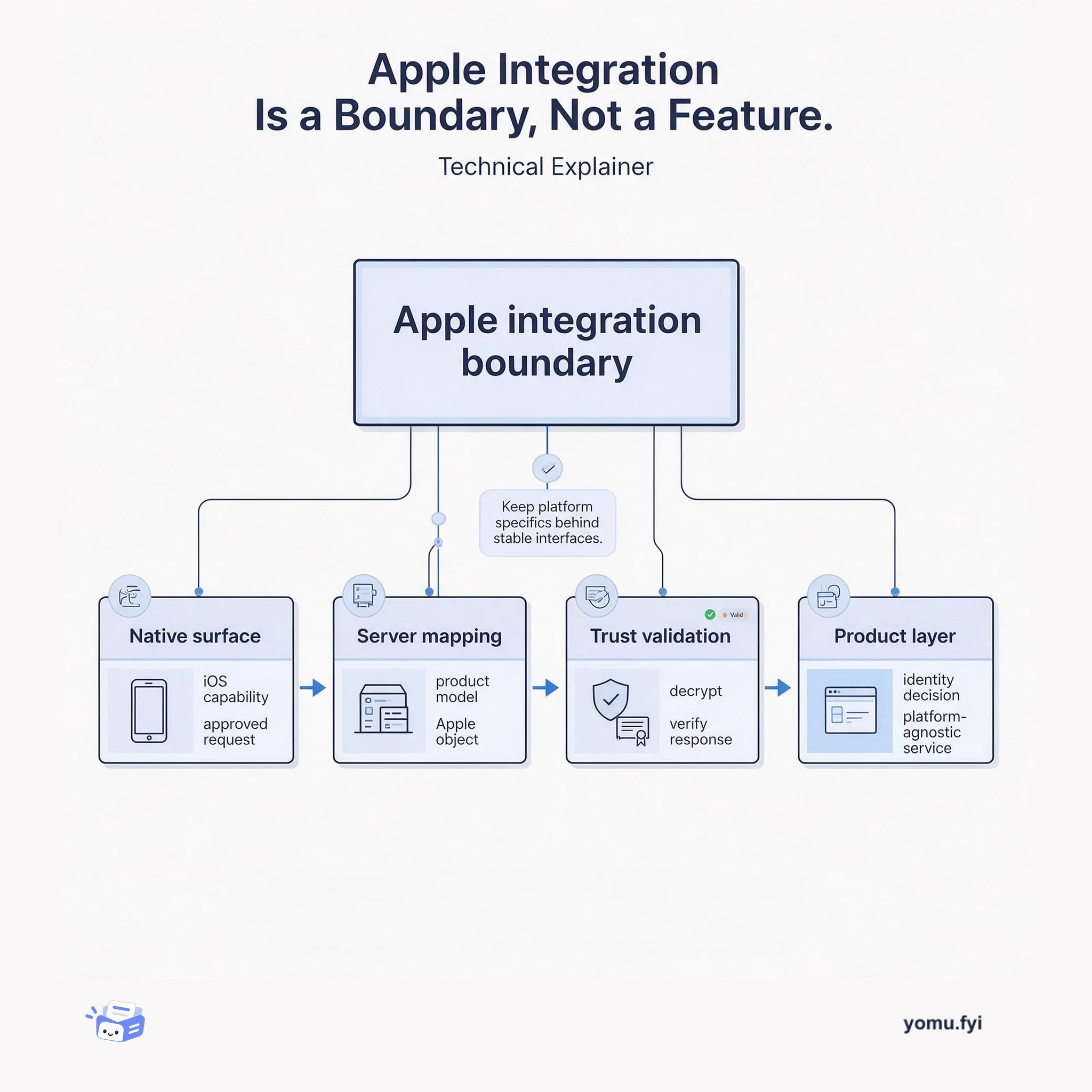
Apple integrations are boundary designs: native capability, server-side mapping, and trust checks must meet a platform-agnostic product layer. See where each responsibility belongs.
Uber integrated Apple’s Verify with Wallet API into its cross-app Identity Verification Platform to support government-backed digital IDs across driver onboarding, age-gated ordering, and car rental use cases. The central challenge was allowing each use case to request only its Apple-approved identity data while operating through a scalable, platform-agnostic service rather than separate integrations. Server-side configurations map Uber identity models to PassKit objects, set one-time or persistent storage intent, and validate responses using HPKE decryption, CBOR payloads, session transcripts, MSOs, device signatures, and issuer certificate chains under ISO/IEC 18013-5. A registry of IACA certificates, sourced from jurisdictional portals and AAMVA’s VICAL, supports overlapping certificate rotations, while the platform is intended to accommodate new document types and cross-platform digital credential integrations.
Uber needed to support different identity verification requirements across multiple apps and marketplace segments while ensuring each Verify with Wallet request stayed within its Apple-approved data scope. The integration also had to handle platform abstraction, ISO/IEC 18013-5 validation, cryptographic security, and rotating government certificate authorities at scale.
Uber centralized orchestration in its Identity Verification Service. Server-side configurations define use-case-specific data elements and storage intent, a mapping layer converts internal identity models into PassKit objects, and the service decrypts and validates responses using HPKE, session transcripts, MSOs, device signatures, issuer certificate chains, and a registry of rotating IACA trust anchors.
Per-use-case scoping occurs in Uber’s backend, allowing an app-level Entitlements file to cover multiple flows while requests remain limited to pre-vetted identity data elements.
Verification responses use HPKE-encrypted CBOR payloads and undergo session-transcript, MSO, device-binding, and issuer-certificate validation under ISO/IEC 18013-5.
The IACA registry supports multiple active certificates per jurisdiction, allowing credentials signed with older keys to remain valid during certificate rotations.
Summaries are generated from the original by a language model. Check the original before relying on it.
See the idea
Apple integrations are boundary designs: native capability, server-side mapping, and trust checks must meet a platform-agnostic product layer. See where each responsibility belongs.
Keep reading
The Good Stuff
Paid picks we use ourselves. Links carry a referral code — a subscription through one earns us a commission at no extra cost to you.
One useful email. Unsubscribe anytime.
