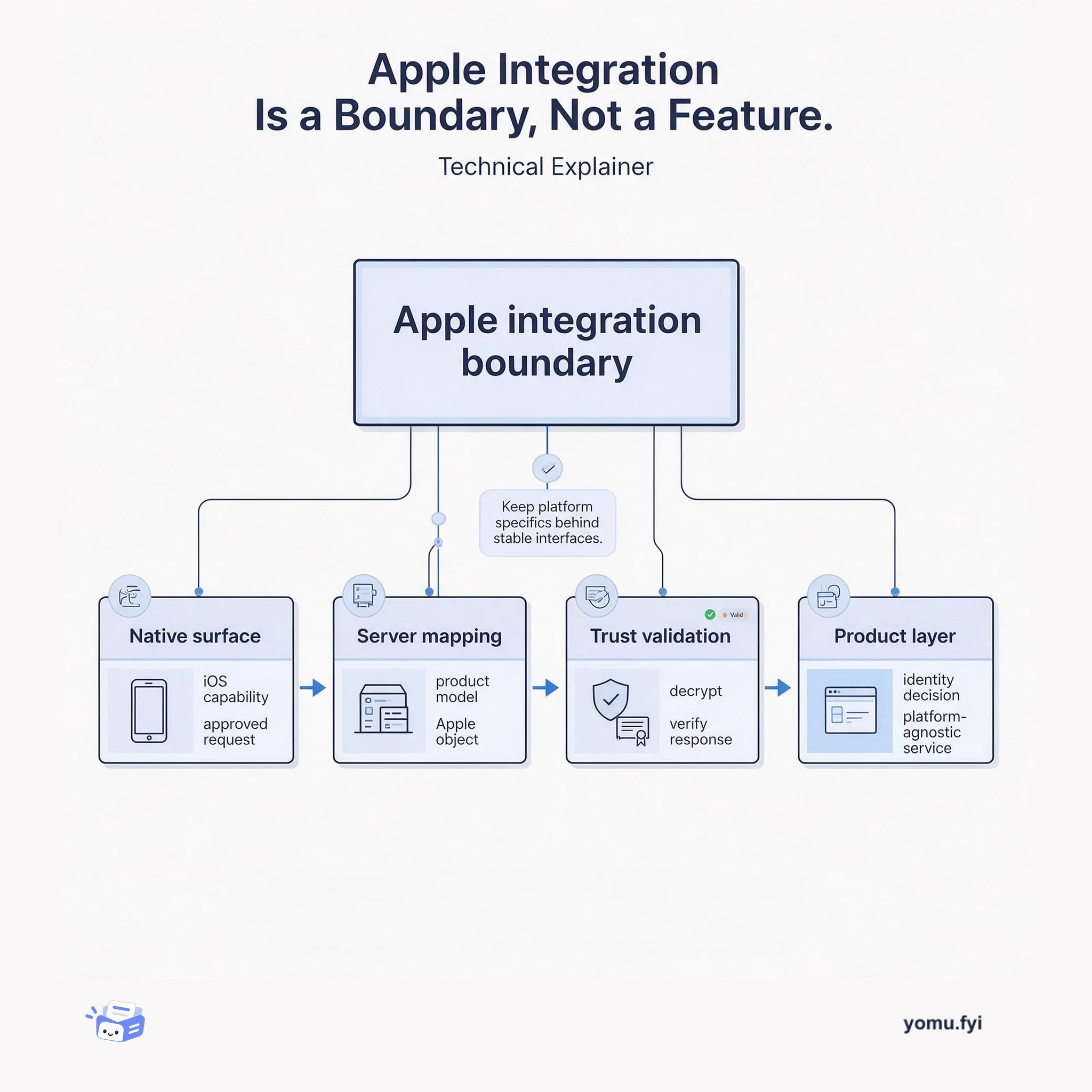
Apple Integration Is a Boundary, Not a Feature
Apple integrations are boundary designs: native capability, server-side mapping, and trust checks must meet a platform-agnostic product layer. See where each responsibility belongs.
Loading…
Topic
74 posts about iOS. Every summary links to the original.
See the idea
Apple integrations are boundary designs: native capability, server-side mapping, and trust checks must meet a platform-agnostic product layer. See where each responsibility belongs.
The Good Stuff
Paid picks we use ourselves. Links carry a referral code — a subscription through one earns us a commission at no extra cost to you.
Newest first
Auth0 released its official Kotlin Multiplatform SDK for Android and iOS, enabling unified authentication logic in shared common code. Developers write login, logout, token management, and direct API calls once in commonMain using Kotlin suspend functions and a sealed Result type for exhaustive error handling. Native security is maintained through platform-specific implementations: Android uses Keystore-backed DataStore and Custom Tabs, iOS uses Keychain and ASWebAuthenticationSession, with Swift async/await interop via SKIE. The SDK is available on Maven Central as com.auth0.kmp:auth0:1.0.0-beta.1 as a single artifact or separate modules, requiring Kotlin 2.3.21, Android minSdk 24, and iOS 14.0+. It includes a Credentials Manager for token storage and automatic renewal, and supports advanced features including WebAuthn passkeys, DPoP token binding, custom storage, and configurable retry with fixed or exponential backoff.
Cursor has introduced Remote Control, allowing users to view and interact with local agents running on their computer from the Cursor iOS app; agents appear in a list and users can tap one to see its activity or send a message. The feature is enabled by default for all users except Enterprise organizations; users tap their computer in the app and approve a pairing request in the Cursor desktop app. Agents remain running on the user’s computer, which must stay on and online; the app provides a “Keep this computer awake” setting to prevent sleep, and the computer must be plugged in with the lid open. Enterprise admins can enable Remote Control in Org settings under Security and identity. Remote Control does not rely on cloud agents and is available now in the Cursor iOS app.
Yelp Assistant is the first large-scale consumer LLM product at Yelp, connecting users with local professionals via chat. To iterate quickly across iOS, Android, and web while avoiding long app-store update cycles, the team chose a hybrid architecture: the top bar and input bar are native, while the chat content area is server-driven using Yelp’s CHAOS framework. The view and data are separated — the client fetches a CHAOS view template once, then conversation data hydrates that template on each turn. The backend sends MessageEvent objects, quick replies, and client actions (such as DisableChat) to control the UI. This hybrid approach enabled rapid iteration, but required building new CHAOS components for text input and network requests, and posed cross-platform consistency challenges.
The post describes the design of a new TeamCity integration for Kotlin Multiplatform (KMP) developers building iOS apps. The integration addresses common pain points: iOS builds require macOS infrastructure, Apple signing is complex, and there is no guided path from IDE to CI/CD. The solution provides a progressive onboarding flow within the IDE, starting with a tooltip after the first Git push. The flow generates four configuration files (teamcity.yaml, Fastfile, Appfile, Gemfile) and runs a build and tests on a hosted macOS agent, then guides the developer through a single form for Apple signing and TestFlight publishing, and finally automates the pipeline on GitHub pushes. TeamCity Cloud provides hosted macOS agents and a free starting tier, so no Mac is required. The design was validated through usability sessions and focuses on meeting the developer at the right moment with minimal configuration.
Building real-time mobile personalization across iOS, Android, React Native, and Flutter required one architecture to handle different rendering models, lifecycles, identity flows, consent requirements, and release cycles without disrupting native app experiences. The team standardized schemas, event semantics, identity behavior, fallback handling, and SDK APIs, using bridge layers so React Native and Flutter could access native iOS and Android capabilities. Developers instrument apps once with constrained content zones and approved native components, while marketers configure templates, targeting, and content through Salesforce UI; metadata is published via a global CDN and rendered dynamically by the SDK. Data 360 performs server-side identity resolution and decisioning, limiting unnecessary raw profile storage on devices. An early customer implemented the system in two months and generated more than 150 million decisions within three weeks, while QR-code previews enabled testing against live profiles without app recompilation.
Yelp developed Menu Vision to help diners recognize menu items and view corresponding user-generated photos and reviews in real time using their phone cameras. The feature evolved from a two-day hackathon Android prototype into a production system deployed across iOS and Android. Client devices perform all optical character recognition, text cleanup, and dish matching locally using native machine learning frameworks, while dish metadata is prefetched upon opening a restaurant page. Backend pipelines combine partner data, reviews, and photo captions into a Cassandra database, filtering exclusively for dishes with photos. To handle optical character recognition errors and name variations, the matching pipeline runs exact matching, bidirectional substring matching, and Jaro-Winkler similarity matching.
bitdrift has joined ClickHouse’s House Mates program as a mobile observability partner, bringing mobile-native telemetry, tracing, and debugging to ClickStack. ClickStack provides an open-source or managed observability stack built on ClickHouse, with HyperDX and an OpenTelemetry Collector for logs, metrics, traces, and OTLP ingestion. bitdrift’s Capture SDK supports iOS, Android, and React Native, stores unsampled telemetry in a fixed-size on-device ring buffer, and uses control-plane configuration to decide what is collected or uploaded. Shared OpenTelemetry trace context lets engineers follow a mobile request’s trace ID from a session timeline into ClickStack, where backend traces, dependencies, logs, metrics, database operations, and infrastructure behavior are available, creating a continuous debugging path across the device and distributed systems.
Genie One mobile apps for iOS and Android let business users ask questions of company data, view dashboards, access Databricks Apps, and use conversational agent capabilities away from a desk. Answers draw on Genie Ontology, Genie Agents, enterprise governance, and connectors to Google Drive, Microsoft 365, and Atlassian, while respecting source permissions. AI/BI Dashboards reflow widgets into a single column in portrait mode and preserve their designed layout in landscape. Authentication uses the existing OAuth flow and identity provider, with MFA, conditional access, device posture, network controls, regional data handling, and workspace permissions carried over from the browser; there is no separate mobile backend or mobile-only endpoint. The app is available in Public Preview, with dark mode, push notifications, voice mode, and account-level access listed as planned capabilities.
Usage is an Apple ecosystem resource monitor that relies on undocumented APIs vulnerable to silent data structure changes across OS updates. To maintain stability across iPhone, iPad, and Mac without degrading device performance, the development team uses Sentry across separate component projects in a unified workspace. Beyond capturing standard crashes, the team wraps Swift errors with unexpected raw data payloads to quickly diagnose undocumented API structure drift while scrubbing sensitive user values. They also employ Sentry Size Analysis as a regression gate to monitor release payload deltas, preventing unintended asset omissions or bloat from slipping through code reviews. This multi-layered monitoring setup enables the team to detect and resolve platform-induced breakages before most end users encounter them.
Cursor for iOS is available in public beta on all paid plans, bringing agent-based development to a native mobile app. Users can choose a repository, select a frontier model, provide voice input or slash commands, and launch agents in the cloud or control agents running on their computers through Remote Control. The app supports asynchronous workflows with Live Activities and push notifications, while cloud agents use isolated virtual machines and full development environments to test, verify, and produce demos, screenshots, logs, and merge-ready pull requests. Developers can review diffs, provide follow-up instructions, merge pull requests, and hand sessions between local and cloud environments, including sending a local plan to the cloud or returning a cloud session to the computer for local testing. Cursor says repo-less chats are planned, and offers 75% off Composer 2.5 runs in the mobile app through July 5, 2026.
Cursor for iOS is available in public beta for all paid plans, bringing agent management and development workflows to mobile. Users can choose a repository, launch a cloud agent with any frontier model, provide voice input, and guide it with slash commands; agents run in isolated virtual machines with full development environments for testing, verification, and demos. Sessions can move from local to cloud, while Remote Control lets people continue directing a computer-based agent from the phone, with an option to keep the computer awake; Teams and Enterprise administrators must enable that feature in Cursor Dashboard. Live Activities and push notifications report agent status, including completion, requests for input, and review readiness, and the app supports reviewing artifacts such as demos, screenshots, logs, and diffs, leaving instructions, and merging pull requests.
Software engineers deploying AI agents often encounter unreliable skill invocation for repository-specific architectures, such as Pinterest's iOS framework. To quantify and resolve this issue, a Bash test harness piped positive and negative prompts into Pin-agent and Claude Code while parsing streamed JSON logs for execution signatures. Initial vanilla benchmarks yielded baseline accuracies of 73% for GPT 5.2-codex and 62% for Opus 4.5 Claude. Optimizations such as expanding YAML frontmatter descriptions with architectural context, utilizing capitalized imperative directives, and adding reference tables in AGENTS.md raised invocation rates. Both agents reliably loaded skills when prompts contained explicit invocations, demonstrating that empirical testing paired with descriptive prompting stabilizes agent skill adoption.
Yelp maintains two major applications across Web, iOS, and Android, which previously led to fragmented server-driven UI implementations with mismatched backend component representations. To unify its server-driven UI framework, CHAOS, with its cross-platform design system, Cookbook, Yelp built an automated bridge library called Konbini. Konbini reads centralized JSON interface definitions through Jenkins pipelines to automatically generate synchronized libraries for Python, Kotlin, Swift, and TypeScript. These generated libraries handle component serialization on the backend and deserialization on client platforms. To maintain backward compatibility when component interfaces introduce breaking changes, client requests pass versioned spec identifiers, prompting the backend to execute migration methods that downcast newer component models to older supported versions.
iOS continuous integration at Thumbtack previously required 30 to 40 minutes per pull request because every change triggered all 400 or more tests for an affected app. To solve node exhaustion and prepare for increased AI-generated code volume, the infrastructure team built Smart Test Selection. The system relies on a nightly pipeline that executes the full test suite with coverage instrumentation to generate a JSON map connecting source files to test classes. When a pull request opens, the pipeline looks up changed files in this map and runs only the relevant tests instead of the full suite. Built using Groovy, Ruby, and Bash, the tool reduces typical continuous integration time by approximately 50 percent while cutting documentation-only validation by about 90 percent.
Ramp built automatic receipt detection for its iOS app to reduce the effort of finding receipt photos while keeping private images on device. An initial design used PhotoKit, Vision OCR, background processing, local storage, and exact checks for merchant, amount, and date, but formatting differences, aliases, and OCR errors produced many false negatives. FoundationModels enabled a local structured-output LLM, yet a single prompt performed poorly in evals because the small 4096-token model hallucinated and took shortcuts. Splitting the merchant, date, and amount questions and requesting rationale improved evaluation results, but the alpha release reached 66% precision and about 18% recall. Version 3.0 combined one LLM merchant-name check with deterministic iOS 26 data detectors for dates and monetary values; it cut processing time, more than doubled recall, and raised precision to 87%.
Slack redesigned its legacy notification architecture to address user confusion, conflicting desktop and mobile preference systems, and tight coupling between notification content and push delivery. The engineering team unified four separate preference models into a single framework with three channel options: All new posts, Mentions, and Mute. To ensure safe rollback and backwards compatibility without direct database mutations, Slack implemented a read-time translation strategy alongside a new desktop_push_enabled preference and auto-saving cross-platform React UI components. This decoupling of activity from push delivery resulted in a fivefold sustained increase in settings engagement, reduced reliance on per-channel overrides, and eliminated synchronization mismatches across mobile and desktop clients.
Troubleshooting critical issues in the Grab app was hindered by incomplete user-journey data, because manually instrumenting hundreds of UI components left interaction gaps and delayed diagnosis. AutoTrack is a new SDK that records application state, user interactions, and UI screens in real time, creating an end-to-end session chronicle from launch through navigation. It tracks lifecycle transitions and launch mechanisms such as deeplinks and push notifications, while UIViewController, Activity, and Fragment lifecycle events identify the displayed screen. Screen metadata includes the full hierarchy as JSON; after personal information is redacted for GDPR/PDPA compliance, that data is used to train an AI model that generates an HTML representation of the screen and interactions. AutoTrack supports reproducing elusive bugs, automated issue assignment, UI test generation, and analytics-trigger validation, with future work adding network and performance signals, privacy guardrails, and automated triage.
Apple developers frequently face integration friction when trying to support a mix of local and cloud language models across disparate APIs. To resolve this fragmentation, AnyLanguageModel introduces a unified Swift package that acts as a drop-in replacement for Apple's Foundation Models framework. The package standardizes interactions across local backends such as Core ML, MLX, and llama.cpp alongside cloud providers like Anthropic and OpenAI. To avoid dependency bloat from multi-backend support, the library employs Swift 6.1 package traits so projects only import the specific runtime engines they require. Furthermore, the library extends beyond current Foundation Models limitations by adding prompt image support for vision-language models.
The tutorial shows how to build a native iOS sign-in flow using Okta DirectAuth and push notification MFA. It starts with an Okta Integrator Free Plan org, configures an OIDC Native Application and enables Okta Verify push notifications, while noting additional authorization policies may be required for a custom authorization server. In Xcode, the app uses Swift, SwiftUI, Swift Package Manager, and the Okta mobile Swift packages OktaDirectAuth and AuthFoundation to handle credentials, tokens, and MFA challenges without browser redirects. An AuthService coordinates authentication state, user and token information, sign-out, access-token refresh, and session restoration from stored credentials. The completed flow is described as phishing-resistant and able to maintain an active session directly within a SwiftUI app.
Web-based POS systems can reuse ecommerce infrastructure for showroom-floor selling, but mobile readers such as the Stripe M2 and Tap to Pay cannot be accessed directly by a mobile browser. The proposed wrapper app avoids a complete native POS rebuild by embedding the site in a React Native WebView and connecting a mobile or Tap to Pay reader through the Stripe Terminal React Native SDK. A bridge message carries cart information, such as a cart ID and ready-to-pay status, to a ReaderManager that retrieves the amount and calls createPaymentIntent(), collectPaymentMethod(), and confirmPaymentIntent(). Payment results can return to the POS through a backend webhook and WebSocket or frontend polling, while security requires origin-checked messages, nonces, and server-side validation. The approach retains WebView performance, offline, native-access, debugging, and security limitations.
The best engineering reads, once a week.