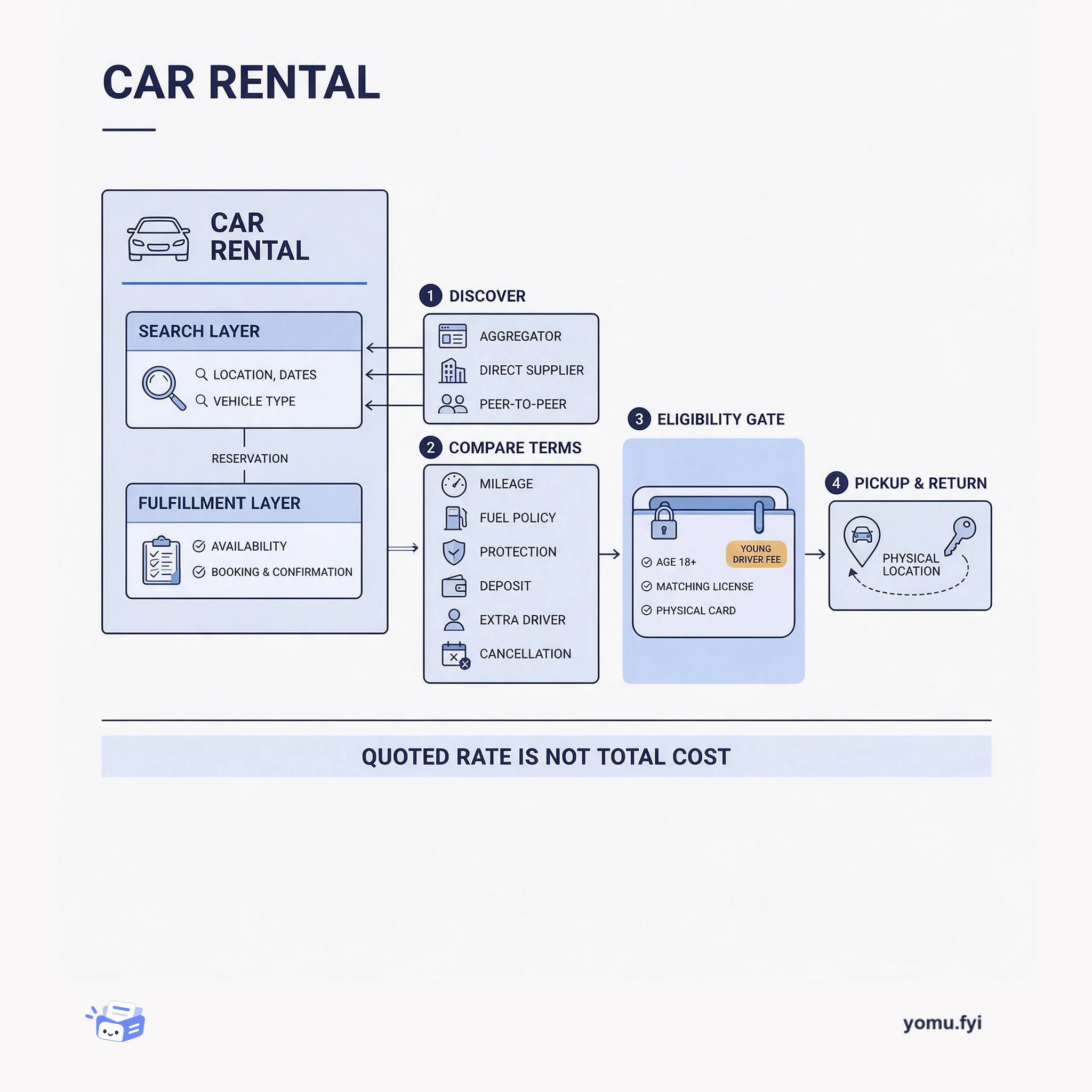
Car Rental: A Search Layer, a Contract, and a Handover
A car rental is a search layer over many fleets plus a contract enforced at the counter. This explainer maps its four parts and why the advertised daily rate never equals the total cost.
Apple integrations are boundary designs: native capability, server-side mapping, and trust checks must meet a platform-agnostic product layer. See where each responsibility belongs.
An Apple integration is a chain of boundaries rather than a single API call. The native surface requests an approved capability, a server-side layer maps product needs to Apple objects and platform-specific behavior, and a trust layer validates the returned data before the product acts on it. Uber’s Verify with Wallet implementation shows this pattern for digital identity, while cross-platform SDKs and OAuth integrations reinforce the value of stable schemas, explicit callbacks, identity handling, and fallbacks. The model helps engineers decide what belongs on-device, at the service boundary, and in verification code.
The posts behind it
 Twilio · · Tutorial
Voice agents can converse, but need external APIs to retrieve live data or take actions such as checking inventory and booking appointments. This tutorial builds a Python and FastAPI voice agent with Twilio Conversation Relay, OpenAI tool calling, and an unauthenticated Cat Facts REST API. A FastAPI webhook returns TwiML that connects callers to a websocket, while Conversation Relay messages are converted into conversation history and streamed responses. When the model requests a cat fact, the application executes the tool, sends its result back to OpenAI, and streams the follow-up answer to the caller. The setup uses environment variables for the OpenAI key, httpx for asynchronous external requests, and ngrok to expose local webhooks; the completed test lets a caller ask for and receive a cat fact.
 Salesforce · · Explainer
Building real-time mobile personalization across iOS, Android, React Native, and Flutter required one architecture to handle different rendering models, lifecycles, identity flows, consent requirements, and release cycles without disrupting native app experiences. The team standardized schemas, event semantics, identity behavior, fallback handling, and SDK APIs, using bridge layers so React Native and Flutter could access native iOS and Android capabilities. Developers instrument apps once with constrained content zones and approved native components, while marketers configure templates, targeting, and content through Salesforce UI; metadata is published via a global CDN and rendered dynamically by the SDK. Data 360 performs server-side identity resolution and decisioning, limiting unnecessary raw profile storage on devices. An early customer implemented the system in two months and generated more than 150 million decisions within three weeks, while QR-code previews enabled testing against live profiles without app recompilation.
 Auth0 · · Tutorial
The tutorial shows how to add Google login to a Vite-based React single-page app without implementing OAuth directly, using Auth0’s React SDK and Google social connection. It covers installing @auth0/auth0-react, creating an Auth0 Single Page Web Application, checking RS256 and OIDC Conformant settings, registering callback, logout, and web-origin URLs, and supplying the domain and client ID through Vite environment variables. The React code wraps the app in Auth0Provider, uses useAuth0 for loading and authentication state, and calls loginWithRedirect with connection: 'google-oauth2' to bypass provider selection. For production, it explains replacing Auth0’s shared development keys with Google Cloud credentials whose origin and redirect URI target the Auth0 domain, then storing them in the Auth0 social connection. It also points to route protection with withAuthenticationRequired, API access tokens from getAccessTokenSilently, and exact redirect-URI matching as important follow-on considerations.
 Uber · · Problem & solution
Uber integrated Apple’s Verify with Wallet API into its cross-app Identity Verification Platform to support government-backed digital IDs across driver onboarding, age-gated ordering, and car rental use cases. The central challenge was allowing each use case to request only its Apple-approved identity data while operating through a scalable, platform-agnostic service rather than separate integrations. Server-side configurations map Uber identity models to PassKit objects, set one-time or persistent storage intent, and validate responses using HPKE decryption, CBOR payloads, session transcripts, MSOs, device signatures, and issuer certificate chains under ISO/IEC 18013-5. A registry of IACA certificates, sourced from jurisdictional portals and AAMVA’s VICAL, supports overlapping certificate rotations, while the platform is intended to accommodate new document types and cross-platform digital credential integrations.
More like this
A car rental is a search layer over many fleets plus a contract enforced at the counter. This explainer maps its four parts and why the advertised daily rate never equals the total cost.
An app store is a distribution surface, a versioned contract, and a health loop between a platform and its developers. Here is how those parts fit together and why each one fails loudly if ignored.
A GPU-resident astronomy pipeline keeps every stage of image analysis — load, align, subtract, detect, review — inside GPU memory instead of round-tripping through the CPU.
The Good Stuff
Paid picks we use ourselves. Links carry a referral code — a subscription through one earns us a commission at no extra cost to you.
One useful email. Unsubscribe anytime.


