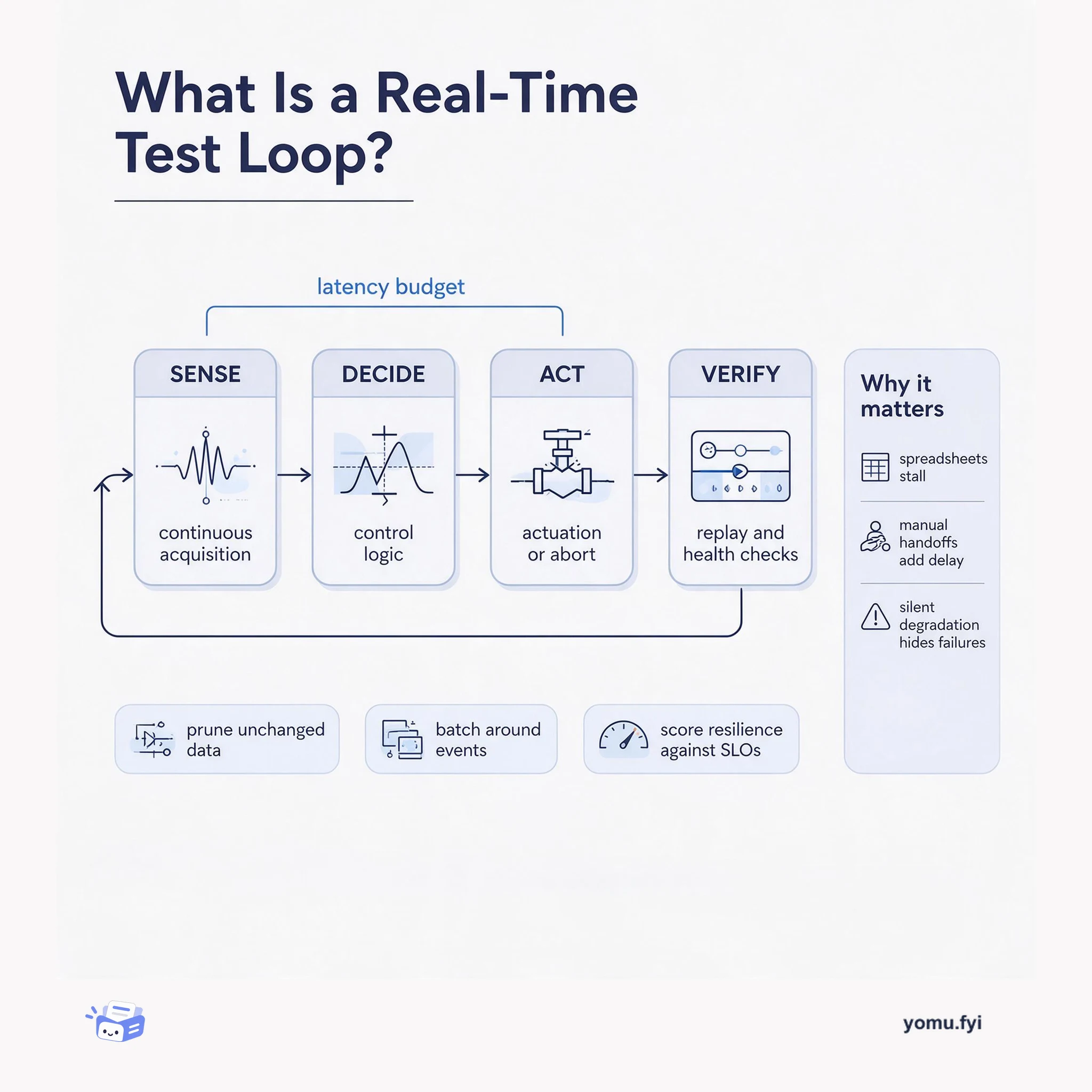
What Is a Real-Time Test Loop?
A real-time test loop is the closed path from sensor acquisition to control action and back to verification. This explainer maps its four parts and the latency budget that binds them.
 JetbrainsMitsal AthayaAnnouncement
Emiliano Bonilla, CEO of Synnax, built the company after witnessing rocket engine testing operations ruin multi-million-dollar hardware because Excel and Python could not handle real-time control. Synnax is a platform that replaces decades-old aerospace tools, capturing sensor data in real time and tightening the loop between collection and action. The team built its own real-time programming language, Arc, in about six months after finding existing tools unsuitable. Synnax currently focuses on aerospace but is expanding into cryogenic control for quantum computing, oil and gas, and manufacturing. The company uses JetBrains IDEs, citing their debuggers and merge conflict resolution as critical to balancing speed and quality in mission-critical software.
Emiliano Bonilla, CEO of Synnax, previously developed aerospace ground software at Firefly Aerospace through their first two orbital launches. He observed that the industry still relies on tools built in the 1980s, using unstructured file dumps where drives of 20-30 terabytes are named only by date and time. This leads to bad decisions because teams cannot review data fast enough, causing millions of dollars in losses and hardware destruction.
Synnax developed its own real-time programming language, Arc, after Excel failed to handle complex logic and Python proved too slow and unsafe for real-time control of rocket engine testing. They built Arc in approximately six months, deliberately keeping it simpler than Python. The company uses JetBrains IDEs (GoLand, CLion, PyCharm) alongside Claude Code, relying particularly on their debuggers and merge conflict tool.
Synnax built its own real-time programming language, Arc, in about six months after finding Excel unsuitable for complex logic and Python too slow and unsafe for controlling rocket engines.
The company says that a mistake of a few milliseconds in timing requirements can destroy a customer’s multi-million-dollar hardware, requiring careful balancing of speed and quality.
Synnax replaces unstructured file dumps where drives of 20-30 terabytes are named only by date and time, which leads to teams making bad decisions because they cannot review data fast enough.
Because Excel cannot handle complex logic or state machines, and Python is not fast or safe enough for real-time control of rocket engines. They resisted building a language until it was unavoidable, then completed Arc in about six months, making it deliberately simpler than Python.
The debuggers in JetBrains IDEs work with any target by pressing play without configuration wrangling. Emiliano also values the merge conflict tool and the ability to review Claude Code output directly inside the IDE.
Synnax is expanding into cryogenic control for quantum computers, oil and gas, and manufacturing. On the Arc side, the company is building automated data review with anomaly detection to flag and correct issues in real time, since a human can only review so much data.
Summaries are generated from the original by a language model. Check the original before relying on it.
See the idea
A real-time test loop is the closed path from sensor acquisition to control action and back to verification. This explainer maps its four parts and the latency budget that binds them.
Keep reading
The Good Stuff
Paid picks we use ourselves. Links carry a referral code — a subscription through one earns us a commission at no extra cost to you.
One useful email. Unsubscribe anytime.
