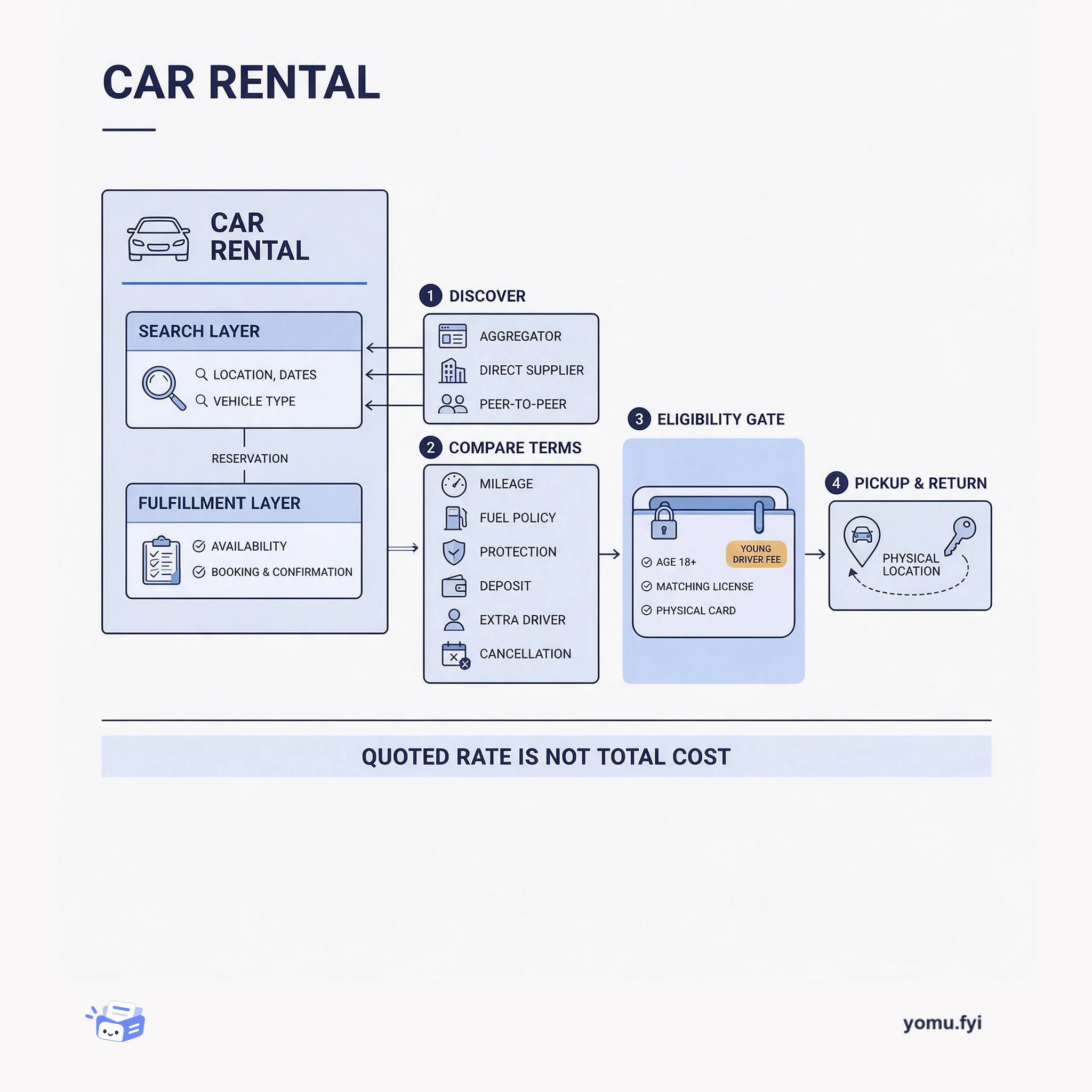
Car Rental: A Search Layer, a Contract, and a Handover
A car rental is a search layer over many fleets plus a contract enforced at the counter. This explainer maps its four parts and why the advertised daily rate never equals the total cost.
A real-time test loop is the closed path from sensor acquisition to control action and back to verification. This explainer maps its four parts and the latency budget that binds them.
A real-time test loop is the closed path that takes a physical measurement, turns it into a decision, and returns an action to the hardware before the next measurement arrives. In aerospace test stands, that loop replaces spreadsheet-and-script workflows that cannot keep up: sensor data is captured continuously, control logic evaluates it, actuation or abort fires, and recorded telemetry is replayed to verify what happened. The binding constraint is the latency budget rather than raw throughput, which is why event-driven pruning and continuous health checks matter as much as the control code itself. Seeing the four parts separately helps engineers decide where a given pipeline belongs on the sense-to-act spectrum.
Because the loop has to close before the next measurement arrives. Synnax was built after rocket engine testing operations ruined multi-million-dollar hardware when Excel and Python could not handle real-time control, so the team wrote its own real-time language, Arc, in about six months. The failure mode is latency and manual handoff, not analytical power.
Prune before you infer. NVIDIA's VSS Blueprint 3.3 uses Adaptive EVS to drop unchanged video patches by cosine similarity before the vision-language model runs, then batches tokens around detected events. That delivered 80% fewer VLM input tokens for a 60-minute summary and 46% more concurrent streams on the same GPU.
Binary pass/fail uptime is not enough, because a cluster can stay up while dropping packets or breaching SLOs. Krkn combines a weighted 0-100 Resiliency Score computed from live Prometheus data against predefined SLOs, continuous HTTP health checks that capture exact downtime windows, and KubeVirt checks that confirm virtual machines are reachable after the experiment ends.
The posts behind it
 Databricks · · Announcement
The announcement introduces the general availability of IP Functions, a feature that brings high-performance network analytics to the Lakehouse by enabling SQL-based processing of IP addresses. The post explains that IP data is warehousing data, as firewalls, load balancers, VPNs, CDN edges, DNS resolvers, Kubernetes clusters, and application servers emit streams of records keyed on IP addresses, generating tens of billions of events daily for large enterprises. These streams support valuable analytics such as threat detection, fraud investigation, and network governance. The post notes that network analytics used to be painful because IP addresses were deceptively hard to handle in SQL, with no regex support. The feature aims to simplify this by providing native IP functions for the Lakehouse.
 Red Hat · · Problem & solution
Binary pass/fail uptime testing no longer suffices for cloud-native deployments because a cluster can remain operational while dropping packets, breaching SLOs, or suffering performance degradation. Krkn addresses this with a trifecta of telemetry: a weighted Resiliency Score, continuous HTTP Health Checks, and KubeVirt Checks. The Resiliency Score is a 0–100% macro-health metric that evaluates live Prometheus data against pre-defined SLOs using custom weights, allowing engineers to prioritize business-critical components like authentication or payment gateways. HTTP Health Checks probe application endpoints at configurable intervals, capturing exact downtime start and end times alongside HTTP status codes, enabling teams to track self-healing duration. KubeVirt Checks monitor virtual machine instances via real-time SSH connectivity and record node, IP address changes, and exact down-time, with a final post-chaos check that flags VMs remaining unreachable after the experiment concludes.
 Jetbrains · · Announcement
Emiliano Bonilla, CEO of Synnax, built the company after witnessing rocket engine testing operations ruin multi-million-dollar hardware because Excel and Python could not handle real-time control. Synnax is a platform that replaces decades-old aerospace tools, capturing sensor data in real time and tightening the loop between collection and action. The team built its own real-time programming language, Arc, in about six months after finding existing tools unsuitable. Synnax currently focuses on aerospace but is expanding into cryogenic control for quantum computing, oil and gas, and manufacturing. The company uses JetBrains IDEs, citing their debuggers and merge conflict resolution as critical to balancing speed and quality in mission-critical software.
 NVIDIA · · Announcement
Vision-language models enable production-scale video understanding, but building maintainable systems that combine ingestion, stream processing, event detection, retrieval, summarization, and reporting with services like Kafka, Redis, and Elasticsearch is challenging. The NVIDIA VSS Blueprint 3.3 introduces the Build Vision Agent skill, which composes multi-workflow applications from a single natural-language prompt using one of four Foundation profiles. It also adds Adaptive EVS, which prunes unchanged video patches via cosine similarity before VLM processing and batches tokens around events. Adaptive EVS cuts alert latency by 17%, delivers 80% fewer VLM input tokens for a 60-minute summary, and enables 46% more concurrent streams on the same GPU. These updates reduce development effort, infrastructure duplication, and operating costs, allowing a single prompt to build a bottling-line agent in under 30 minutes.
More like this
A car rental is a search layer over many fleets plus a contract enforced at the counter. This explainer maps its four parts and why the advertised daily rate never equals the total cost.
An app store is a distribution surface, a versioned contract, and a health loop between a platform and its developers. Here is how those parts fit together and why each one fails loudly if ignored.
A GPU-resident astronomy pipeline keeps every stage of image analysis — load, align, subtract, detect, review — inside GPU memory instead of round-tripping through the CPU.
The Good Stuff
Paid picks we use ourselves. Links carry a referral code — a subscription through one earns us a commission at no extra cost to you.
One useful email. Unsubscribe anytime.


