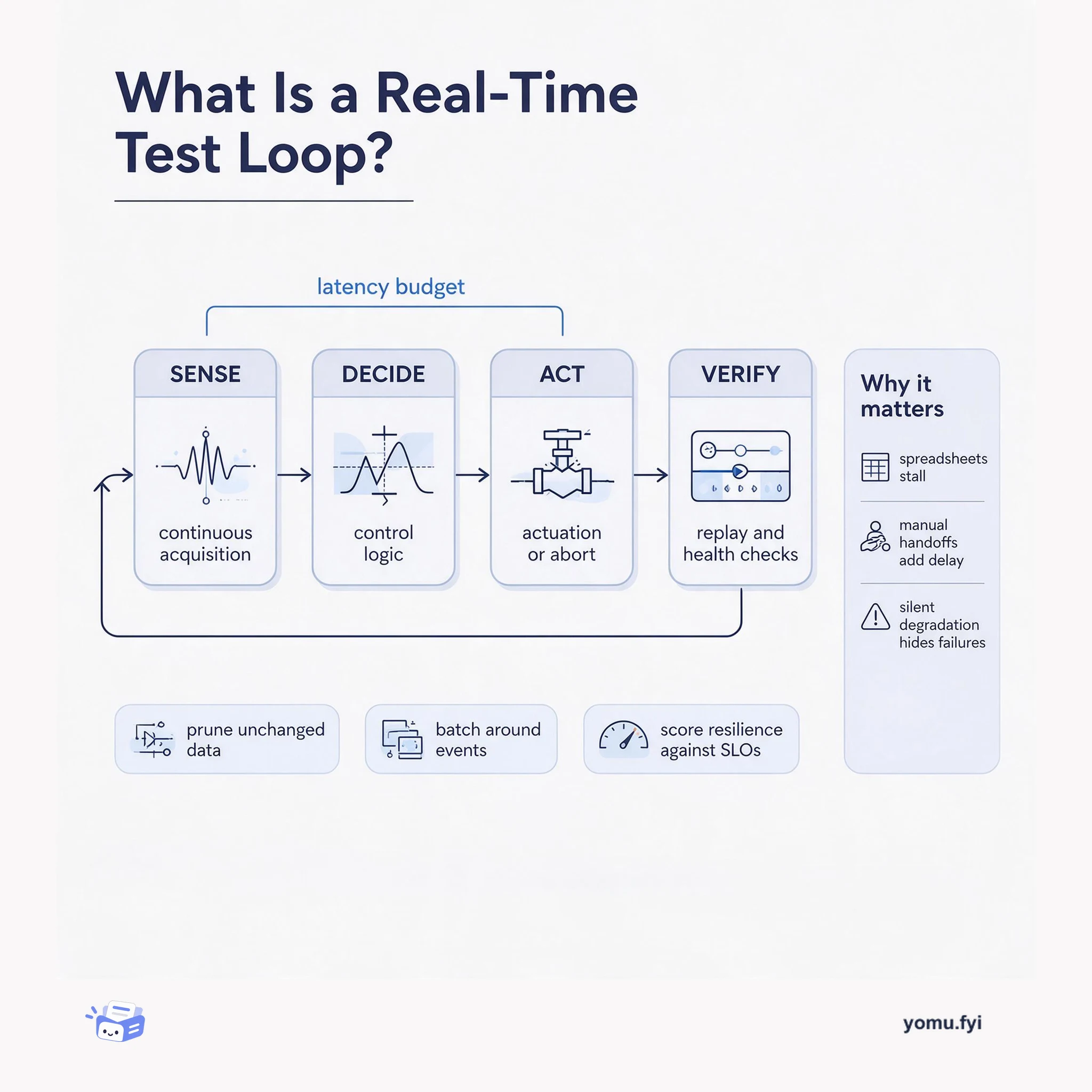
What Is a Real-Time Test Loop?
A real-time test loop is the closed path from sensor acquisition to control action and back to verification. This explainer maps its four parts and the latency budget that binds them.
Loading…
Topic
3 posts about Predictive Maintenance. Every summary links to the original.
See the idea
A real-time test loop is the closed path from sensor acquisition to control action and back to verification. This explainer maps its four parts and the latency budget that binds them.
The Good Stuff
Paid picks we use ourselves. Links carry a referral code — a subscription through one earns us a commission at no extra cost to you.
Newest first
Unplanned manufacturing downtime costs $2.3 million per hour in the automotive sector, and a workforce shortage means 26% of existing workers will retire by 2030. Existing predictive maintenance systems operate in isolation, increasing mean equipment recovery times from 49 to 81 minutes per incident. MongoDB Enterprise Advanced provides a unified data platform for multi-agent AI systems that combine sensor telemetry, vector embeddings, agent memory, and operational records in a single database. Its document model, hybrid search, time series collections, and change streams enable agents to perform semantic retrieval, keyword search, and real-time stream processing. A multi-agent workflow includes a monitoring agent that detects anomalies, a diagnostics agent that retrieves historical patterns, a planning agent that drafts work orders with human-in-the-loop review, and a scheduling agent that checks production calendars and inventory, all on a single on-premise deployment with enterprise security and local embedding generation.
Gas turbines produce millions of daily readings—vibration, temperature, pressure, flow rates, and electrical output—but maintenance teams may learn about warning signals only when an unplanned outage occurs. The post argues that predictive maintenance has struggled less because of model capability than because decision-makers lack fluid access to model findings and operational context. Databricks Genie provides a conversational interface to sensor, maintenance, dispatch, cost, and regulatory data, allowing questions about elevated vibration against maintenance baselines and timing maintenance around outage cycles. It is presented as decision support, not automation, with time-series analysis, maintenance history, integrated costs, and compliance context helping asset managers investigate fleets and act with more confidence.
IoT in manufacturing is presented as an operational architecture for collecting machine data, improving production and supply-chain visibility, and preventing equipment failures under strict latency, reliability, and safety requirements. The guide covers device selection, sensor placement, tiered sampling, edge-to-cloud pipelines, platform criteria, security, compliance, workforce training, and a phased deployment roadmap. Its technical split sends high-frequency vibration and acoustic signals to edge gateways for local processing while cloud systems support stateful analytics, predictive maintenance scoring, and model training; protocols such as MQTT, OPC-UA, AMQP, and Modbus are evaluation criteria. Reported examples include multi-factory OEE monitoring across more than 200 production lines, reducing reporting lag from 24 hours to under five minutes, digital twins for maintenance simulation, and IoT logistics routing. The action plan recommends starting with predictive maintenance and OEE monitoring on one line before scaling.
The best engineering reads, once a week.


