Databricks’ AI coding agent usage initially caused exponential cost growth, threatening to reverse the productivity gains that motivated adoption. To control spending without hindering developers, the company built a control layer that routes requests to appropriate models and provides spend visibility, avoiding hard caps that frustrate top users. Key cost-reduction levers include continuously migrating to cheaper models as they become available, which alone cut costs by over 50%, and using a Smart Router that reduces average task cost by 30% while maintaining quality. The company benchmarks models on its own multi-million-line codebase using real pull requests, finding that an open source model tied a frontier model at a third less cost per task, and combined with spend visibility, harness optimization, and caching adjustments, unit costs dropped by up to 90%. This internal solution was productized as Unity Gateway, now used by thousands of customers to manage AI coding costs.
Context
An interview with Databricks’ Patrick about the company’s experience with AI coding agents, the exponential cost growth that followed widespread adoption, and the techniques used to reduce unit costs by up to 90%, including model routing, continuous model migration, and a control layer that became Unity Gateway.
Approach / What changed
Databricks implemented a control layer (Unity Gateway) between developers and AI models to route requests, provide spend visibility, and enable continuous migration to cheaper models. Key techniques include a Smart Router that reduces average task cost by 30%, benchmarking models on their own codebase, and using graduated friction (warning, approval, model downshift) instead of hard caps.
Takeaways
1
Continuously migrating to newer, cheaper models as they become available can reduce AI coding costs by over 50% without any developer effort, as long as traffic goes through a central gateway.
2
Model routing, such as Databricks’ Smart Router, can cut average task cost by more than 30% while maintaining the quality of the most expensive model by directing simple tasks to cheaper models.
3
Hard spend caps on AI tools can backfire by frustrating top developers, who may switch to personal accounts, so Databricks uses graduated friction (warning, approval, model downshift) instead.
FAQ
How did Databricks reduce AI coding costs by up to 90%?
By combining four levers: continuously migrating to cheaper models (50%+ reduction), using a Smart Router for model routing (30%+ reduction), improving spend visibility, and optimizing harness and caching settings. The control layer Unity Gateway enables these changes without developer friction.
Why did Databricks avoid hard spend caps on AI tools?
Hard caps cut off top developers mid-task, causing frustration and leading some to use personal accounts, which eliminates visibility. Instead, Databricks uses graduated friction: warnings, approvals, and automatic downshifts to cheaper models.
How does Databricks benchmark AI coding models for its own use?
Databricks built a benchmark from real pull requests in its multi-million-line codebase and grades by running actual tests, not using an LLM as judge. This revealed that an open source model (GLM 5.2) tied a frontier model (Opus 4.8) at a third less cost per task.
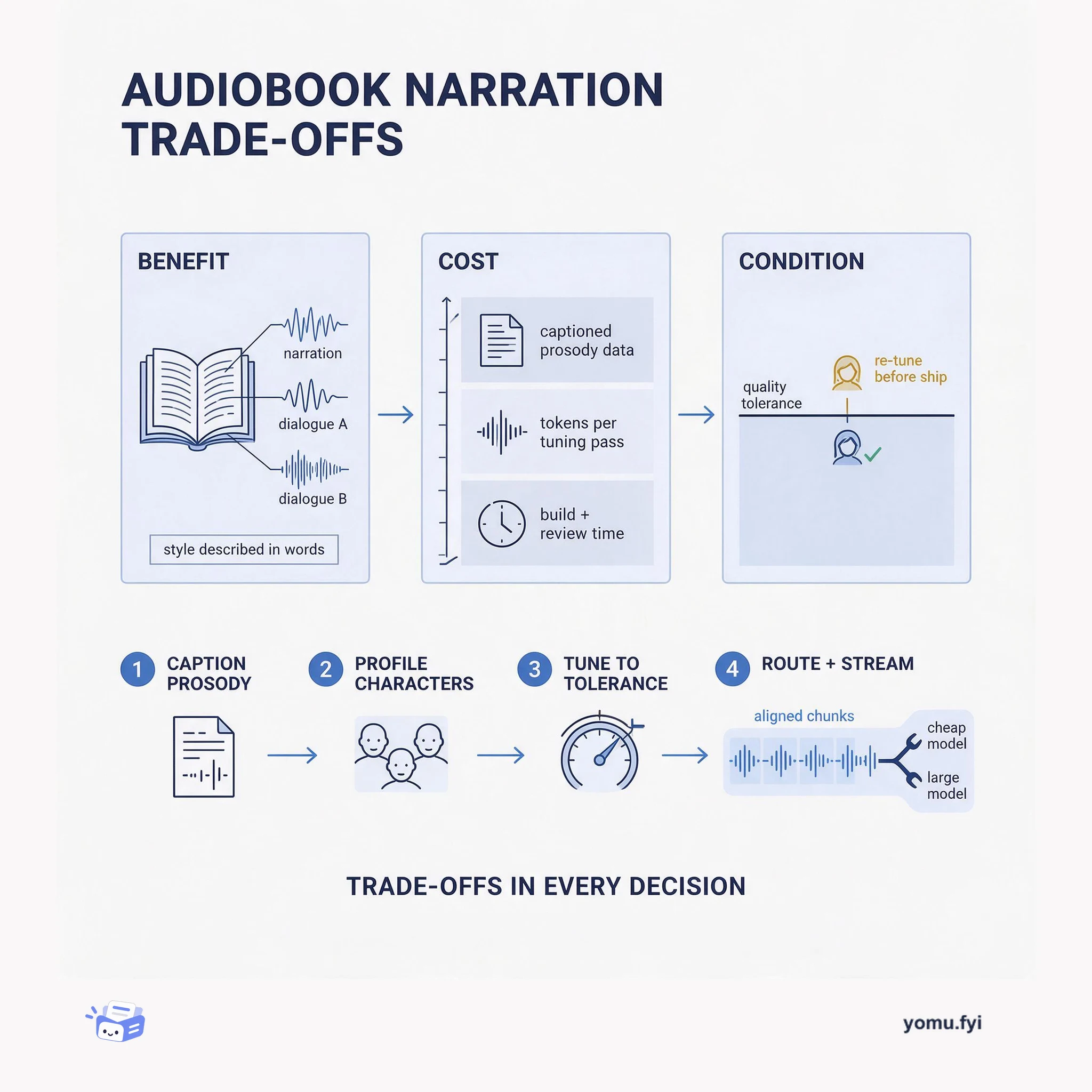
A tradeoff map for synthetic audiobooks: natural-language style control buys character differentiation, but spends captioned data, tokens, and compute. See which lever to pull first and when plain narration is good enough.
Keep reading
Related reading
The Good Stuff
Paid picks we use ourselves. Links carry a referral code — a subscription through one earns us a commission at no extra cost to you.