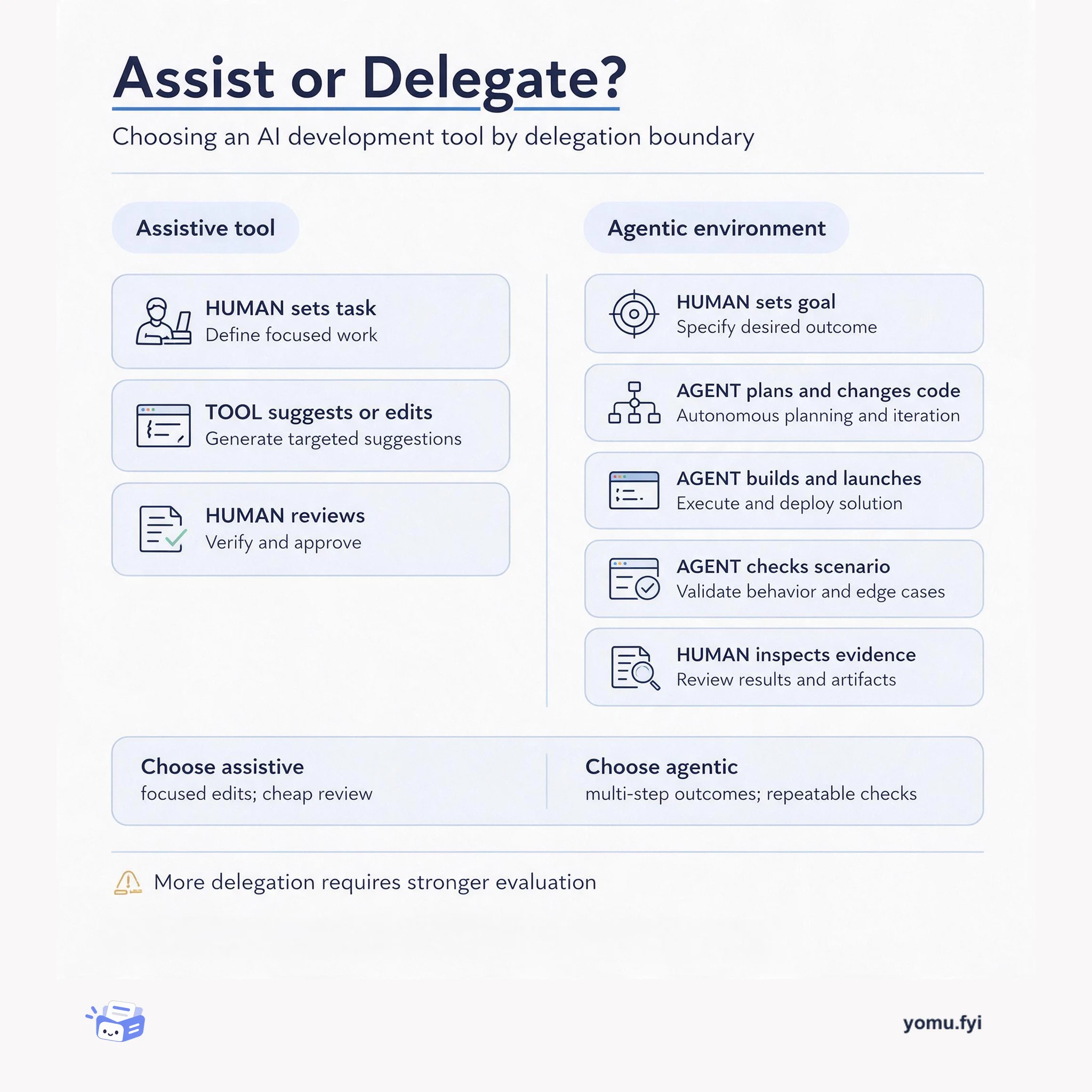
Assist or Delegate? Choosing an AI Development Tool
Compare assistive coding tools with agentic development environments to see where human control, automation, verification, and evaluation belong in the workflow.
 JetbrainsStanislav TikhomirovExplainer
JetBrains presents the AIDEs Framework as a model for understanding how AI development tools evolve, rather than trying to track every market change. The post describes a progression from single-line completion through multiline completion, IDE chat, AI code editors, agentic development environments, and cloud-based agents. It defines an Artificial Intelligent System as a system that demonstrates intelligence in helping users achieve goals, and an Artificial Intelligent Development Environment (AIDE) as an AIS for creating software; intelligence may come from deterministic heuristics as well as LLMs. The framework treats principals and agents as potentially human or AI actors and views software creation as a broader delegation process than coding alone. It proposes examining assumptions, building a model, and validating it against ongoing change, while suggesting a possible future of vertically integrated Agentic Software Production Platforms that use AI as an “intelligence” resource.
The framework emerged from JetBrains’ nearly two years of AI product and market research and an early-2025 effort to evaluate AI strategy. It is presented as a way to reason about what is fundamentally possible, not as a prediction of exactly what will happen or when.
The framework starts by defining Artificial Intelligent Systems, Artificial Intelligent Development Environments, principals and agents, and software creation, then establishes foundational assumptions for reasoning about the field. It traces the evolution of AI development tools from completion to autonomous cloud agents and recommends examining assumptions, building a model, and validating it against observed change.
AI use is concentrated mainly in brainstorming and coding, while many other parts of the software development lifecycle remain largely untouched.
Agentic coding changes the development loop from “code → validate → fix” in an editor to “plan → execute → review” in agentic chat; cloud agents can already handle simple, low-effort tasks but still have heavy limitations.
The framework targets the user experience of intelligence rather than AI everywhere, because intelligent behavior can come from deterministic heuristics as well as LLMs.
Conventional development is described as a loop of coding, validation, and fixing in an editor. Agentic development shifts this toward planning, execution, and review in an agentic chat, with developers delegating entire coding tasks.
No. The framework defines intelligence by the experience and assistance provided to users, noting that existing IDEs use deterministic heuristics for core capabilities and that intelligence does not have to come from LLMs.
It recommends examining core assumptions, building or adopting a model of reality, and validating that model against ongoing change. The post says the framework does not predict exactly what future will occur or when, so continued observation is necessary.
Summaries are generated from the original by a language model. Check the original before relying on it.
See the idea
Compare assistive coding tools with agentic development environments to see where human control, automation, verification, and evaluation belong in the workflow.
Keep reading
The Good Stuff
Paid picks we use ourselves. Links carry a referral code — a subscription through one earns us a commission at no extra cost to you.
One useful email. Unsubscribe anytime.
