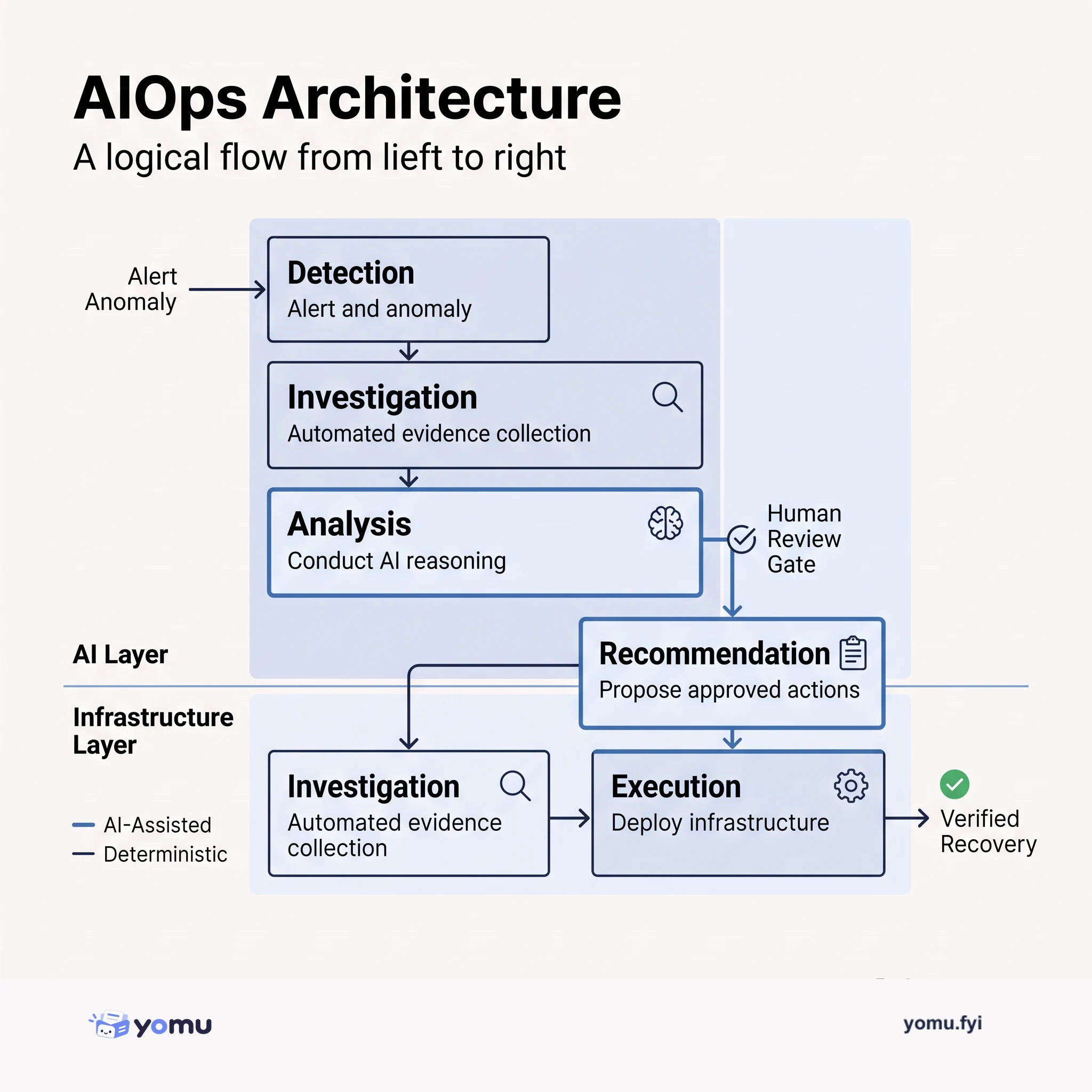
AIOps Architecture: From Detection to Remediation
AIOps automates the detect-investigate-analyze-recommend-execute-verify cycle by combining AI reasoning with infrastructure automation, keeping humans in control of credentials and final decisions.
Loading…
Topic
2 posts about AIOps. Every summary links to the original.
See the idea
AIOps automates the detect-investigate-analyze-recommend-execute-verify cycle by combining AI reasoning with infrastructure automation, keeping humans in control of credentials and final decisions.
The Good Stuff
Paid picks we use ourselves. Links carry a referral code — a subscription through one earns us a commission at no extra cost to you.
Newest first
AIOps applies AI and machine learning to IT operations to analyze logs, metrics, traces, events, alerts, and related system data. It detects anomalies, correlates events, uses topology and dependencies to identify likely root causes, and supports guided or automated responses. The guide positions AIOps between observability and action, reducing noise and adding context without replacing observability, DevOps, or human judgment. Its workflow includes data ingestion, normalization, anomaly detection, event correlation, root-cause analysis, automation and orchestration, and collaboration workflows, with human-in-the-loop review recommended for higher-risk production changes. It contrasts domain-centric and domain-agnostic approaches and recommends evaluating coverage, depth, integrations, setup effort, and organizational fit before expanding automation.
This tutorial builds an AIOps workflow for diagnosing and remediating a deliberately induced CPU incident in a product catalog application running on an AWS EC2 instance with RHEL. An Ansible investigation playbook collects CPU utilization, top processes, application status, and HTTP health evidence, which Claude Code analyzes through MCP to identify the Python process as the likely contributor and recommend the approved “AIOps - Remediate High CPU” Job Template. AI does not access the host directly: Ansible Automation Platform retains responsibility for credentials, inventory, execution, and remediation. The remediation changes the application from HTTP 503 and degraded to HTTP 200 and healthy, while a final health check confirms recovery and completes the detect-investigate-analyze-recommend-execute-verify sequence.
The best engineering reads, once a week.


