What is Kafka?
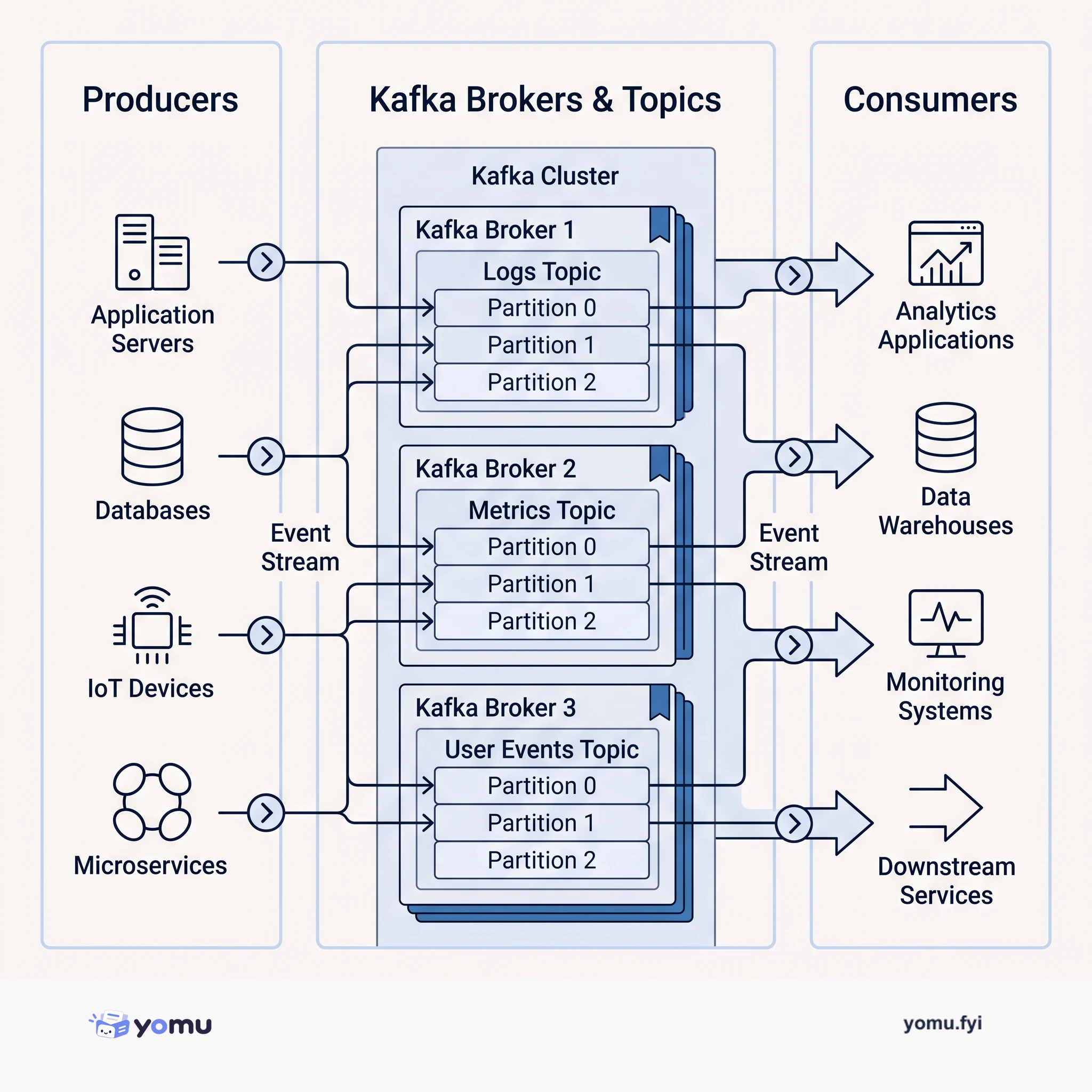
Kafka is a distributed event streaming platform that ingests, buffers, and distributes high-volume data streams in real time, enabling applications to publish, subscribe, and process continuous event flows reliably.
Loading…
Topic
3 posts about DataOps. Every summary links to the original.
See the idea
Kafka is a distributed event streaming platform that ingests, buffers, and distributes high-volume data streams in real time, enabling applications to publish, subscribe, and process continuous event flows reliably.
The Good Stuff
Paid picks we use ourselves. Links carry a referral code — a subscription through one earns us a commission at no extra cost to you.
Newest first
DataOps is presented as a collaborative practice that applies DevOps principles—continuous integration, automated testing, and rapid delivery—to the full data lifecycle, from ingestion and transformation through trusted data-product delivery. It treats data as a continuously delivered product, with technical and non-technical participants sharing an operational cadence to improve quality and shorten time-to-insight. The recommended operating model standardizes source onboarding, enforces schemas at ingestion, uses idempotent jobs, version-controls transformations, and promotes them through tested staging and production environments, with the Bronze, Silver, and Gold layers serving as quality gates. Automated unit, data-contract, and regression tests, alongside observability, anomaly detection, SLAs, lineage, and documented rollback procedures, support reliable delivery and faster incident diagnosis. Organizations with mature DataOps practices report up to 99% fewer data-downtime incidents and 30–50% less reactive maintenance.
SQL ETL pipelines are presented as repeatable workflows that extract data from sources, transform it, and load it into warehouses, lakes, or lakehouses for analysis and machine-learning use. The guide addresses source connectivity, extraction patterns, transformation logic, loading targets, governance, performance, testing, and operational design, while contrasting ETL with ELT and broader data pipelines. It explains that SQL can serve as the primary implementation language for transformations and load operations, with techniques including JOIN and GROUP BY, window functions, MERGE upserts, and deduplication with ROW_NUMBER() or DISTINCT. It also covers full versus incremental extraction, batch and streaming needs, schema-on-write versus schema-on-read, and layered validation using row counts, checksums, business rules, and schema-drift monitoring.
The playbook presents AI and data transformation as an enterprise capability built on trustworthy, well-governed data, rather than a model-only project. It explains how governance, scalable pipelines, and continuous quality monitoring address incompatible formats, missing values, duplicate records, and schema inconsistencies from systems such as CRM platforms, operational databases, IoT sensors, and cloud applications. Operational guidance covers KPI design, named pipeline ownership, review checkpoints, data mapping and lineage, automated de-duplication, deterministic enrichment, regulatory classification, and role-based access. It states that deterministic tests and human review remain necessary for AI-assisted code, while telemetry and quarterly audits help detect reliability, governance, and data quality degradation. The concluding position is that operational discipline—not model sophistication—supports reliable machine learning, predictive analytics, and generative AI outcomes.
The best engineering reads, once a week.