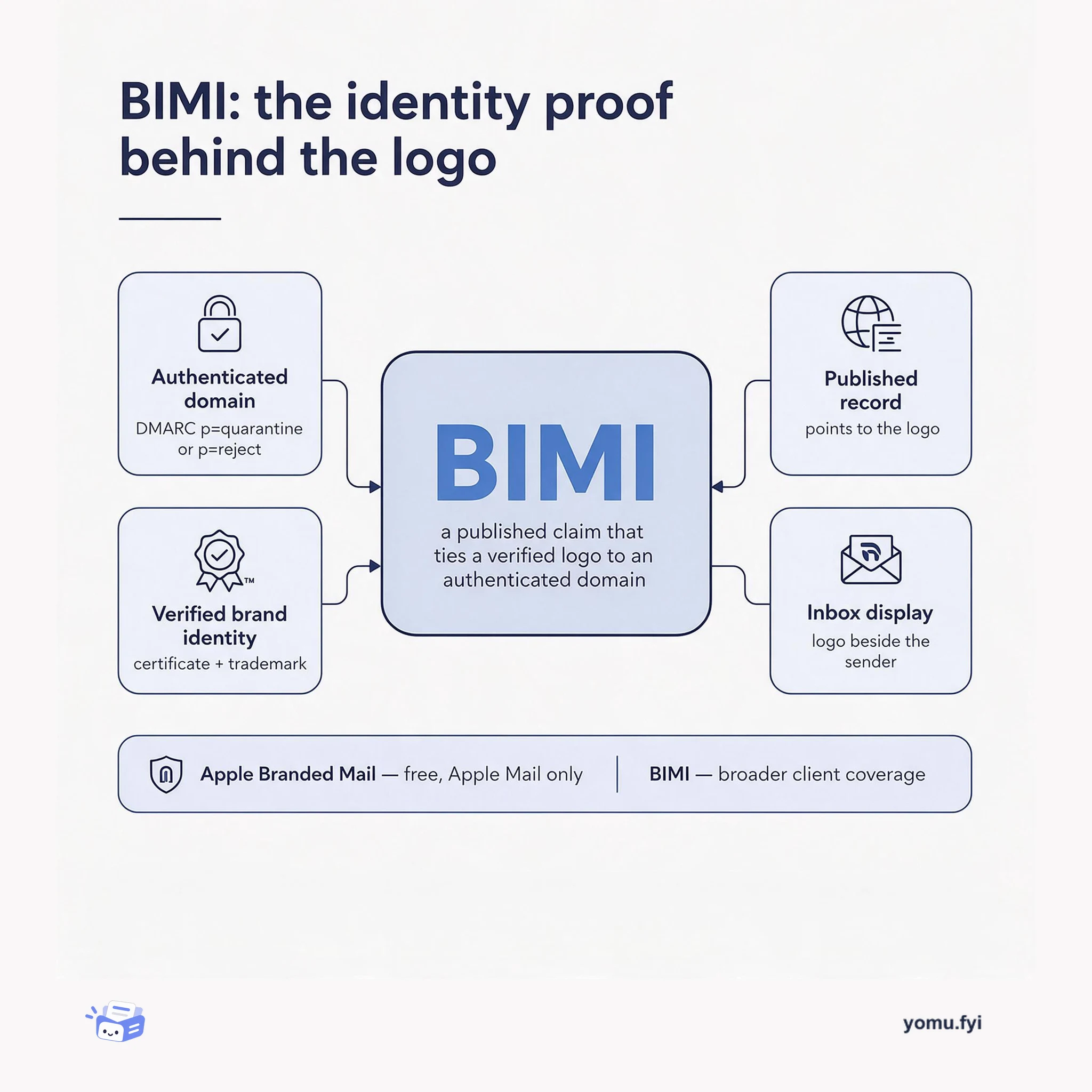
BIMI: The Identity Proof Behind the Logo
BIMI is a DNS-published claim that ties a verified brand logo to an authenticated domain, so mailbox providers can display it. Here is what each part of that claim requires.
Loading…
Topic
2 posts about DMARC. Every summary links to the original.
See the idea
BIMI is a DNS-published claim that ties a verified brand logo to an authenticated domain, so mailbox providers can display it. Here is what each part of that claim requires.
The Good Stuff
Paid picks we use ourselves. Links carry a referral code — a subscription through one earns us a commission at no extra cost to you.
Newest first
Displaying a company logo in Apple Mail can improve inbox recognition, trust, and visual distinctiveness, while cited studies associate logos with higher brand recall, open rates, purchase likelihood, and email confidence. The article presents Apple Branded Mail, a proprietary format shipped in iOS 18.2 in 2024, as a free alternative to inconsistent provider settings and the paid certificates and trademarks sometimes needed for broad BIMI coverage. Setup begins with a DMARC policy of p=quarantine or p=reject, then uses Apple Business Connect to add a brand, upload a PNG, HEIF, or JPEG logo at least 1024 × 1024 pixels, select domains, and verify identity. Verification can take up to seven business days; root-domain branding covers unconfigured subdomains, while brands needing broader client coverage are directed to BIMI.
DMARCbis is finalized as three Standards Track RFCs: RFC 9989 for the core protocol, RFC 9990 for aggregate reporting, and RFC 9991 for failure reporting. Existing DMARC records continue working as before, so most senders do not need immediate changes. The largest behavioral update replaces Public Suffix List lookups with an algorithmic DNS Tree Walk, in which receivers query _dmarc records up the DNS hierarchy; the psd tag can declare hierarchy boundaries. The pct tag is replaced by boolean t, while np can specify a policy for non-existent subdomains, including np=reject. Reporting knobs rf and ri are removed, but rua and ruf remain available; senders using fractional pct should use a none-to-quarantine-to-reject rollout, keep reading reports, and avoid rushing to reject.
The best engineering reads, once a week.

