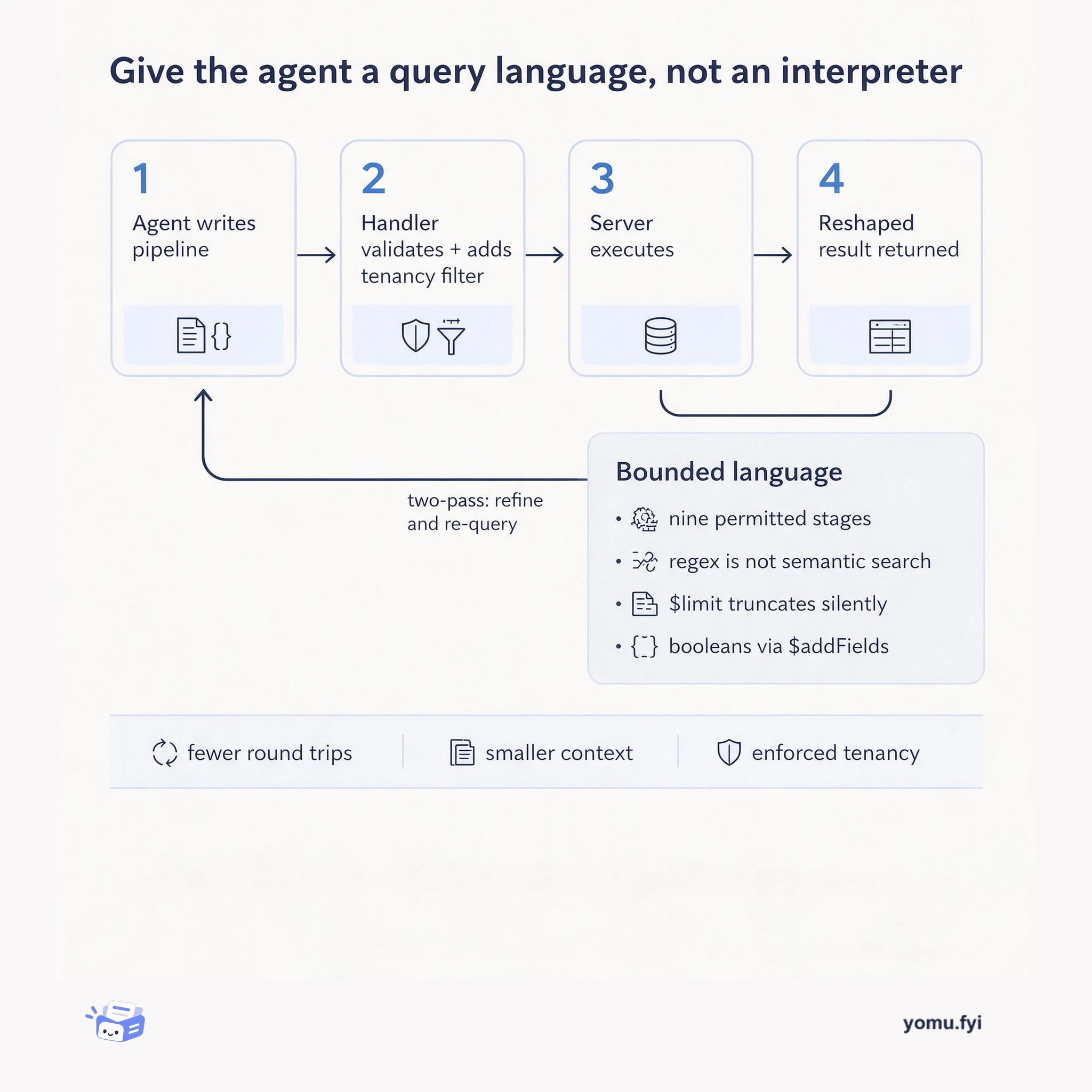
How to Give an Agent a Query Language Instead of a Code Interpreter
A four-step pattern for letting a document agent write validated aggregation pipelines instead of arbitrary code, so results come back shaped and tenancy stays enforced.
Loading…
Topic
42 posts about MongoDB. Every summary links to the original.
See the idea
A four-step pattern for letting a document agent write validated aggregation pipelines instead of arbitrary code, so results come back shaped and tenancy stays enforced.
The Good Stuff
Paid picks we use ourselves. Links carry a referral code — a subscription through one earns us a commission at no extra cost to you.
Newest first
MongoDB 8.0, the latest version of the document database, is now generally available, delivering significant performance and security improvements. The release features 36% better read throughput, 56% faster bulk writes, 20% faster concurrent writes during data replication, and 200% faster complex aggregations of time series data. MongoDB’s internal build system, which runs on MongoDB, saw query latencies drop by approximately 75% after upgrading. The company also reports that customer OCELL experienced queries running twice as fast. MongoDB 8.0 includes sharding enhancements for up to 50 times faster data distribution, quantized vectors that reduce memory usage by up to 96%, and expanded Queryable Encryption to support range queries. The release is available via MongoDB Atlas, MongoDB Enterprise Advanced, and MongoDB Community Edition.
Atlas Online Archive moves infrequently accessed data from a cluster to a MongoDB-managed object store while enabling unified queries across both tiers. A new data expiration feature lets users set a deletion threshold for archived data, configurable from 7 to 9,125 days through the Atlas UI or Admin API, and rules can be edited after creation; previously, the only way to remove data was deleting the entire archive. Once data is deleted from the archive, it cannot be recovered, so rules must be defined carefully. Scheduled archiving addresses performance concerns by allowing users to define a recurring window—daily, weekly, or monthly—with a minimum duration of two hours, replacing the previous five-minute interval that could overload clusters during peak times. Users can edit the archive rule to specify both when to archive and when to delete, and both features are in preview to improve operational efficiency for Atlas customers.
The best engineering reads, once a week.

