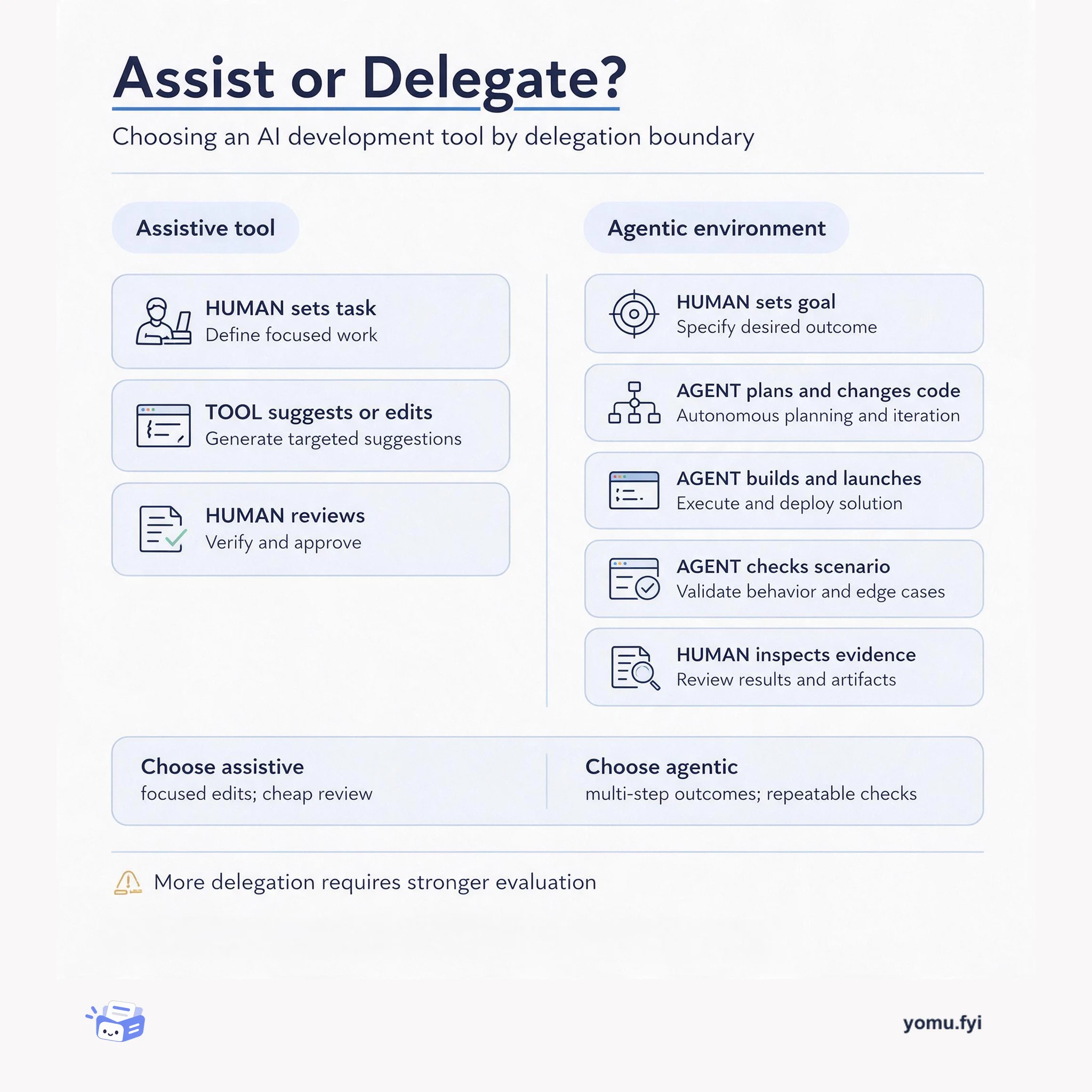
Assist or Delegate? Choosing an AI Development Tool
Compare assistive coding tools with agentic development environments to see where human control, automation, verification, and evaluation belong in the workflow.
Loading…
Topic
267 posts about Testing. Every summary links to the original.
See the idea
Compare assistive coding tools with agentic development environments to see where human control, automation, verification, and evaluation belong in the workflow.
The Good Stuff
Paid picks we use ourselves. Links carry a referral code — a subscription through one earns us a commission at no extra cost to you.
Newest first
Grab replaced third-party cloud CI services with an in-house Xcode Server pipeline to run automated iOS integration tests across an expanding engineering team. Instead of performing fresh repository clones on shared cloud instances, Xcode Server pulls code incrementally and mirrors local developer configurations. The team automated testing bots through Ruby scripts and Arcanist hooks tied to Phabricator code reviews, dynamically provisioning bots on diffs and deleting them after merges. This architecture preserves step-by-step UI test execution logs and screenshots for easier failure diagnostics. To maintain stability on on-premises hardware, pre-integration scripts clear application cache states using simctl commands.
Xcode projects with unit tests commonly separate implementation and test files into two directories, often mirroring the source structure in the tests directory. The post argues that this arrangement creates maintenance overhead, slows navigation, obscures how well-tested a codebase is when browsed or reviewed, and can leave tests with lower coding standards. It proposes co-locating each unit-test file beside its implementation file while retaining the test target association, accepting more files per directory in exchange for clearer relationships and easier movement between code and tests. The same SwiftLint configuration is used for implementation and test code, treating tests as first-class code. Tests without a single-file correspondence, including integration or UI tests, should remain in separate directories and may warrant separate targets; the authors say their codebase has adopted the style.
Grab transitioned its public passenger app APIs from a legacy Rails application to a Golang service-oriented architecture to consolidate its codebase and engineering teams. Initial attempts to proxy traffic through a cloned Rails server via gRPC were abandoned after encountering TCP load imbalances during autoscaling events and memory leaks in the gRPC Ruby gem. The team pivoted to direct logic migration, porting Ruby logic directly into Go while decomposing modules into standalone services. Verification relied on log-based load testing and live shadow testing, where write operations were safely validated using mock data access layers that evaluated expected database outcomes. Production rollout progressed endpoint-by-endpoint using requests-per-second traffic throttling and prewarmed AWS Elastic Load Balancers before executing the final DNS switch.
Grab announced its first Grab Vietnam Careers Week, held in Ho Chi Minh City from 22 to 26 October 2016, aimed at hiring engineers to improve regional transportation and reduce congestion. At the time, Grab operated on 23 million mobile devices supported by 460,000 drivers across Southeast Asia. The announcement features an interview with Singapore-based iOS engineer Hai Pham and Android engineer Son Nguyen discussing team culture, regular hackathons termed "Grabathons", and relocation to Singapore. Technical candidates undergo a Codility test and are evaluated on clean mobile architecture, testing, and performance maintenance. The engineers also offer advice on apartment hunting through online community forums and adapting to life in Singapore.
Stakeholders often question whether qualitative testing with only five participants yields reliable design findings. The chosen research problem dictates the methodology, with qualitative usability evaluations requiring smaller cohorts than broad quantitative surveys. Jakob Nielsen's 1993 analysis demonstrated that testing with five participants uncovers 75 to 80 percent of usability issues, after which additional users yield diminishing returns. In agile environments, teams maximize efficiency by iterating designs across successive rounds of five participants rather than testing large cohorts simultaneously. This five-user threshold applies strictly to qualitative usability testing for specific feature flows rather than opinion gathering, A/B testing, or multi-segment user analysis.
Heroku’s help application depends on the Platform API for authentication, authorization, and user data, so it must remain available to agents and customers during platform incidents. The open-sourced api-maintenance-sim app tests this requirement by imitating an outage in which every request receives an HTTP 503 Service Unavailable response. After deploying the simulator, teams point the application under test to its hostname through PLATFORM_API_URL, passed to platform-api’s connect_oauth method; when unset, the gem uses the production URI. A heroku config:set command enables the alternate endpoint, making regular simulations possible and helping reveal what failure means for the application or service when the Platform API is unavailable, supporting preparation for incidents and communication during outages.
Heroku Platform API had remained on Active Record 2.3.18, released in March 2013, creating maintenance and security burdens as support ended and custom query infrastructure replaced newer features. The team moved first to Active Record 3.0.20, preserving 2.x APIs, then directly to 4.2.4, using a feature branch, console-driven fixes, automated and acceptance tests, private deployments, staging, and a partial production rollout. The first step took one engineer about two weeks, while the second took two engineers about two weeks; deployment had no downtime but briefly required a rollback for an acts_as_paranoid bug. Performance improved 18% from 2.3.18 to 3.0.20 but worsened 13% from 3.0.20 to 4.2.4, challenging micro-benchmark expectations. The upgrade ultimately left performance at the same overall level, removed patches, restored supported status, and made future updates and training easier.
The best engineering reads, once a week.