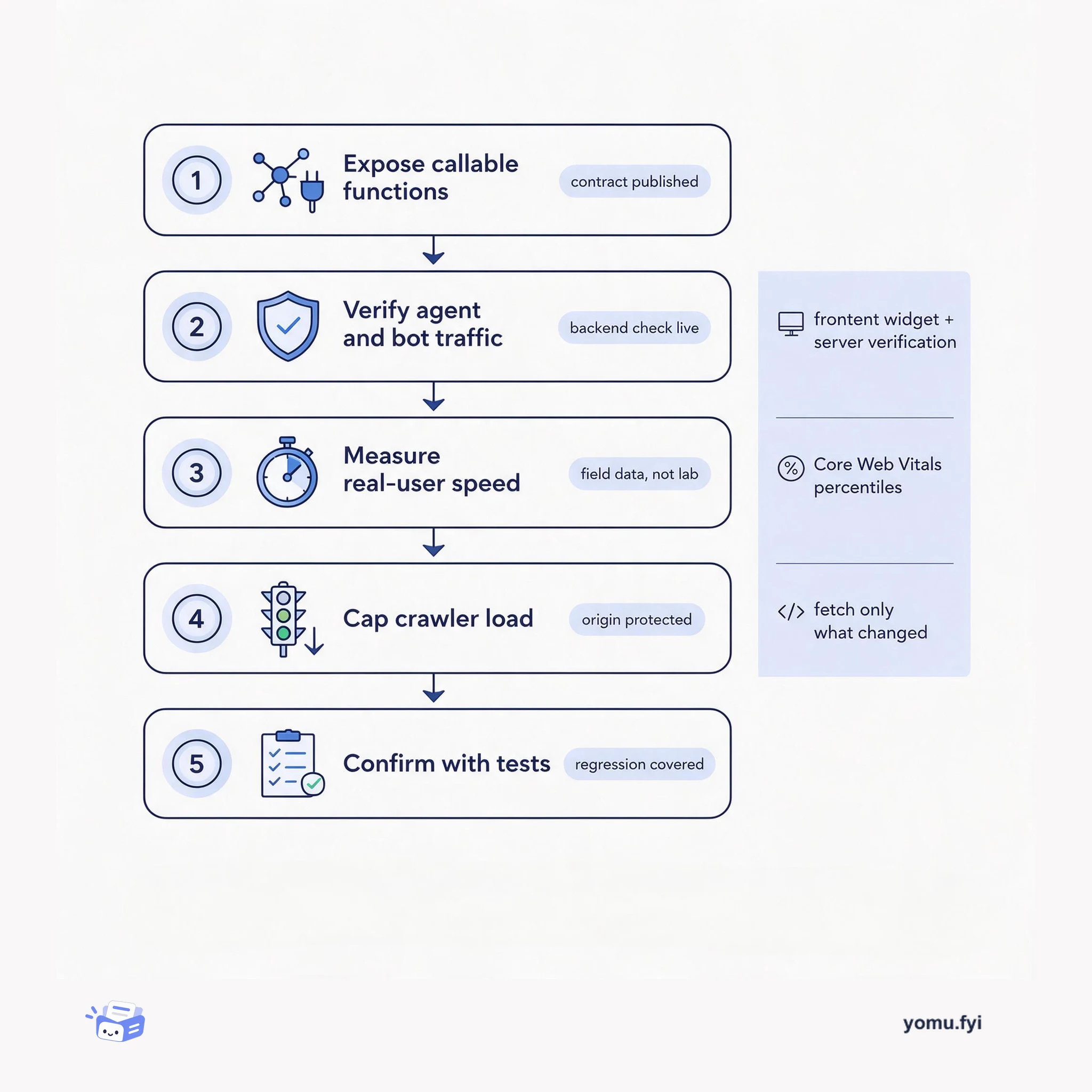
How to Prepare Your Site for the Agentic Browser
A five-step readiness checklist for teams whose sites are increasingly visited by AI agents: expose callable functions, verify bot traffic, measure real-user speed, and control crawler load.
Loading…
Topic
2 posts about WebMCP. Every summary links to the original.
See the idea
A five-step readiness checklist for teams whose sites are increasingly visited by AI agents: expose callable functions, verify bot traffic, measure real-user speed, and control crawler load.
The Good Stuff
Paid picks we use ourselves. Links carry a referral code — a subscription through one earns us a commission at no extra cost to you.
Newest first
Kitesurf, Cloudflare’s browser for AI agents built entirely on Workers, has received a major update. It now supports WebMCP, enabling agents to call site functions like searchFlights() instead of simulating clicks, and site owners can enable WebMCP with one switch. The browser passes over 730,000 Web Platform Tests, up 500,000 since launch, and adds support for CSS Layout, CSSOM, custom elements, URL-based module resolution, and improved iframe behavior. Efficiency optimizations reduce DOM traversal overhead, font fetching, and timer work, keeping CPU usage in line with launch benchmarks despite expanded capabilities. Kitesurf also gains full Browser Run API coverage, including Quick Actions from Worker bindings, and a terminal rendering mode using the Kitty protocol or ANSI text, with open-sourcing planned soon.
Stripe implemented WebMCP on its Checkout UIs, which processes around 0.45% of global GDP, to optimize the buying experience for AI agents. Previously, agents relied on slow browser automation, consuming an average of 1.8 million tokens and 38.83 tool calls per transaction, taking over 2.5 minutes. WebMCP exposes MCP tools from the client side, allowing agents to execute actions like get_order_summary or fill_payment_form instead of interpreting the DOM. The implementation uses progressive tool disclosure, revealing only relevant tools; in evaluations across six models, agents using WebMCP consumed 42% fewer tokens, made 38% fewer tool calls, and completed checkout 39% faster. Stripe reused existing UI state and forms via imperative and declarative APIs, avoiding a separate agent-only code path and keeping human and agent experiences aligned.
The best engineering reads, once a week.


