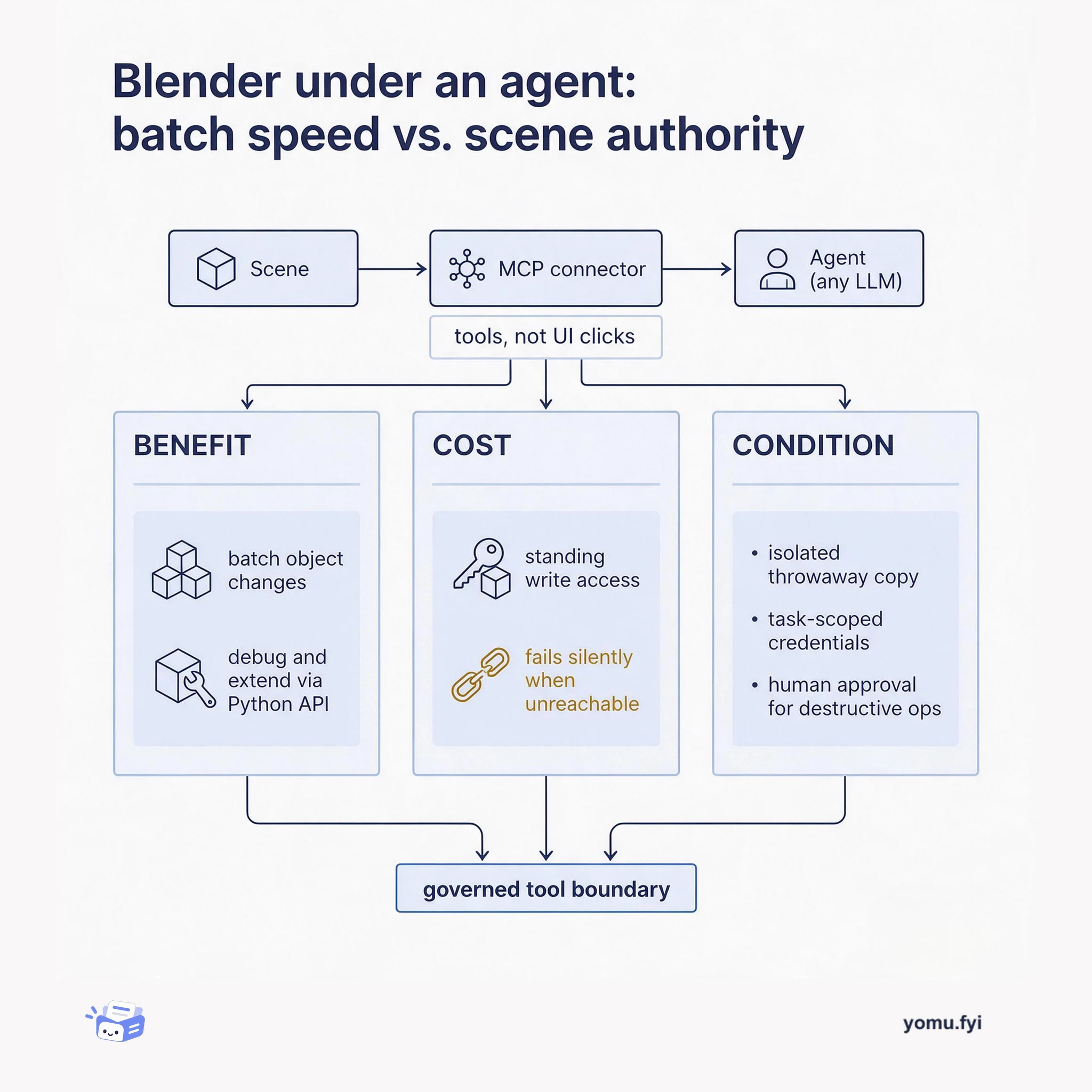
Blender's MCP Connector: Batch Speed vs. Authority Over the Scene
Blender's MCP connector lets an LLM analyze and batch-edit scenes through Blender's Python API. This trade-offs view weighs that speed against the authority and isolation it requires.
 StripeCara MecozziProblem & solution
Stripe implemented WebMCP on its Checkout UIs, which processes around 0.45% of global GDP, to optimize the buying experience for AI agents. Previously, agents relied on slow browser automation, consuming an average of 1.8 million tokens and 38.83 tool calls per transaction, taking over 2.5 minutes. WebMCP exposes MCP tools from the client side, allowing agents to execute actions like get_order_summary or fill_payment_form instead of interpreting the DOM. The implementation uses progressive tool disclosure, revealing only relevant tools; in evaluations across six models, agents using WebMCP consumed 42% fewer tokens, made 38% fewer tool calls, and completed checkout 39% faster. Stripe reused existing UI state and forms via imperative and declarative APIs, avoiding a separate agent-only code path and keeping human and agent experiences aligned.
AI agents navigating websites for checkout faced inefficiencies: they had to interpret visual interfaces and DOM, leading to high token consumption (1.8M tokens average), many tool calls (38.83), and long durations (>2.5 minutes). This made agent-driven purchases costly and slow.
Stripe implemented WebMCP with progressive tool disclosure, revealing only relevant tools and parameters based on checkout state. They used imperative APIs for actions like get_order_summary and select_payment_method, and declarative APIs for form filling that derive from rendered HTML. This reused existing UI state and forms, avoiding a separate agent-only code path.
WebMCP reduced token consumption by 42%, tool calls by 38%, and execution time by 39% compared to baseline browser automation in evaluations across six models.
Progressive tool disclosure reveals only tools and parameters relevant to the current checkout state, reducing errors and unnecessary invocations; for example, submit_payment is hidden until all fields are filled.
Stripe reused existing UI state and forms via imperative and declarative WebMCP APIs, avoiding a separate agent-only implementation and ensuring human and agent experiences stay aligned.
WebMCP is a browser technology that lets websites expose MCP tools to agents from the client side. Instead of navigating the DOM, agents can execute tools like get_order_summary or fill_payment_form, reducing token consumption and tool calls.
The page only exposes tools and parameters that are relevant in its current state. For example, submit_payment is not revealed until all required fields are filled, and changing payment method removes irrelevant parameters from the form filling tool.
Without WebMCP, agents consumed an average of 1.8 million tokens, made 38.83 tool invocations, and took over 2.5 minutes to complete a transaction with Stripe Checkout.
Summaries are generated from the original by a language model. Check the original before relying on it.
See the idea
Blender's MCP connector lets an LLM analyze and batch-edit scenes through Blender's Python API. This trade-offs view weighs that speed against the authority and isolation it requires.
Keep reading
The Good Stuff
Paid picks we use ourselves. Links carry a referral code — a subscription through one earns us a commission at no extra cost to you.
One useful email. Unsubscribe anytime.
