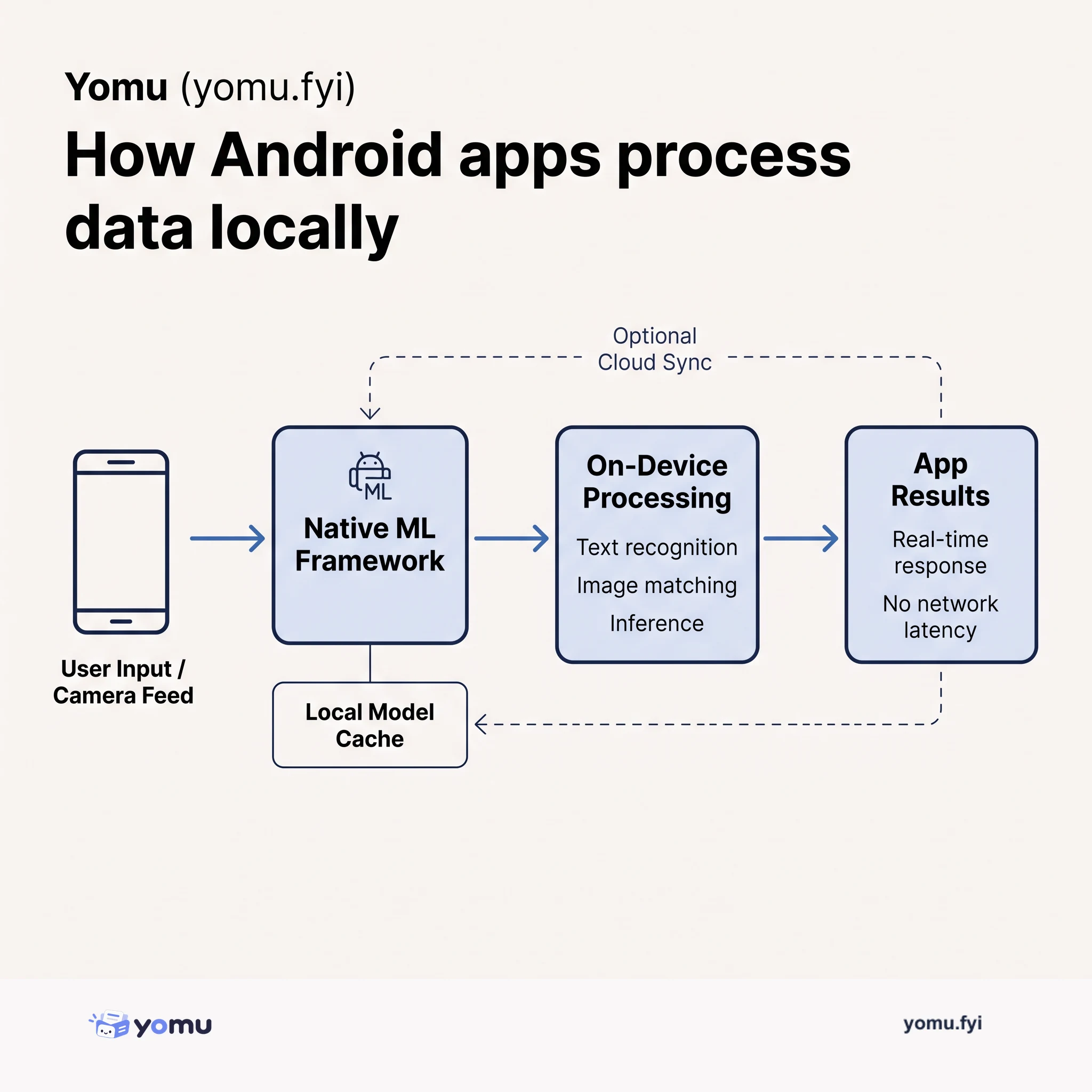
How Android Apps Handle Real-Time Local Processing
Android's on-device machine learning stack lets apps run inference, image recognition, and text processing locally without sending data to servers, reducing latency and protecting privacy.
 ClickhouseAnnouncement
bitdrift has joined ClickHouse’s House Mates program as a mobile observability partner, bringing mobile-native telemetry, tracing, and debugging to ClickStack. ClickStack provides an open-source or managed observability stack built on ClickHouse, with HyperDX and an OpenTelemetry Collector for logs, metrics, traces, and OTLP ingestion. bitdrift’s Capture SDK supports iOS, Android, and React Native, stores unsampled telemetry in a fixed-size on-device ring buffer, and uses control-plane configuration to decide what is collected or uploaded. Shared OpenTelemetry trace context lets engineers follow a mobile request’s trace ID from a session timeline into ClickStack, where backend traces, dependencies, logs, metrics, database operations, and infrastructure behavior are available, creating a continuous debugging path across the device and distributed systems.
Most observability platforms focus on servers, containers, and short-lived backend requests, while mobile sessions can run for hours, move across networks, go offline, encounter device-specific limits, and produce more diagnostic context than can be streamed continuously. Traditional mobile tools may sample away the session needed to diagnose an issue.
The integration combines bitdrift Capture’s on-device, unsampled telemetry and selective upload model with ClickStack’s ClickHouse-backed, OpenTelemetry-native observability stack. Shared trace IDs connect mobile network requests to backend traces; Android uses bitdrift’s OkHttp tracing integrations, while iOS uses the existing URLSession integration.
bitdrift Capture stores mobile telemetry in a fixed-size ring buffer on the device and uploads selected data through real-time control-plane configuration.
OpenTelemetry trace context connects a request’s trace ID from a bitdrift mobile session timeline to its distributed backend trace in ClickStack.
ClickStack’s ClickHouse storage and parallel query engine are intended for high-cardinality observability workloads such as large volumes of traces and application logs.
Summaries are generated from the original by a language model. Check the original before relying on it.
See the idea
Android's on-device machine learning stack lets apps run inference, image recognition, and text processing locally without sending data to servers, reducing latency and protecting privacy.
Keep reading
The Good Stuff
Paid picks we use ourselves. Links carry a referral code — a subscription through one earns us a commission at no extra cost to you.
One useful email. Unsubscribe anytime.
