The AI Tool Trade-off: Rented Speed vs. Owned Control
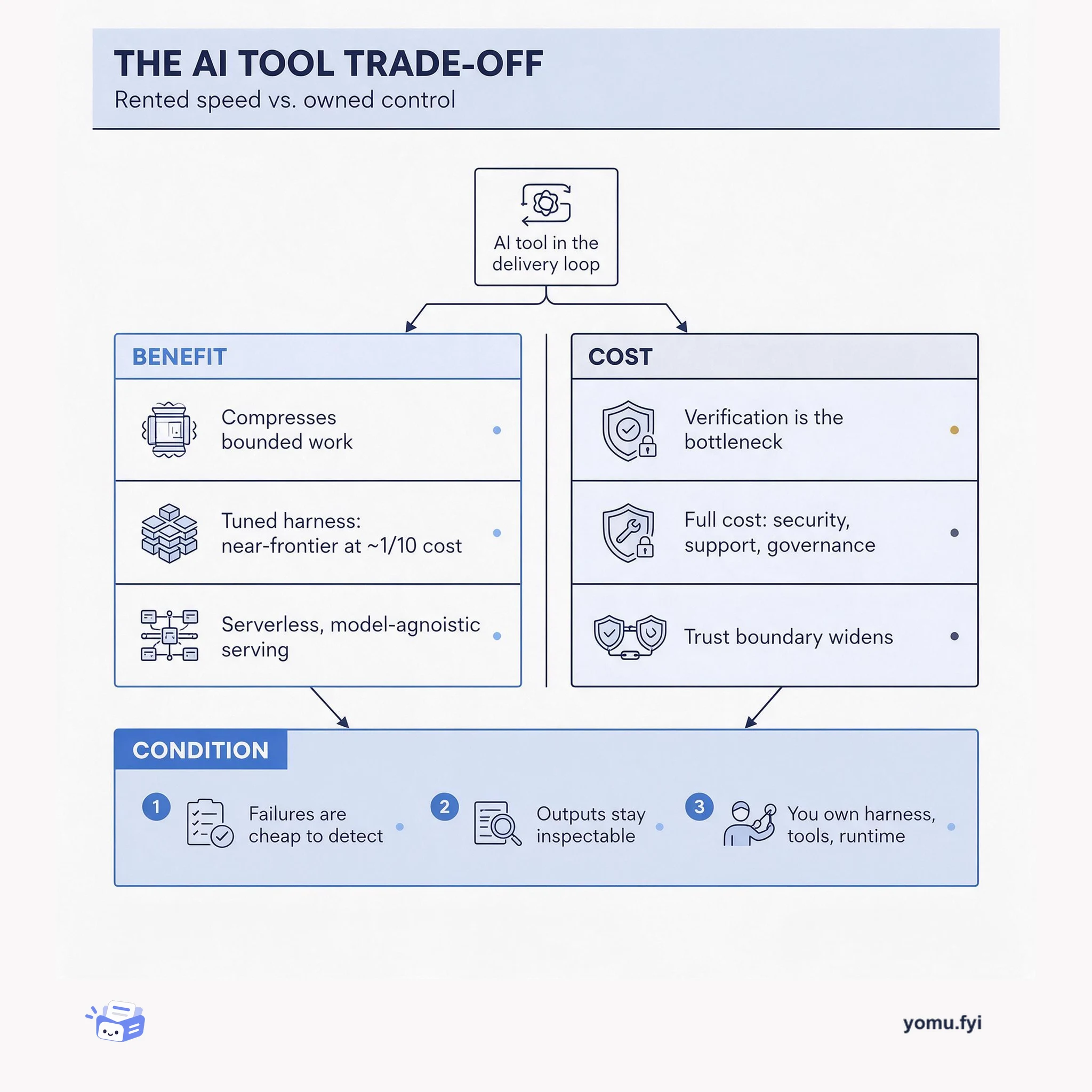
The AI tool trade-off: where AI compresses bounded work, what verification and governance really cost, and the condition that decides whether to rent capability or own the stack.
 NVIDIANicola SessionsTutorial
Building a production-grade autonomous agent requires a reasoning model, a harness that manages tools and context, domain-specific tools, and a runtime that enforces security policies. NVIDIA NemoClaw provides open blueprints that assemble these components into a stack developers can own and customize, working with harnesses such as OpenClaw, Hermes Agent, or LangChain Deep Agents. The blueprints integrate a tuned harness optimized for Nemotron models, NeMo Relay for telemetry and optimization, and OpenShell for runtime governance of file, network, and credential access. LangChain demonstrated that tuning its Deep Agents harness for Nemotron 3 Ultra achieved near-frontier performance at roughly one-tenth the cost of leading closed models. NemoClaw agents can run across cloud, data center, and local systems, and can delegate tasks to or receive tasks from other agents.
Building autonomous agents for production requires combining a reasoning model, a harness that defines agent operation, domain-specific tools, and a secure runtime. NemoClaw is a collection of open blueprints that assembles these components into a custom stack. The post explains the role of each component and provides criteria for integrating NemoClaw with harnesses OpenClaw, Hermes Agent, or LangChain Deep Agents, illustrating how co-optimizing model and harness can reduce cost without sacrificing performance.
NemoClaw provides open blueprints that integrate a chosen agent harness (OpenClaw, Hermes Agent, or LangChain Deep Agents) with NVIDIA Nemotron models, NeMo optimization and telemetry tools, and the OpenShell secure runtime. Developers select a supported harness, then use the NemoClaw blueprint to assemble the surrounding stack without rewriting the agent. The blueprint includes a tuned harness optimized for Nemotron, NeMo Relay for observing and improving execution, and OpenShell policies to govern file, network, and credential access.
NemoClaw is not a competing harness or runtime; it is a collection of open blueprints that assembles a tuned harness, Nemotron models, NeMo optimization tools, and OpenShell runtime governance around a selected agent harness.
LangChain tuned its Deep Agents harness for Nemotron 3 Ultra by adjusting prompts, tools, and middleware without retraining the model, achieving near-frontier performance at approximately 10x lower cost per run compared with leading closed models.
OpenShell enforces policy on agent actions by governing file system, process, and network access, and keeping credentials for managed inference and MCP connections outside the sandbox, helping maintain security even when agent memory suggests unintended actions.
NemoClaw is a collection of open blueprints that assembles an agent stack on top of a harness you already use, such as OpenClaw, Hermes Agent, or LangChain Deep Agents. It adds Nemotron models, NeMo optimization and telemetry tools, and the OpenShell secure runtime. You do not rewrite the agent; the blueprint packages the surrounding stack.
OpenShell is a secure runtime that governs what an agent can access and do in production. It enforces policies on file system, process, and network access, and keeps credentials for managed inference and MCP connections outside the sandbox. This helps keep the agent bound by policy even when its memory or context leads toward unintended actions.
LangChain tuned its Deep Agents harness specifically for Nemotron 3 Ultra by adjusting prompts, tools, and middleware without retraining the model. This tuning brought Nemotron 3 Ultra to near-frontier performance at approximately 10x lower cost per run compared with leading closed models.
Summaries are generated from the original by a language model. Check the original before relying on it.
See the idea
The AI tool trade-off: where AI compresses bounded work, what verification and governance really cost, and the condition that decides whether to rent capability or own the stack.
Keep reading
The Good Stuff
Paid picks we use ourselves. Links carry a referral code — a subscription through one earns us a commission at no extra cost to you.
One useful email. Unsubscribe anytime.
