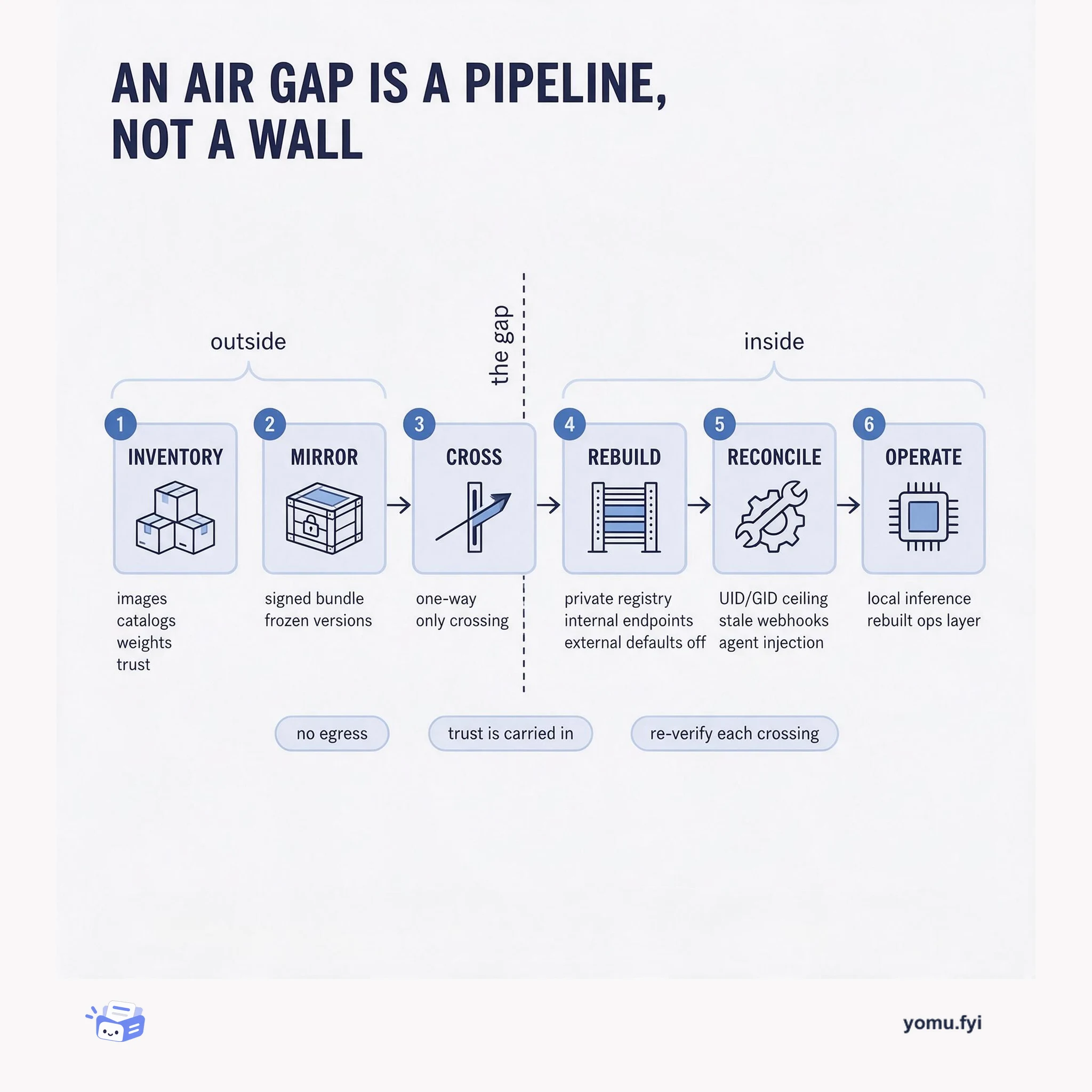
An Air Gap Is a Pipeline, Not a Wall
An air gap is a one-way artifact pipeline, not just a blocked network. This explainer follows six stages, from mirroring dependencies outside to operating inside with no egress.
 NVIDIAElizabeth GoodmanAnnouncement
NVIDIA RTX Spark consolidates AI development onto a single machine by integrating the GB10 system-on-a-chip, up to 128GB unified memory, a Blackwell GPU with 1 petaflop of FP4 compute, and a Grace CPU. This eliminates the split across laptop, cloud API, and cloud VM, enabling local coding agents and reducing token consumption through hybrid prompt routers. Compared with Intel Panther Lake, RTX Spark delivers 4.6x faster coding-agent performance, 2.7x faster fine-tuning, and 1.8x faster compilation. A partnership with Microsoft provides Windows Developer Config, WSL optimizations, native PyTorch-CUDA, Python 3.15, and over 2,000 Conda packages for Arm. Local agents like GitHub Copilot, Pi, and Junie are optimized, and decision models in llama.cpp and Unsloth offer near-instant actions while the Nemotron 3.5 Bolt model fits in 24GB using 2-bit quantization.
AI development workflows currently require developers to use separate devices for coding, cloud model APIs, and cloud virtual machines, creating friction and cost.
NVIDIA RTX Spark combines the GB10 system-on-a-chip, up to 128GB of unified memory, a Blackwell GPU, and a Grace CPU in a single laptop or desktop, enabling local coding agents, fine-tuning, and deployment without cloud dependency. It includes optimizations for Windows and WSL, support for local agents like GitHub Copilot, Pi, and Junie, and the Nemotron 3.5 Bolt model for efficient local inference.
RTX Spark delivers up to 4.6x faster coding-agent performance, 2.7x faster fine-tuning, and 1.8x faster compilation compared with Intel Panther Lake, based on NVIDIA’s tests using AA-AgentPerf-local, Unsloth LoRA, and Phoronix Test Suite.
The Nemotron 3.5 Bolt 74B-9B MoE model uses 2-bit quantization with quantization-aware training to fit in 24GB, aiming for a balance between speed and intelligence for local agents on RTX Spark.
Decision models supported in llama.cpp and Unsloth on RTX Spark enable AI agents to select actions up to 200x faster than traditional reasoning loops, near-instantly.
GitHub Copilot, Pi, Hermes, OpenClaw, and JetBrains Junie Local are optimized. Improvements include seamless local model deployment, OS-level sandboxing with NVIDIA OpenShell or Microsoft Execution Containers, and hybrid prompt routers that reduce cloud token consumption.
According to NVIDIA, RTX Spark offers 4.6x faster coding-agent performance (AA-AgentPerf-local), 2.7x faster fine-tuning (Unsloth LoRA with Llama-3.1-8B), and 1.8x faster Linux kernel compilation (Phoronix Test Suite).
It's a 74B-parameter MoE model with 9B active parameters, using 2-bit quantization to fit in 24GB. It aims to be faster than popular dense models and smarter than MoE models of similar size, making it suitable for local agents on RTX Spark. It is open-source with training data, weights, and recipes.
Summaries are generated from the original by a language model. Check the original before relying on it.
See the idea
An air gap is a one-way artifact pipeline, not just a blocked network. This explainer follows six stages, from mirroring dependencies outside to operating inside with no egress.
Keep reading
The Good Stuff
Paid picks we use ourselves. Links carry a referral code — a subscription through one earns us a commission at no extra cost to you.
One useful email. Unsubscribe anytime.
