Change Management: Reversibility Sets the Gate
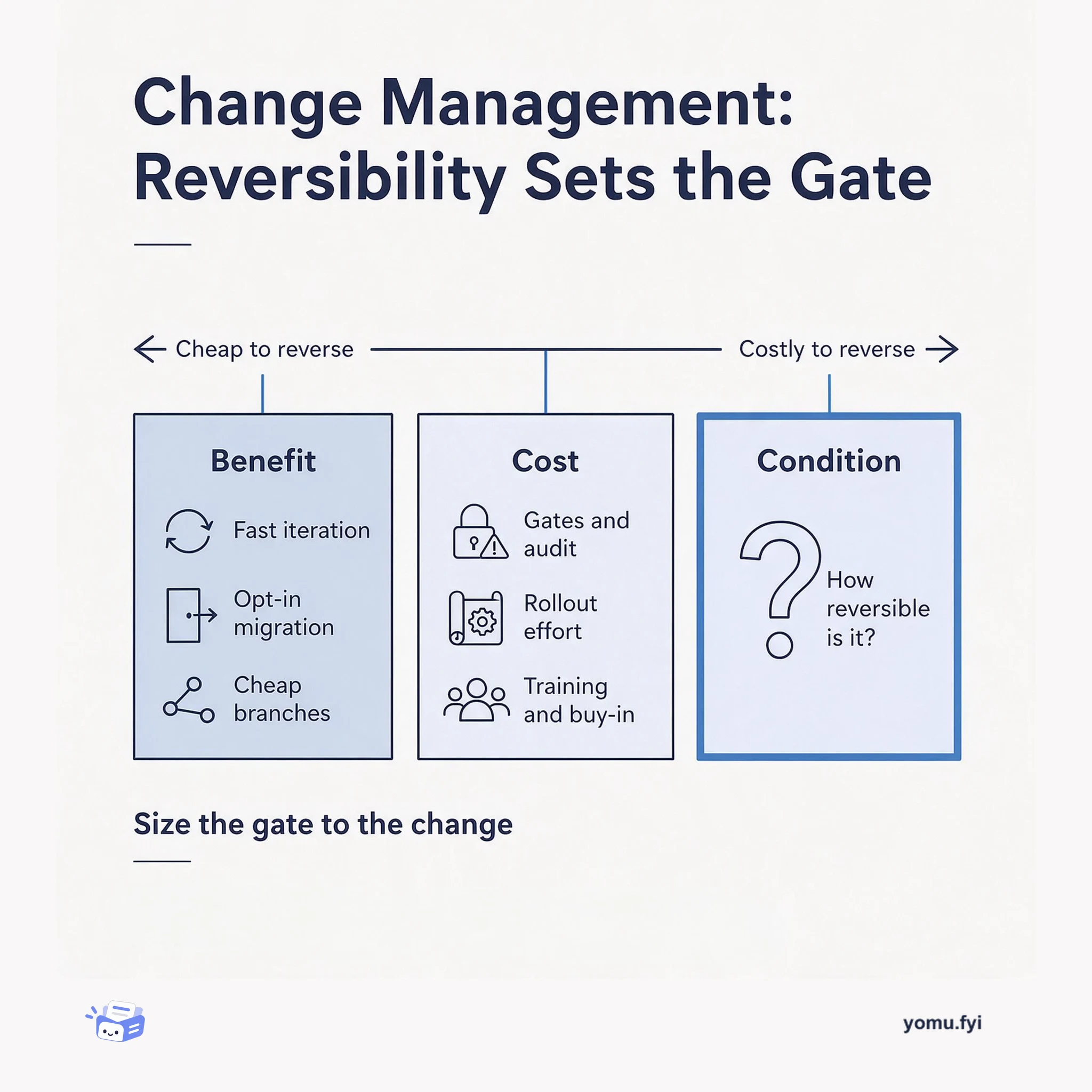
A trade-off map for change management: reversible changes can move fast with light gates, while irreversible ones need staged rollout, auditability, and adoption work.
 DatabricksJack Yallop, Lexy KassanAnnouncement
DataIQ and Databricks have published Deliberate Decisions, a report on how senior data and AI leaders make grounded choices amid fast-moving AI progress. Based on peer discussions at DataIQ Guild 2026, it identifies five recurring pressures and five leadership disciplines, including confidence grounded in reality, enterprise choices over demand-led reactions, and stability without rigidity. The report also outlines four foundations—context, control, cost, and choice—for balancing commitment with flexibility, and four adoption stages from concerned to competent. It distinguishes pilot success from production readiness, arguing that the full cost of AI includes security, support, adoption, governance, and the operating model. Leaders are urged to define business ownership, protect human judgment, and keep nonessential decisions flexible and reversible.
The report is aimed at senior data and AI leaders moving from experimentation toward enterprise AI value, and is based on two days of peer discussion at DataIQ Guild 2026.
The report synthesizes open peer discussions at DataIQ Guild 2026 into five leadership disciplines and four foundations, and offers a framework for testing readiness, prioritizing use cases as a portfolio, clarifying business ownership, protecting human judgment, and fixing only the points that need stability.
The report identifies five leadership disciplines: confidence grounded in reality, enterprise choices rather than demand-led reactions, leadership through influence, human judgment as a strategic capability, and stability without rigidity.
Databricks’ perspective in the report names four foundations for balancing commitment and flexibility: context grounds AI in trusted, governed data; control supports responsible innovation; cost keeps adoption aligned with ambition; choice preserves the ability to evolve.
A successful pilot is not the same as production readiness; the full cost of AI includes security, support, adoption, governance and the operating model, and an approved use case without committed business ownership can create a new problem.
Look beyond pilot results. AI is ready to scale when the organization can support, govern, adopt and afford it in a live workflow, including operational support, governance, skills, monitoring and a cost model. As one leader notes, the cost includes security, support, adoption, governance and the operating model around it.
Start with a well-defined business problem and enterprise value rather than demand alone. Manage initiatives as a portfolio, making trade-offs visible and increasing investment as evidence strengthens, while stopping or redirecting work that does not justify further commitment.
A business owner should be accountable for the outcome, adoption, operating consequences and ongoing costs, with clear decision rights across teams. An approved use case without committed ownership can create a new problem rather than solve an existing one.
Summaries are generated from the original by a language model. Check the original before relying on it.
See the idea
A trade-off map for change management: reversible changes can move fast with light gates, while irreversible ones need staged rollout, auditability, and adoption work.
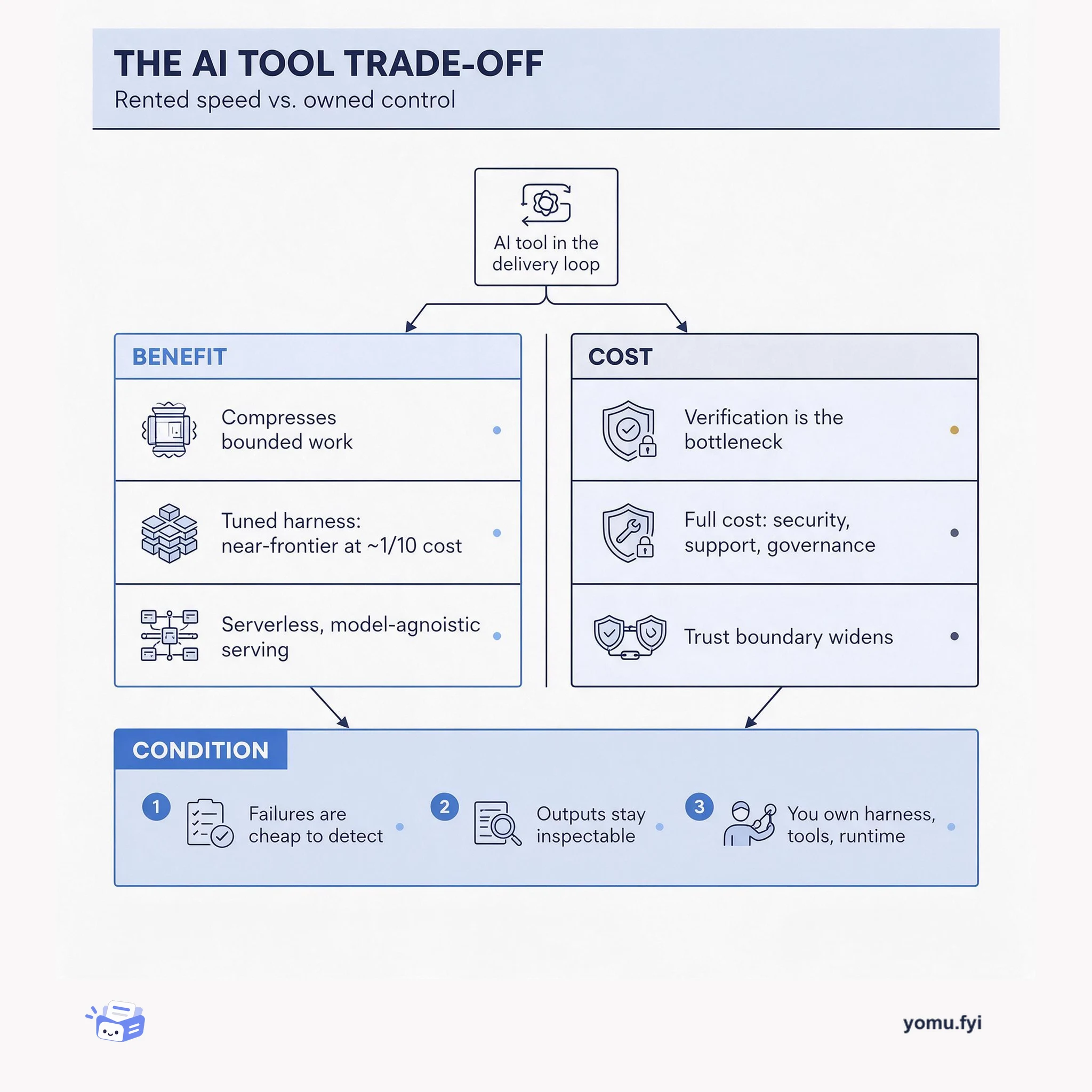
The AI tool trade-off: where AI compresses bounded work, what verification and governance really cost, and the condition that decides whether to rent capability or own the stack.
Keep reading
The Good Stuff
Paid picks we use ourselves. Links carry a referral code — a subscription through one earns us a commission at no extra cost to you.
One useful email. Unsubscribe anytime.