Boolean remains essential for social listening because it gives researchers explicit rules for defining, inspecting, and reusing datasets, providing precision, transparency, and reproducibility. AI can accelerate Boolean query building by generating terms, fixing syntax, and assessing result quality, but the logic stays visible and editable, unlike black-box model decisions. A Foxit survey shows executives save 4h36m per week with AI but spend 4h20m verifying outputs, highlighting the verification burden. Cision’s Iris AI tools illustrate this approach: Query Writer creates a first draft from a plain-language prompt, Query Fixer catches syntax errors, and Query Health evaluates relevancy and source diversity. The goal is less manual work without removing control, with researchers retaining final judgment on query quality.
Context
The tension between AI-driven search and Boolean precision in social listening, with the need for control and transparency in research datasets.
Approach / What changed
Cision’s Iris AI tools (Query Writer, Query Fixer, Query Health) that generate, fix, and assess Boolean queries while keeping logic visible and editable.
Takeaways
1
Boolean provides precision, transparency, and reproducibility that model-driven classification cannot match for high-stakes research.
2
AI can accelerate Boolean query building by generating terms, fixing syntax, and assessing result quality, but the logic must remain visible and editable.
3
A Foxit survey found that executives save 4h36m per week with AI but spend 4h20m verifying outputs, highlighting the verification burden.
FAQ
Why does Boolean still matter when AI can search?
Boolean gives researchers explicit rules for defining, inspecting, and reusing datasets, providing precision, transparency, and reproducibility that black-box models cannot offer.
How can AI help with Boolean queries without removing control?
AI can generate a first draft, fix syntax errors, and assess result quality, but the Boolean query remains visible and editable so researchers retain control.
What is the verification burden of AI-driven search?
A Foxit survey found that executives save 4h36m per week with AI but spend 4h20m verifying outputs, and only one in ten researchers are very confident in AI outputs.
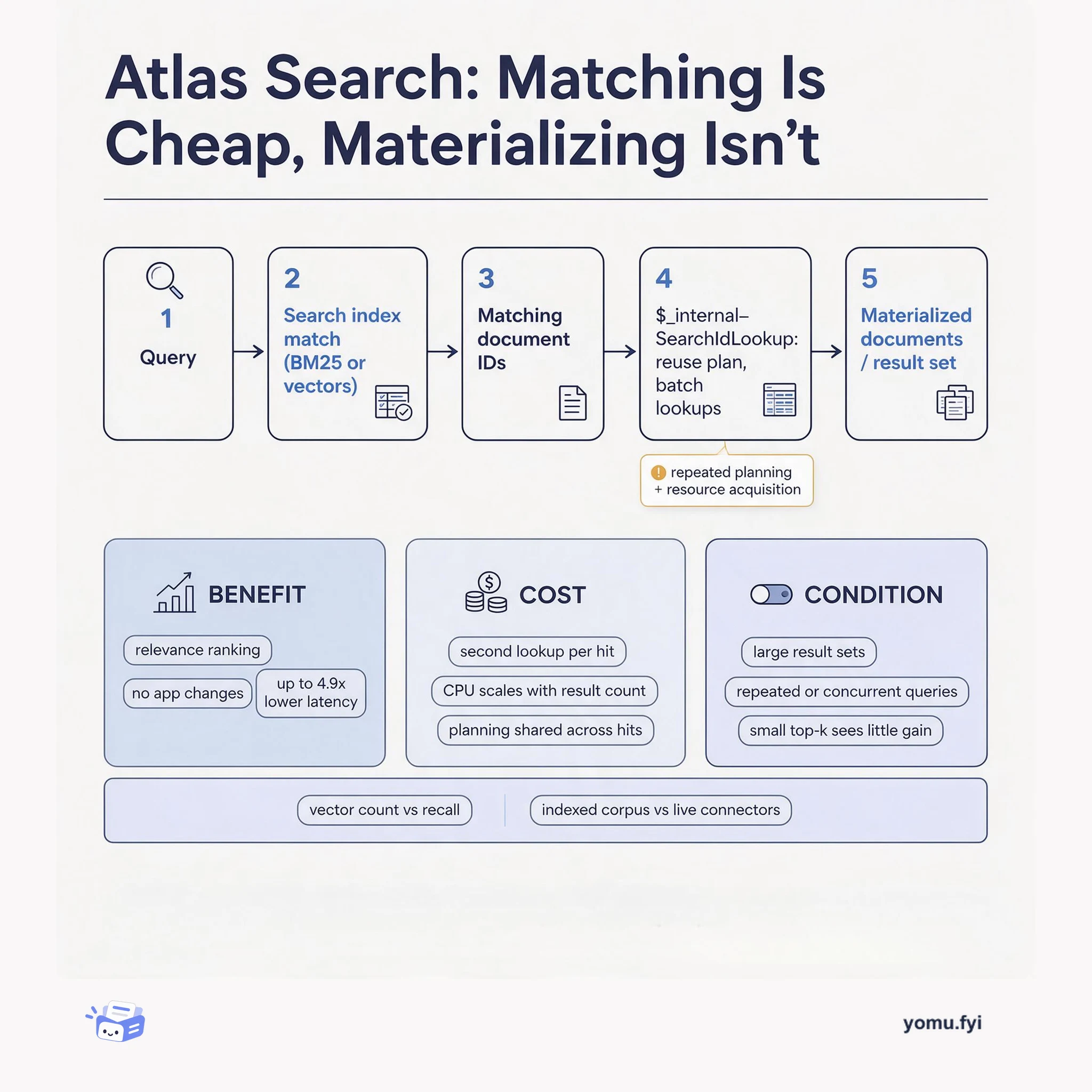
Atlas Search finds matching document IDs fast, but materializing each hit from the collection is where the latency and CPU go. This trade-off map shows the benefit, the cost, and the condition for accepting that second phase.
Keep reading
Related reading
The Good Stuff
Paid picks we use ourselves. Links carry a referral code — a subscription through one earns us a commission at no extra cost to you.