Zepto describes its customer-support system, processing more than 100,000 tickets daily, and the assurance problems that emerged as volume, categories, and customer behavior changed. Its response is an evaluation-first architecture on Databricks and MLflow, using development and production loops connected by a quality gate. Agent traces capture prompts, completions, retrieved documents, tool calls, latencies, and decision paths through MLflow, OpenTelemetry spans, and Unity Catalog-backed Delta tables; stakeholders define evaluation pillars and gates around a living golden dataset. The dataset grew from 500 examples with an eight-point development–production accuracy gap to 5,247 examples with a 0.4-point gap over six months, while prompt optimization and multiple scorers support iteration. Reported outcomes include 80% plus of tickets fully managed with human oversight, a 65% reduction in support cost or tickets, 20% higher CSAT, 8% better accuracy, and faster development and resolution.
Context
Zepto needed to maintain reliable customer support as it handled more than 100,000 AI-agent tickets daily, expanded into additional product categories, experienced demand spikes, and served a more diverse, multilingual customer base. Failures could occur at any stage of multi-step agent workflows, while fixes were slow, internal errors were hidden by final answers, and reliability was difficult to assure as agents evolved.
Approach / What changed
Zepto made evaluation core AI infrastructure using Databricks and MLflow. The framework connects development and production loops through a quality gate, enables detailed MLflow tracing with OpenTelemetry and Unity Catalog-backed Delta tables, defines stakeholder-specific evaluation pillars, maintains a living golden dataset, and uses automated prompt optimization, multiple scorers, monitoring, and feedback to guide deployment and iteration.
Takeaways
1
LLM judges require calibration: the framework recommends measuring their agreement with human labels, using ensembles for high-stakes cases, and recalibrating them as base models change.
2
Stratified sampling focused on high-risk flows produced an order of magnitude better issue detection per dollar than naive uniform sampling.
3
Automating detection, labeling, retraining, deployment, and monitoring saved about 155 hours per month, equivalent to two full-time engineers redirected to feature work.
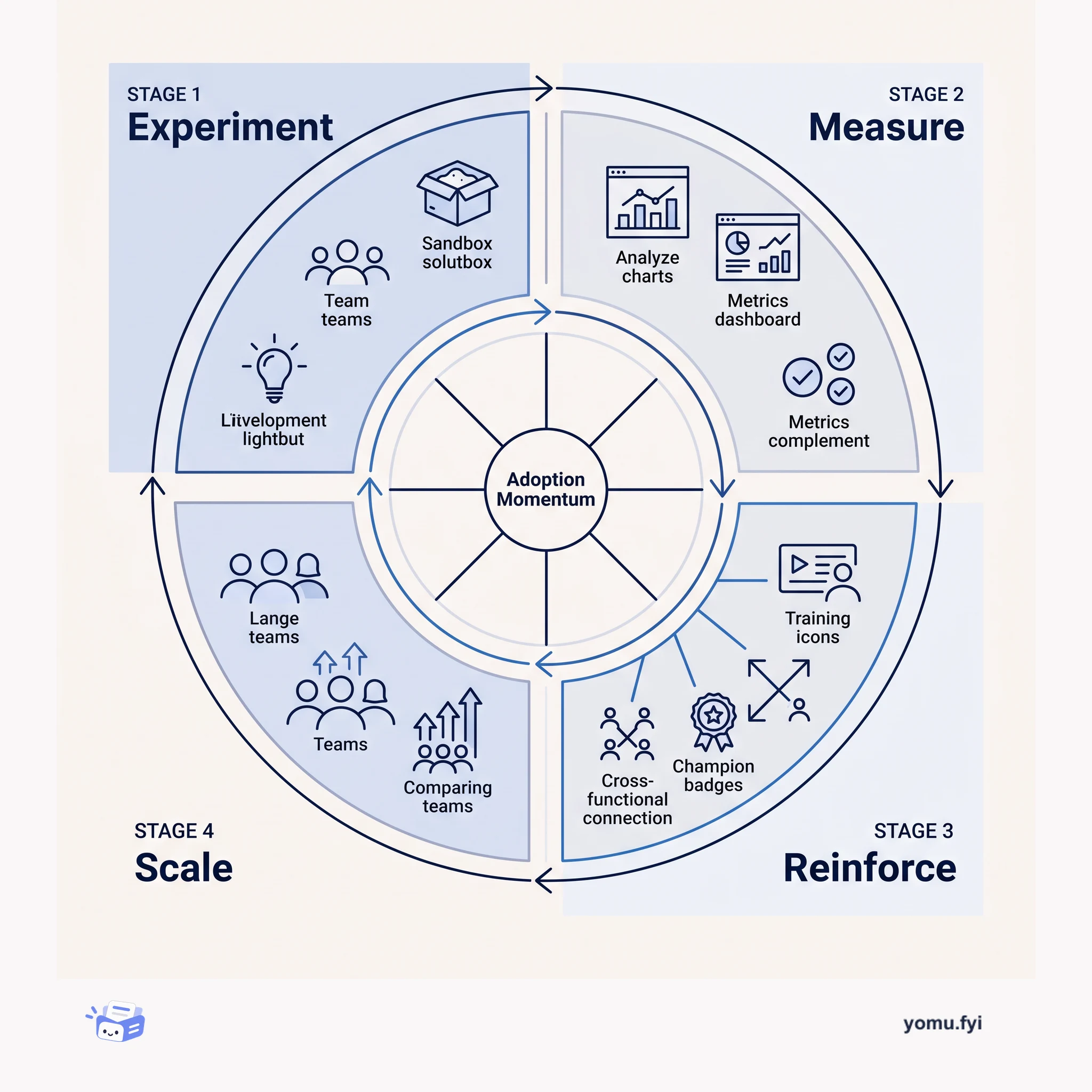
Adoption moves through experimentation, measurement, and reinforcement loops. Learn how leading companies build momentum from pilot programs into enterprise-wide habits and measurable business impact.
Keep reading
Related reading
The Good Stuff
Paid picks we use ourselves. Links carry a referral code — a subscription through one earns us a commission at no extra cost to you.