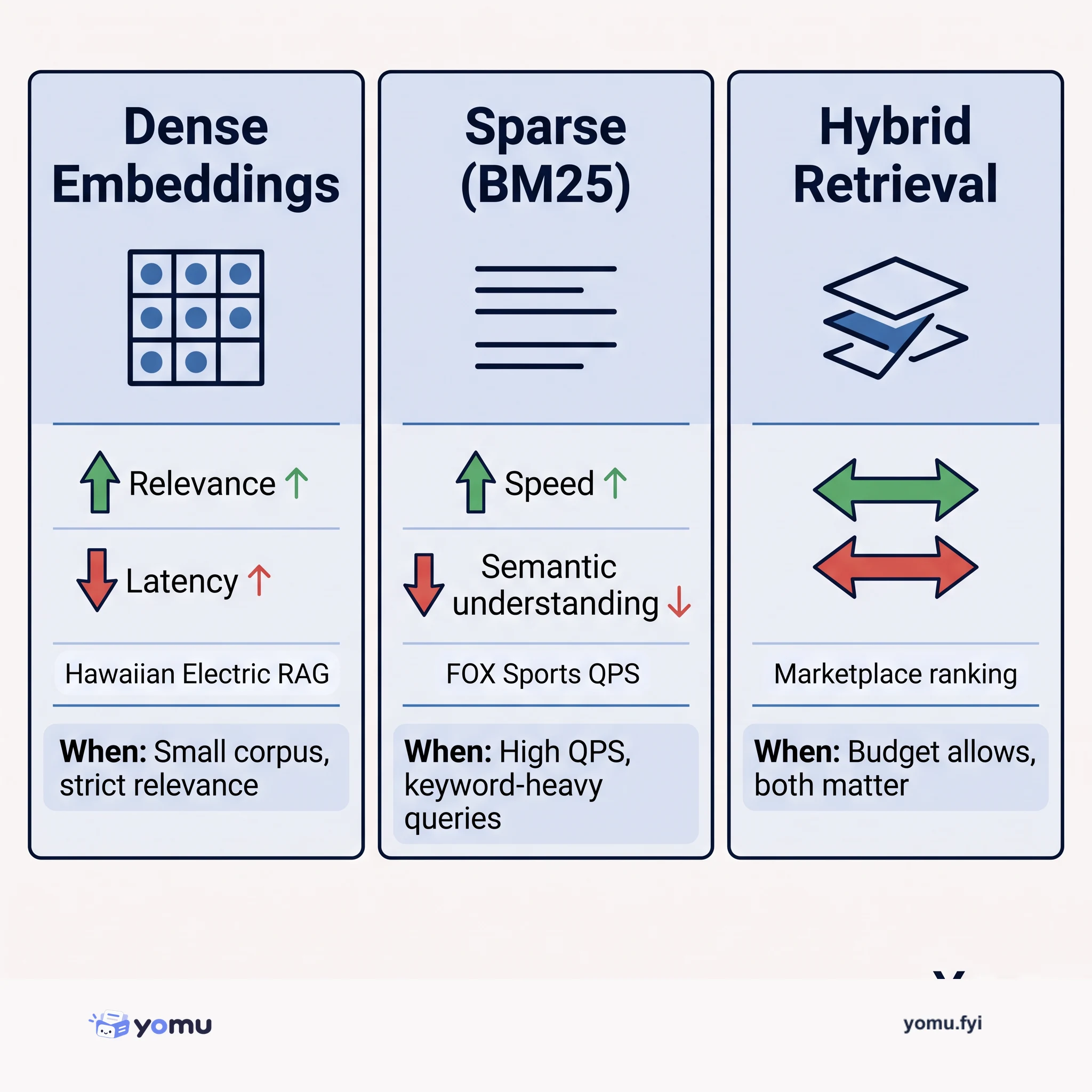
AI Search: Speed vs. Relevance Trade-off
AI Search balances retrieval speed and result quality by choosing between dense embeddings, sparse lexical search, and hybrid approaches. Understand which trade-off fits your workload.
 DatabricksJulien Debard, Edward TavaresExplainer
Electric utilities are facing rising demand, retiring generation, extreme weather, aging infrastructure, and fragmented operational data that manual processes cannot manage at scale. AI agents are presented as a human-centered alternative that synthesizes heterogeneous data, learns from outcomes, and progresses from human-approved recommendations to exception-based control and eventually autonomous operations within defined parameters. Hawaiian Electric used a Retrieval Augmented Generation proof-of-concept with Databricks AI Search, Unity Catalog, and Lakeflow Declarative Pipelines to query regulatory documents and provide page-specific citations. The system reduced response times from five minutes to five seconds and was implemented in two weeks, while the article describes broader potential for predictive maintenance, outage response, load forecasting, and customer service.
Utilities are dealing with accelerating electricity demand, generation retirements, extreme weather, aging infrastructure, regulatory change, and operational data trapped across incompatible systems. The source presents these pressures as challenges that manual, legacy processes cannot address effectively at scale.
The source advocates a staged, human-centered adoption of AI agents: begin with recommendations requiring operator approval, progress to exception-based control for routine decisions, and eventually support autonomous operations within defined parameters. Hawaiian Electric's initial implementation combined Retrieval Augmented Generation with Databricks AI Search, Unity Catalog, and Lakeflow Declarative Pipelines.
Hawaiian Electric reduced regulatory document query time from five minutes to five seconds, a 60X improvement, and implemented the system in two weeks.
The proposed adoption path moves from human-approved recommendations to exception-based control and then autonomous operations with human oversight and defined boundaries.
The regulatory-document chatbot provides specific page references for responses, enabling legal teams to verify AI-generated insights against original sources.
Summaries are generated from the original by a language model. Check the original before relying on it.
See the idea
AI Search balances retrieval speed and result quality by choosing between dense embeddings, sparse lexical search, and hybrid approaches. Understand which trade-off fits your workload.
Keep reading
The Good Stuff
Paid picks we use ourselves. Links carry a referral code — a subscription through one earns us a commission at no extra cost to you.
One useful email. Unsubscribe anytime.
