AI Model Selection: Cost vs. Capability Trade-offs
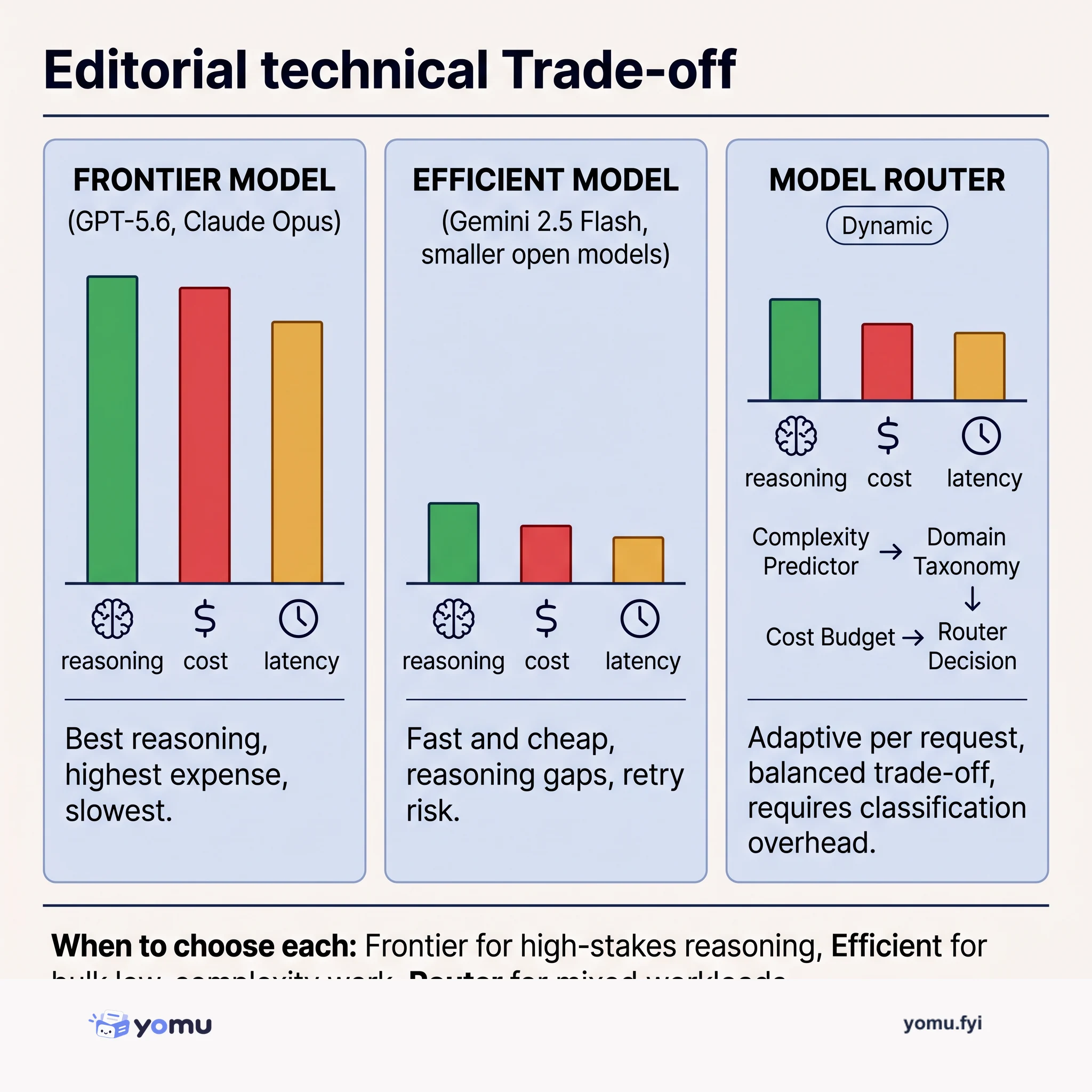
Understand how to choose between frontier models, efficient alternatives, and routing systems by weighing capability gains against token costs and latency constraints.
 CursorConnor O'Keefe & Yuri VolkovExplainer
Cursor Router selects models for developer turns using production behavior rather than benchmark scores, balancing user satisfaction and cost. Its routing system first uses Compass, a continuous 0-to-1 complexity predictor trained on follow-up behavior, to keep simple turns on a price-efficient model or upgrade complex ones. Then a taxonomy of domains, tasks, and modifiers compares frontier-model strengths, while an optimizer applies a one-sided 75% uplift threshold and each mode's cost budget. The dataset contains hundreds of thousands of live Cursor turns, preserving conversation signals, model-switching effects, inferred performance from subsequent user actions, and token-based costs including cache misses. Current results report Auto Intelligence at above Fable-level satisfaction with 68% lower cost, and Auto Balance outperforming Opus 4.8 at 41% lower cost while raising satisfaction by 3%.
Cursor Router is motivated by the limits of selecting models through benchmark scores and by the need to balance developer satisfaction with inference cost. The system is designed to learn from real developer traffic, including production effects such as token usage, caching, and switching between models.
The system uses Compass to predict turn complexity and decide whether a price-efficient model is sufficient. For more demanding turns, a taxonomy of domains, tasks, and modifiers guides frontier-model selection. Routing policies apply a one-sided 75% performance-uplift threshold and optimize traffic within each mode's cost budget, using live traffic and held-out evaluation to assess results.
Compass assigns each turn a continuous complexity score from 0 to 1; its highest-rated turns received a positive performance signal 96% of the time, compared with 71% for the lowest-rated turns.
The routing dataset contains hundreds of thousands of sampled live turns and measures performance from subsequent user actions while calculating cost from API pricing and token usage, including cache misses caused by model switching.
Auto Intelligence delivers above Fable-level user satisfaction at 68% lower cost, while Auto Balance outperforms Opus 4.8 at 41% lower cost and increases user satisfaction by 3%.
Summaries are generated from the original by a language model. Check the original before relying on it.
See the idea
Understand how to choose between frontier models, efficient alternatives, and routing systems by weighing capability gains against token costs and latency constraints.
Keep reading
The Good Stuff
Paid picks we use ourselves. Links carry a referral code — a subscription through one earns us a commission at no extra cost to you.
One useful email. Unsubscribe anytime.
