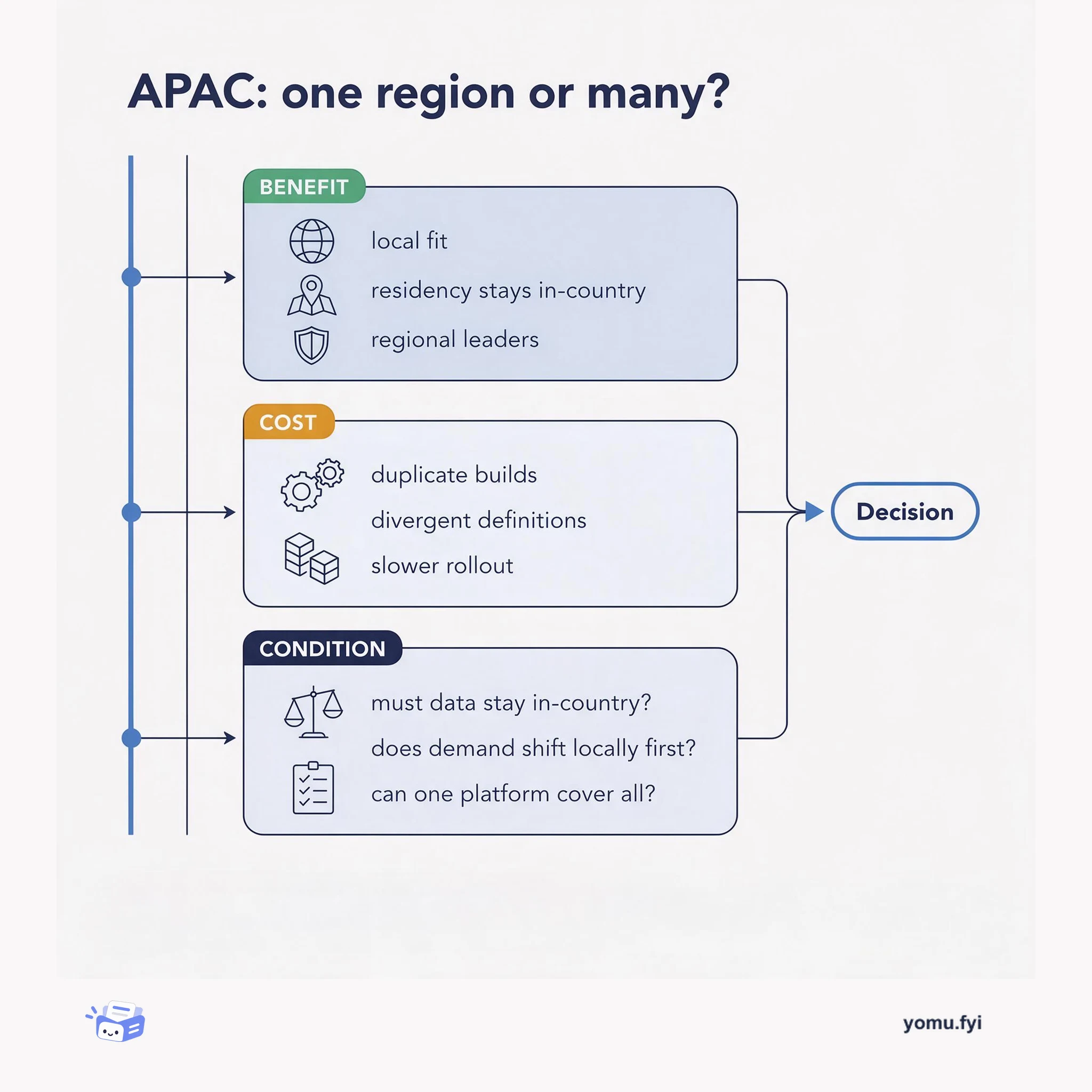
APAC Is Not One Region: The Regionalize vs. Standardize Tradeoff
APAC is a federation of markets, not a single deployment region. This diagram maps the tradeoff between local autonomy and one shared platform, and the conditions that decide it.
Understand how to choose between frontier models, efficient alternatives, and routing systems by weighing capability gains against token costs and latency constraints.
Choosing an AI model involves balancing three competing demands: capability (reasoning depth, accuracy on hard tasks), cost (tokens per request, infrastructure), and latency (response time). Frontier models excel at complex reasoning but consume more tokens and cost more per inference. Efficient models reduce per-token cost and latency but may fail on reasoning-heavy tasks, requiring fallback or retry logic. Model routing systems observe request complexity, task type, and historical performance to assign each request to the best model for its workload, trading upfront classification overhead for lower average cost without sacrificing user satisfaction. Engineers must decide whether to pay for frontier capability uniformly, accept capability risk with cheaper models, or invest in routing logic that adapts per request.
The posts behind it
 Jetbrains · · Explainer
An interview with Python educator Ardit Sulce examines how beginners should learn programming as AI changes development and teaching. Sulce says AI now handles many small questions, while teachers provide curated learning paths, judgment, and context; he also argues that students should preserve productive struggle while outsourcing setup friction. He recommends evaluating understanding through code explanation, review, and debugging rather than treating working code as proof, and identifies reading unfamiliar code, debugging, and system understanding as important junior skills. His proposed three-stage path moves from writing syntax by hand in a professional IDE, to using AI as a tutor, and finally to using it as a co-worker while reviewing increasingly complex projects.
 Stack Overflow · · Explainer
The conversation examines the economics and platform implications of operating dozens or hundreds of AI agents rather than a small number of human-driven workflows. Andi Gutmans argues that many current models are already sufficient for automation, shifting the optimization problem to the complete system: model, harness, context, personalization, and evaluation. The goal is the least sophisticated model and smallest viable context that produce a reliable outcome at the lowest cost, with better trajectories reducing reasoning loops and token processing; Google’s stated approach is to hill climb models and data together. The discussion also addresses cost governance, search and observability for agents as a distinct persona, human-in-the-loop handling, and the continuing importance of computer-science fundamentals, agentic fluency, and business judgment.
 Databricks · · Explainer
An AI copilot is an assistant embedded in a software application that uses workflow context to offer suggestions, generated content, or approved actions while keeping the human in control. Unlike a standalone chatbot, it combines an LLM with contextual grounding, retrieval-augmented generation (RAG), access to enterprise data, and action layers that can call APIs, execute code, trigger workflows, or update records. The explainer surveys code, productivity, data and analytics, customer-facing, and domain-specific copilots, including uses such as SQL generation, dashboard creation, email drafting, and case summarization. Reported benefits include faster routine work, broader data access, more consistent outputs, and less context switching; a cited GitHub study found Copilot users completed a controlled coding task 55% faster. It also stresses hallucinations, privacy, bias, overreliance, integration complexity, cost, and the requirement for human review, governance, and accountability.
 Cursor · · Explainer
Cursor Router selects models for developer turns using production behavior rather than benchmark scores, balancing user satisfaction and cost. Its routing system first uses Compass, a continuous 0-to-1 complexity predictor trained on follow-up behavior, to keep simple turns on a price-efficient model or upgrade complex ones. Then a taxonomy of domains, tasks, and modifiers compares frontier-model strengths, while an optimizer applies a one-sided 75% uplift threshold and each mode's cost budget. The dataset contains hundreds of thousands of live Cursor turns, preserving conversation signals, model-switching effects, inferred performance from subsequent user actions, and token-based costs including cache misses. Current results report Auto Intelligence at above Fable-level satisfaction with 68% lower cost, and Auto Balance outperforming Opus 4.8 at 41% lower cost while raising satisfaction by 3%.
Cursor · · AnnouncementCursor is launching Cursor Router, a model-routing system for Teams and Enterprise plans that automatically selects a model for each coding request to target frontier-quality results at lower cost. It classifies requests using query, context, task complexity, domain, and model behavior, trained on more than 600,000 live requests and optimized for user satisfaction (AFC); the classifier is cache-aware and designed for frequent model updates. In online A/B testing across millions of requests, the company reports frontier-quality performance at 60% savings, while early-access accounts saved 30%–50% versus routing all traffic at Opus 4.8 API rates without a quality decrease. Three modes—Intelligence, Balance, and Cost—let teams choose a cost-intelligence tradeoff, with administrators controlling defaults, availability, and allowed models across supported Cursor clients.
Cursor · · AnnouncementAI spending has moved from experimental pilots into a recurring operating expense, reaching $1.5 trillion globally in 2025, while only 39% of organizations in a cited McKinsey study could trace AI investment to enterprise-level EBIT impact. The launch introduces the Cursor CFO Council, a quarterly forum for finance leaders that will develop shared frameworks for AI productivity, returns on intelligence, model allocation, and cost management. Analyses using Cursor data found higher token usage associated with higher median year-over-year revenue growth, while usage rose after model improvements, especially for high-complexity work. Yet adoption and benefits are concentrated: p99 developers produced 46x more AI-assisted lines per day than median active users, and agent-request costs varied nearly ninefold across model families. With usage-based pricing making intelligence a less predictable variable cost, the council will meet beginning in August to advance measurable and efficient AI economics.
More like this
APAC is a federation of markets, not a single deployment region. This diagram maps the tradeoff between local autonomy and one shared platform, and the conditions that decide it.
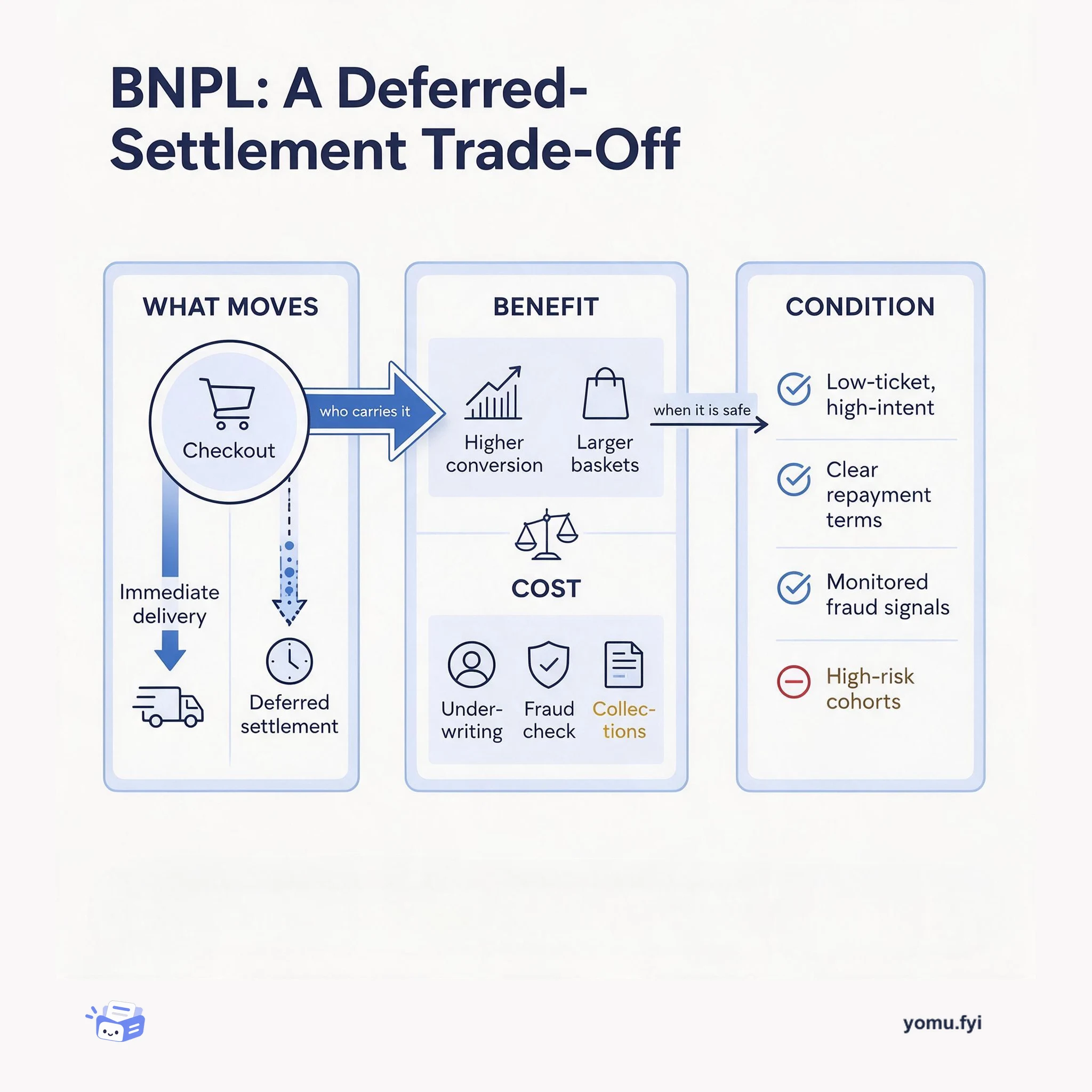
Buy Now, Pay Later is a deferred-settlement trade-off: merchants gain conversion while underwriting, fraud, and collections risk move elsewhere. This diagram maps the benefit, the cost, and the condition that decides.
Bare metal gives engineers direct control over GPU, network, and virtualization layers, but it shifts elasticity and lifecycle work onto the team. This trade-off map shows when that bargain pays off.
The Good Stuff
Paid picks we use ourselves. Links carry a referral code — a subscription through one earns us a commission at no extra cost to you.
One useful email. Unsubscribe anytime.