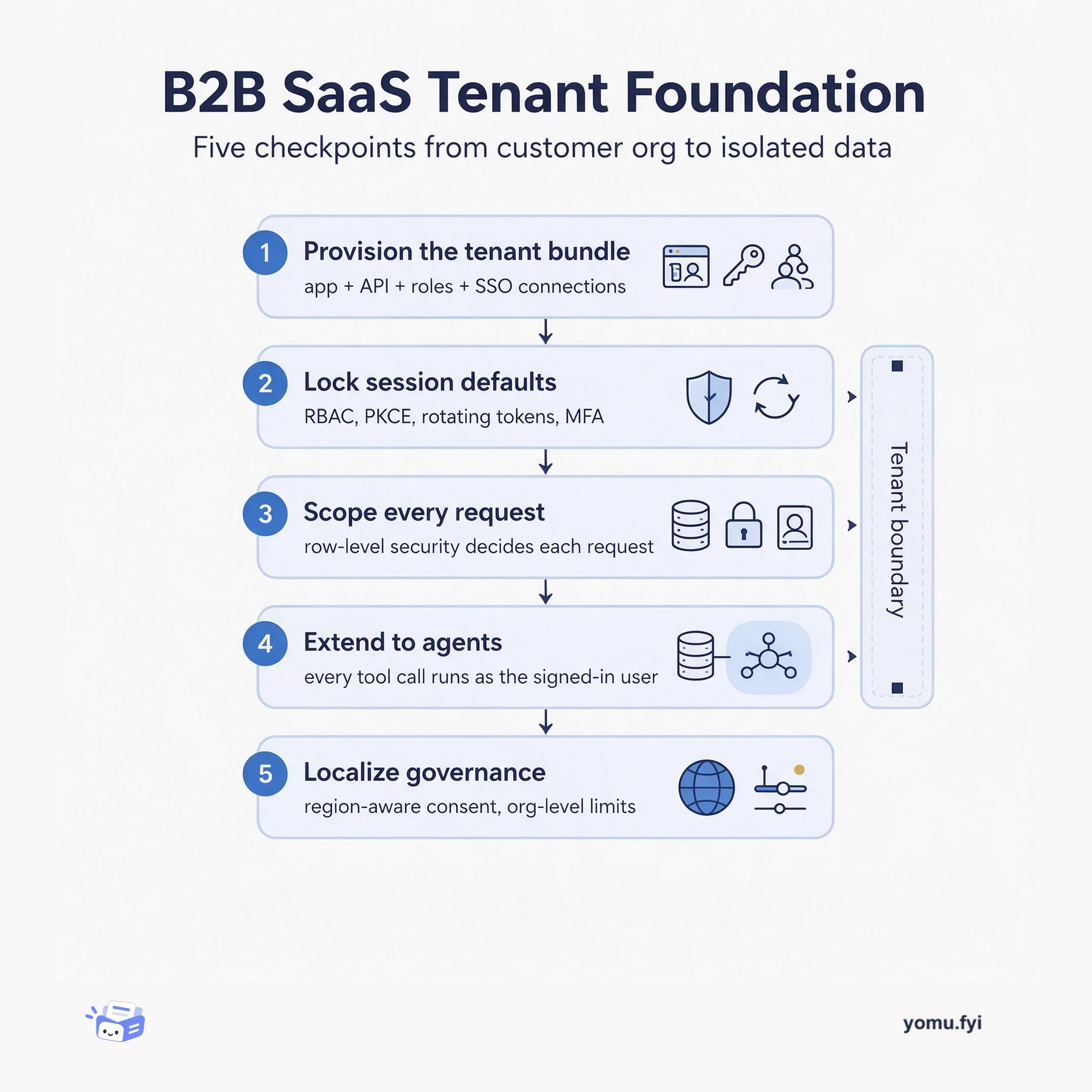
Five Checkpoints for a B2B SaaS Tenant Foundation
A five-checkpoint walkthrough of what a B2B SaaS tenant actually needs: provisioning, identity and session defaults, per-tenant data isolation, agent access, and localized governance.
 CloudflareKabin CalanAnnouncement
Cloudflare obtained South Korea’s ISMS certification after a ten-day audit by KISA-appointed auditors covering 80 controls. To comply with Korean consent laws, Cloudflare localized its sign-up page for South Korean users to display four separately listed consent items and disabled social sign-up so every account goes through that form. Country detection uses IP geolocation as a default but the user’s selected country overrides it to make the consent decision based on residency. The audit examined data flow diagrams and access controls across internal systems, websites, and the dashboard, and verified the exact wording of Korean consent notifications. ISMS certification is valid for three years with annual audits and adds a local layer atop global certifications, requiring over a year of preparation.
Cloudflare is a US-headquartered company operating a global network that serves Korean users. To comply with South Korea’s Personal Information Protection Act, it pursued ISMS certification under the ISMS-P framework, which requires an independent KISA audit and adds local compliance layers beyond global certifications like ISO 27001.
Cloudflare modified account creation for South Korean users: the sign-up page presents four separately listed consent items (three required, one optional) instead of one combined statement, and social sign-up via Google, Apple, or GitHub is disabled so every account goes through that form. The user’s country is determined by IP geolocation as a default, but the country selected at sign-up overrides it to ensure the consent decision reflects residency.
ISMS certification requires an audit by KISA-appointed auditors covering 80 controls across security policy, access control, encryption, and incident response, tailored to Korea’s Personal Information Protection Act.
To meet consent requirements, Cloudflare removed social sign-up in South Korea, forcing all account creation through the consent form that presents three required and one optional consent items.
Country detection uses both IP geolocation (default form) and the user’s selected country at sign-up, ensuring the consent decision is based on residency, not just network location.
Social sign-up flows hand users to an identity provider screen that cannot display the required individual consent items. To ensure each required consent is explicitly checked, Cloudflare removed social sign-up for that country.
The certification is valid for three years, with an annual audit required to maintain it. It adds a local compliance layer on top of global certifications like ISO 27001.
Cloudflare uses IP geolocation to set a default country code, but the user's selected country at sign-up overrides it. This prevents travelers or VPN users from being incorrectly treated as Korean residents.
Summaries are generated from the original by a language model. Check the original before relying on it.
See the idea
A five-checkpoint walkthrough of what a B2B SaaS tenant actually needs: provisioning, identity and session defaults, per-tenant data isolation, agent access, and localized governance.
Keep reading
The Good Stuff
Paid picks we use ourselves. Links carry a referral code — a subscription through one earns us a commission at no extra cost to you.
One useful email. Unsubscribe anytime.
