NVIDIA Alpamayo 2 Edge is an adaptive reasoning vision-language-action model designed for real-time operation on NVIDIA DRIVE AGX Thor. It uses a 2B Nemotron-based reasoning backbone paired with a diffusion action expert, processing surround-camera observations, temporal context, and navigation inputs to generate Chain-of-Causation reasoning and driving trajectories. The model reasons adaptively, producing tokens during routine driving to conserve inference compute. Post-trained with closed-loop reinforcement learning in NVIDIA AlpaGym, it improves closed-loop driving performance by 48.9% over the best checkpoint without closed-loop RL. NVIDIA AlpaJudge provides human-calibrated evaluation and reward signals for measuring reasoning quality and selecting training data.
Context
Autonomous vehicle developers need reasoning models that operate within onboard compute and latency limits. Larger models provide a foundation, but moving them into a vehicle requires reducing model size while preserving reasoning quality and validating performance on target hardware.
Approach / What changed
Alpamayo 2 Edge is a 2B-parameter Nemotron-based reasoning VLA model that uses adaptive reasoning (generating tokens during routine driving to conserve compute), multi-resolution surround-camera inputs, temporal context, navigation inputs, Chain-of-Causation reasoning, a diffusion action expert, speculative decoding with DFlash2, and FP8 quantization with TensorRT-Edge-LLM for real-time operation on NVIDIA DRIVE AGX Thor. It is post-trained with closed-loop reinforcement learning in NVIDIA AlpaGym.
Takeaways
1
Alpamayo 2 Edge uses adaptive reasoning, generating tokens during routine driving to reduce unnecessary token generation and conserve inference compute.
2
Closed-loop RL post-training in AlpaGym improved closed-loop driving performance by 48.9% over the best checkpoint without closed-loop RL.
3
AlpaJudge provides human-calibrated evaluation scores for reasoning traces, enabling data selection and RL reward signals in AV development workflows.
FAQ
How does Alpamayo 2 Edge conserve inference compute?
Alpamayo 2 Edge uses adaptive reasoning: during routine driving it generates special <NOMINAL> tokens instead of reasoning traces, reducing unnecessary token generation and conserving inference compute.
What is AlpaJudge and how is it used?
AlpaJudge is a human-calibrated evaluation and reward model used to evaluate reasoning traces, select higher-value training data, and provide RL rewards. It has two variants: AlpaJudge-RB (reference-based) and AlpaJudge-RF (reference-free).
What performance gains does Alpamayo 2 Edge show?
Alpamayo 2 Edge achieved a 48.9% improvement in closed-loop driving performance on top of the best-performing checkpoint without closed-loop RL, and approximately 40 times the distance between at-fault incidents in AlpaSim compared to Qwen-Drive-1.0.
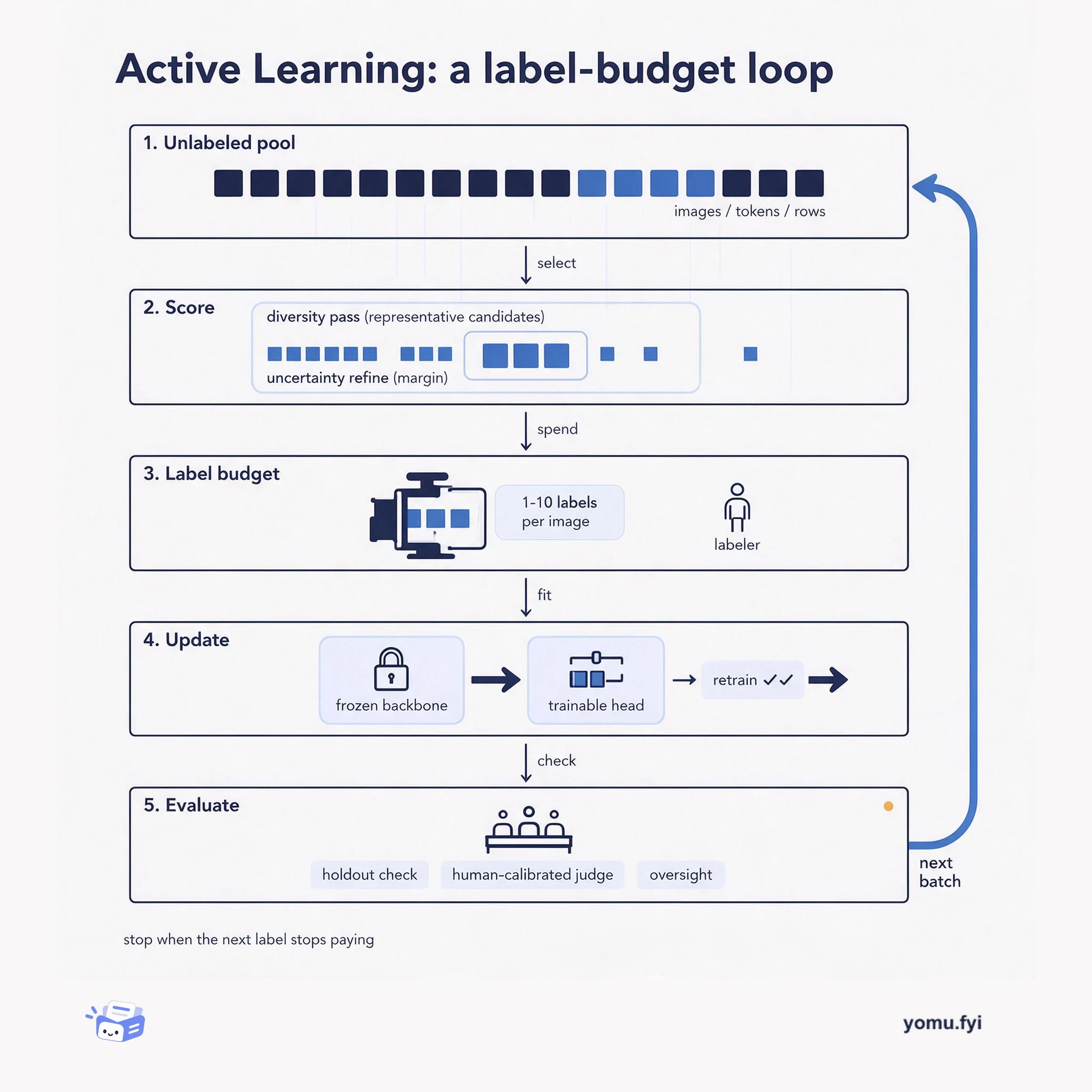
Active learning is a loop that spends a fixed labeling budget on the samples most worth annotating. This diagram maps its stages — pool, score, label, train, evaluate — and the return path that closes the cycle.
Keep reading
Related reading
The Good Stuff
Paid picks we use ourselves. Links carry a referral code — a subscription through one earns us a commission at no extra cost to you.