Bun Is a Toolkit, Not Just a Runtime
Bun packs a runtime, package manager, bundler, and test runner into one binary. Here is how those four parts fit together and where the seams still show.
 Supabaseoli_rice, inian, jonnyAnnouncement
Supabase announced a code-first approach at its Select 2026 event, enabling developers to store schema and configuration in code so coding agents can set up and modify projects end to end. Local Supabase now runs as native processes without Docker, allowing multiple instances per directory and compatibility with sandboxes like Claude Code. A new MCP server lets application users connect their own agents, authenticating through existing Auth flows and enforcing row-level security on every tool call. Operational tools include Health Check Advisors for error rates, Database Connections for session management, Explorer notebooks for unified SQL and log queries, and query_logs for agent monitoring. Scaling features encompass Multigres for multi-node Postgres high availability, OrioleDB to avoid table bloat and VACUUM, Supabase Pipelines for near real-time data streaming to analytics platforms, and dbarena for transparent benchmarks.
Coding agents can write application code but cannot set up, monitor, or fix the backend end to end. This work remains manual in the dashboard and docs.
Schema and configuration can now live in code, managed via pg-delta for migrations and supabase config pull. Local development runs as native processes without Docker. An MCP server allows users to connect their own agents. New operational features include Health Check Advisors, Database Connections, Explorer notebooks, and query_logs. Scaling includes Multigres, OrioleDB, Supabase Pipelines, and dbarena benchmarks.
Supabase now works code first: schema and configuration live in SQL files and project settings in code, enabling agents to declaratively set up and change projects.
Local Supabase runs as native processes without Docker, supporting multiple simultaneous instances per directory for parallel checkouts.
Multigres provides multi-node high availability for Postgres with built-in connection pooling, while OrioleDB replaces the heap to avoid table bloat and VACUUM.
Users connect through the new app-level MCP server, which runs as an Edge Function. They sign in through your existing Auth flow, and every tool call runs as that user, with your RLS policies determining access.
It shows which sessions hold connections, run long, or are blocked, and who holds the lock. You can then cancel a query or terminate the connection directly from the dashboard.
Use Supabase Pipelines to stream Postgres data in near real time to BigQuery, ClickHouse, DuckLake, or Snowflake. This keeps analytics queries off your production database.
Summaries are generated from the original by a language model. Check the original before relying on it.
See the idea
Bun packs a runtime, package manager, bundler, and test runner into one binary. Here is how those four parts fit together and where the seams still show.
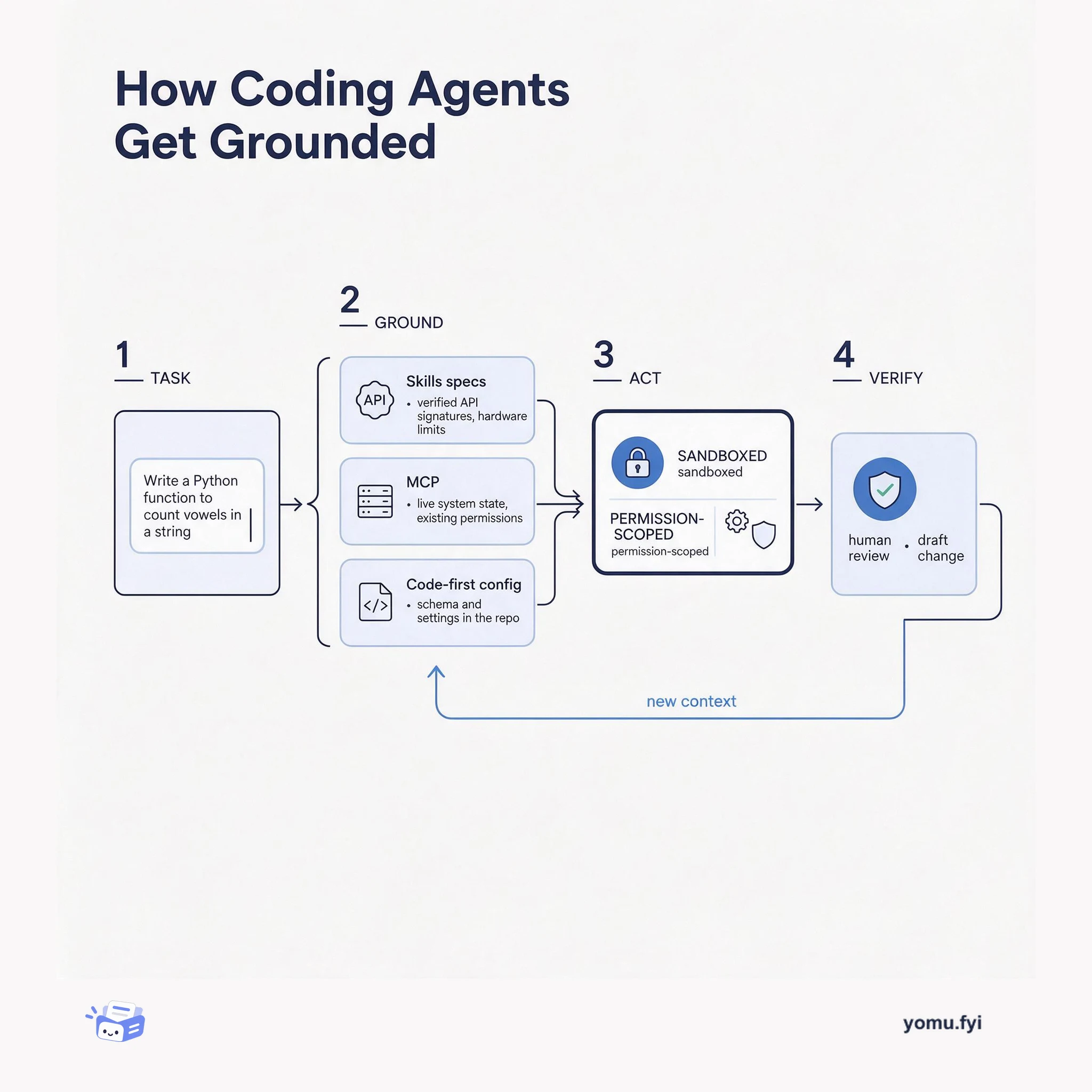
A four-stage flow showing how a coding agent moves from a task to a reviewed change by grounding on verified skills, live system state, and code-first config before it acts.
Keep reading
The Good Stuff
Paid picks we use ourselves. Links carry a referral code — a subscription through one earns us a commission at no extra cost to you.
One useful email. Unsubscribe anytime.