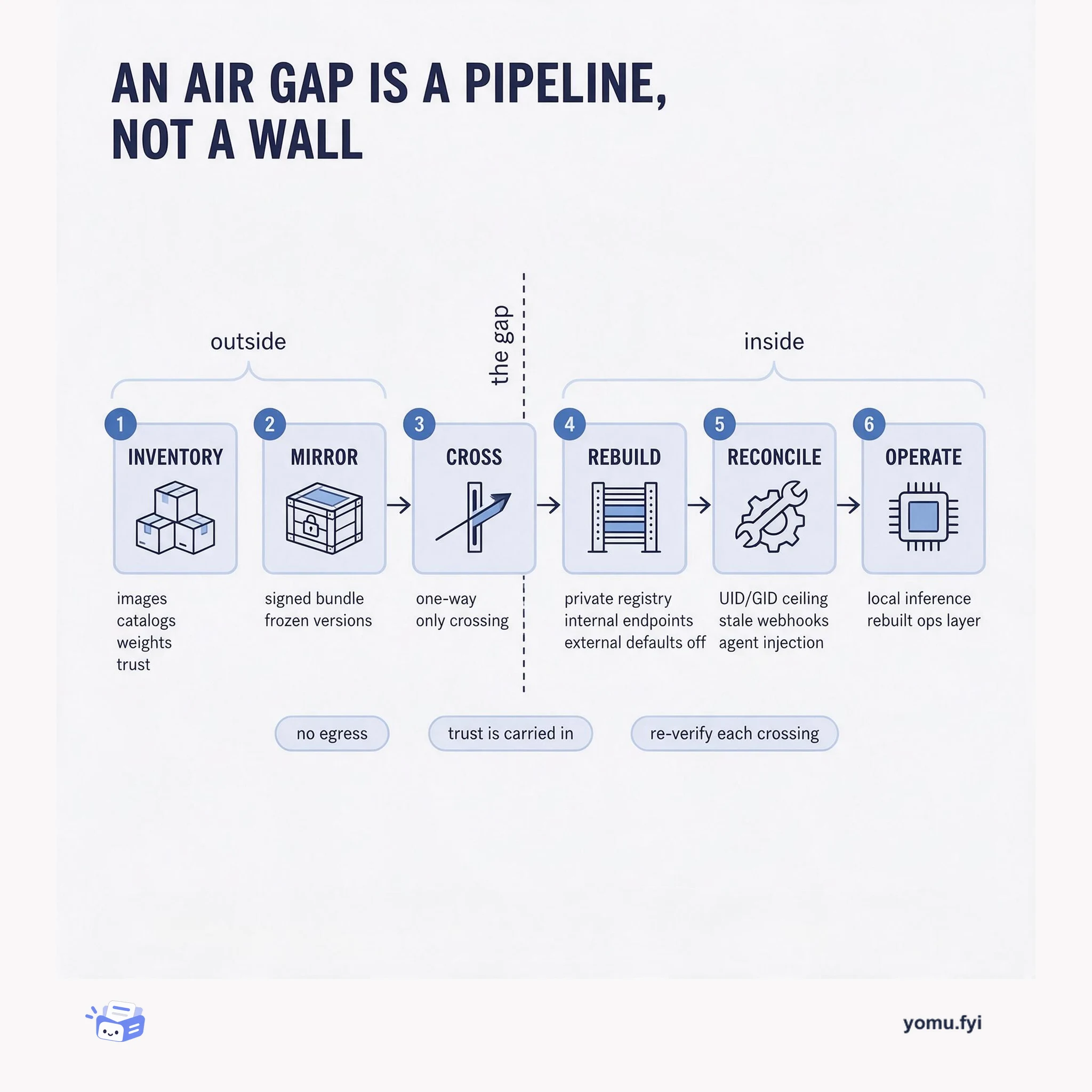
An Air Gap Is a Pipeline, Not a Wall
An air gap is a one-way artifact pipeline, not just a blocked network. This explainer follows six stages, from mirroring dependencies outside to operating inside with no egress.
 Hugging Faceben burtenshaw, merve, Pedro CuencaAnnouncement
Reflection released Beam, a 501B-parameter mixture-of-experts model with 23B active parameters per token, under the Apache 2.0 license, targeting coding and agentic use cases. The model supports a 1M-token context window using hybrid attention with 43 sliding-window and 9 global layers, and a residual stream that scales sublayer outputs by 1/sqrt(k) to maintain constant magnitude. Its MoE router uses a group-limited scheme with 256 experts, 8 routed per token, and the BF16 checkpoint occupies about 1 TB. Benchmarks show strong performance: 81.6% on SWE-bench Verified, 97.7% on AIME 2026, and 90.6% on GPQA Diamond, with minimal degradation in FP8 and NVFP4 quantizations. The model ships with a Rust-based harness, day-0 support in transformers, vLLM, and SGLang, and includes SFT and RL recipes, with a $10,000 Hub credits competition for community projects.
Beam is the first open model from Reflection, a new US AI lab, released on Hugging Face. It is a 501B MoE model designed for long-context reasoning and agentic tasks, with a focus on coding. The model is fully open under Apache 2.0, allowing customization and self-hosting.
The model uses a sparse mixture-of-experts architecture with 256 experts, 8 active per token, and hybrid attention with 43 sliding-window and 9 global layers. It includes a Rust-based harness for optimal performance and supports multiple quantization formats (BF16, FP8, NVFP4). The post provides recipes for inference, supervised fine-tuning, and reinforcement learning using transformers, vLLM, and SGLang.
Beam is a 501B MoE model with 23B active parameters per token, offering the capacity of a large model with the speed of a smaller one.
The model achieves strong results on coding and reasoning benchmarks, including 81.6% on SWE-bench Verified and 97.7% on AIME 2026.
Beam is fully open under Apache 2.0, with day-0 support in major inference libraries and a Rust-based harness for self-hosting.
The NVFP4 checkpoint requires about 280 GB and runs natively on Blackwell GPUs; FP8 checkpoints are suitable for Hopper and Ampere GPUs. Two B200 GPUs (360 GB) can hold the weights.
Beam uses hybrid attention: 43 sliding-window layers cache only 512 tokens each, while 9 global layers cache the full sequence, reducing KV cache growth to 36 KiB per token.
Beam checkpoints are available in BF16, FP8, and NVFP4 formats. NVFP4 stores most parameters in 4-bit precision for Blackwell GPUs, while FP8 is for older GPUs.
Summaries are generated from the original by a language model. Check the original before relying on it.
See the idea
An air gap is a one-way artifact pipeline, not just a blocked network. This explainer follows six stages, from mirroring dependencies outside to operating inside with no egress.
Keep reading
The Good Stuff
Paid picks we use ourselves. Links carry a referral code — a subscription through one earns us a commission at no extra cost to you.
One useful email. Unsubscribe anytime.
