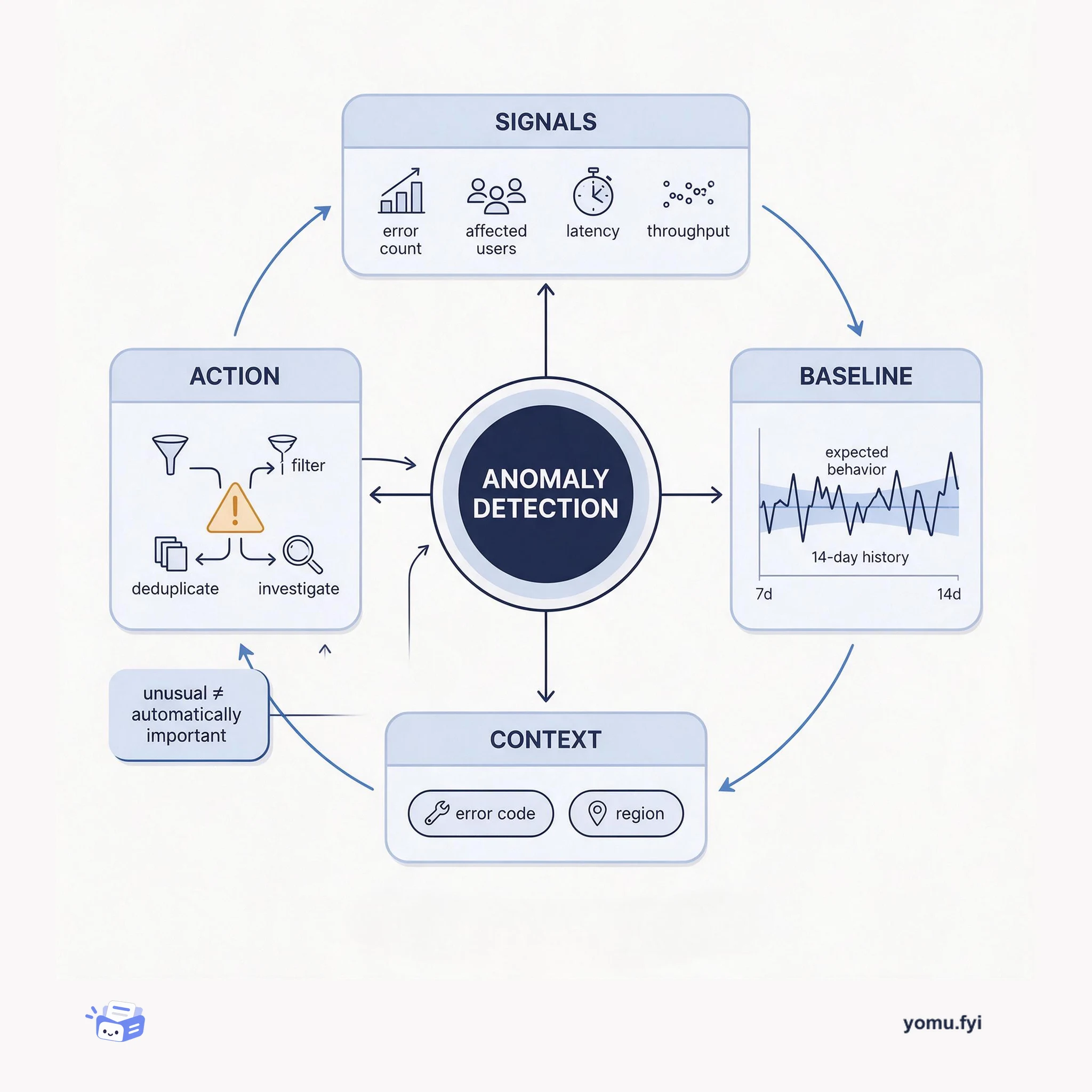
Anomaly Detection: From Baseline to Action
Anomaly detection identifies meaningful departures from expected behavior. This explainer shows how signals, baselines, context, and alert routing turn unusual measurements into engineer-ready findings.
 DatabricksDatabricks StaffExplainer
Agentic analytics is an approach in which autonomous AI agents continuously monitor data, detect patterns and anomalies, generate contextual insights, and take actions with minimal human intervention. Unlike traditional business intelligence, which relies on people to query dashboards and interpret reports, these systems operate as goal-directed decision loops that can recommend or trigger alerts, forecasts, workflows, and system changes within defined boundaries. Their architecture combines data access, agent orchestration, LLM-based reasoning, a semantic layer, action integrations, and feedback signals. The source identifies faster insight, lower reporting overhead, reduced analytics backlogs, and potentially better forecasting as benefits, while stressing governance, auditability, security, monitoring, and human oversight to control errors and unintended outcomes.
Agentic analytics moves analytics from static, human-driven reporting toward continuous systems that sense changes, reason about context, explain findings, recommend actions, and execute workflows. It can work across structured and unstructured data from enterprise systems, cloud platforms, documents, logs, APIs, and real-time streams, while integrating with existing BI platforms and data warehouses.
The explicit approach is a closed-loop workflow: ingest data, analyze trends or anomalies, explain what is happening and why, recommend actions, and act by triggering workflows, alerts, reports, or system changes. A layered architecture supports this loop through data access, agent orchestration, LLM or other AI reasoning, semantic business context, action integrations, and feedback signals. Governance, access controls, monitoring, auditability, approval workflows, and human-in-the-loop checkpoints help constrain agent behavior.
Agentic analytics uses an ingest-analyze-explain-recommend-act loop rather than producing only static reports.
A semantic layer gives agents business meaning for metrics, logic, and relationships, while orchestration coordinates multi-step planning and tool use.
Human-in-the-loop checkpoints, approval workflows, policies, auditability, and monitoring help control errors and unintended outcomes.
Traditional BI focuses on human-driven interpretation of reports and dashboards. Agentic analytics enables AI agents to analyze data, generate insights, and initiate decisions or workflows within defined boundaries.
Agents evaluate data using machine-learning models, rules, and contextual signals. Their decisions follow predefined policies, and systems can escalate to humans when needed.
Yes. Errors can occur when data shifts or edge cases arise. Human-in-the-loop checkpoints, approval workflows, guardrails, and real-time monitoring can help prevent unintended outcomes.
Summaries are generated from the original by a language model. Check the original before relying on it.
See the idea
Anomaly detection identifies meaningful departures from expected behavior. This explainer shows how signals, baselines, context, and alert routing turn unusual measurements into engineer-ready findings.
Keep reading
The Good Stuff
Paid picks we use ourselves. Links carry a referral code — a subscription through one earns us a commission at no extra cost to you.
One useful email. Unsubscribe anytime.
