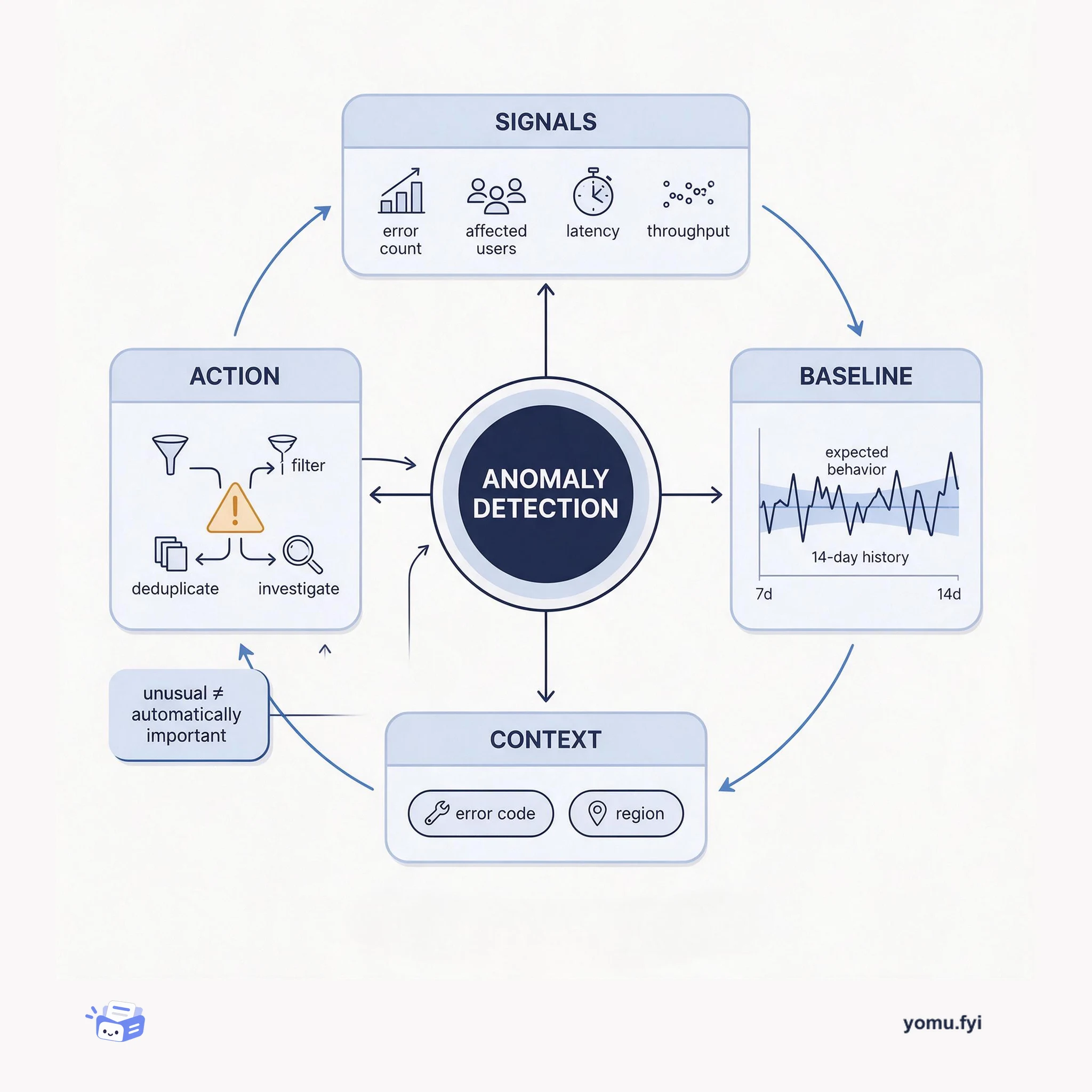
Anomaly Detection: From Baseline to Action
Anomaly detection identifies meaningful departures from expected behavior. This explainer shows how signals, baselines, context, and alert routing turn unusual measurements into engineer-ready findings.
Loading…
Topic
2 posts about Anomaly Detection. Every summary links to the original.
See the idea
Anomaly detection identifies meaningful departures from expected behavior. This explainer shows how signals, baselines, context, and alert routing turn unusual measurements into engineer-ready findings.
The Good Stuff
Paid picks we use ourselves. Links carry a referral code — a subscription through one earns us a commission at no extra cost to you.
Newest first
Data teams frequently field questions about future sales, metric movements, and anomalous data, but answering them typically requires data science teams to build and manage models, creating a bottleneck. Predictive AI Functions, now in Beta, remove that bottleneck by providing SQL-native functions for forecasting, driver analysis, and anomaly detection, backed by state-of-the-art ML models maintained centrally by Databricks. The launch includes ai_forecast for time series projection, ai_top_drivers for segment driver analysis, ai_detect_anomalies for outlier detection, and ai_predict_value and ai_predict_class for regression and classification. These functions can be called directly in SQL, invoked through Genie with plain-language questions, or embedded in dashboards, delivering consistent, high-quality answers without infrastructure management. Benchmarking on fev-bench shows ai_forecast outperforms forecasting functions from leading cloud data warehouses, achieving industry-leading accuracy out of the box with no tuning required.
Gray failures are partial customer-facing problems that can leave health checks green while a subset of users quietly fails. RADAR (Reliability Anomaly Detection, Alerting, and Root-cause analysis) addresses this gap by collecting error counts and distinct affected users, segmented by error code and region, then applying the unsupervised streaming SPOT model. SPOT learns normal behavior from the previous 14 days using a single risk parameter, while downstream stages enrich, filter, deduplicate, and route alerts before providing anomaly details and AI/BI Genie-backed dashboards for investigation. Running RADAR internally reduced incident-discovery time by 95% with over 90% precision and no human needed to spot the pattern. The post also describes a Databricks scaffold that maps metrics, detection, alerting, and root-cause analysis to platform components and can be assembled by an AI agent from a metric, scaffold, and prompt.
The best engineering reads, once a week.

