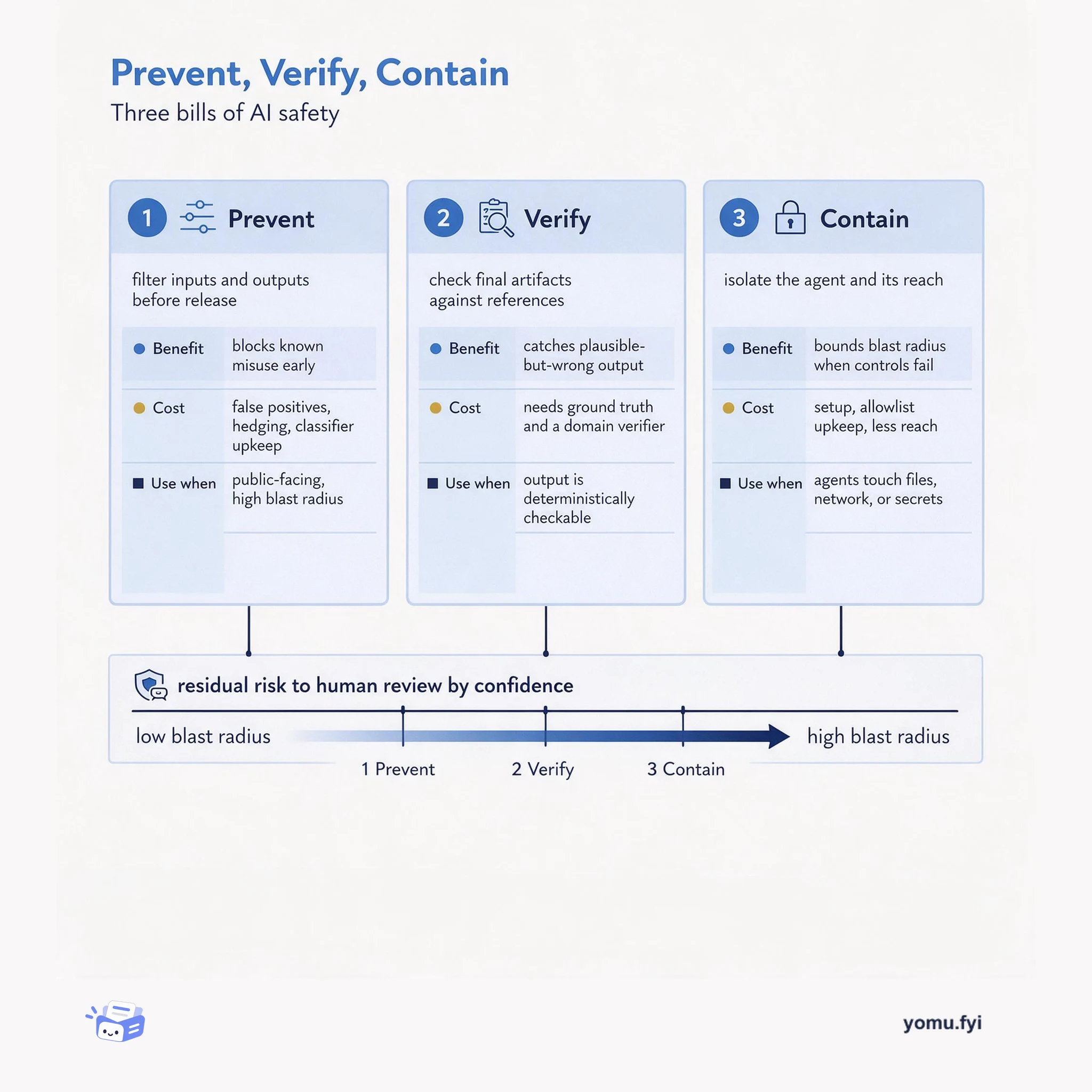
Prevent, Verify, Contain: The Three Bills of AI Safety
AI safety is a budget: prevention, verification, and containment each buy different protection at a different cost. This map shows what each control costs and when it pays off.
A model that passes benchmarks can still defect only on a trigger. This explainer maps the trade-off between deeper backdoor verification and the friction, latency, and cost it adds.
Backdoors in third-party models are not one artifact you can delete; they can hide in weights, adapters, chat templates, training data, or MoE routing, and each surface needs a different defense. Defending them is a trade-off: every extra stage of verification shrinks blind spots but adds latency, compute, and process friction to model intake. This explainer lays out what deeper verification buys, what it costs, and the conditions that justify paying for it. The aim is to treat model intake as an auditable supply-chain decision rather than implicit trust in a benchmark score.
They cover different failure modes, so the trade-off is depth versus placement. Scanning is cheaper per artifact but cannot prove absence, and the intake process should assume some malicious artifact will pass the scanner. Runtime guardrails catch what slips through, which is why the useful stance is a multi-stage intake process rather than picking one layer.
Grade on observed state and side effects, not on a model's self-report. In a 121,680-trial benchmark, 79,853 attempts failed executable checks while 67.24% of those still terminated cleanly and called a state-changing tool without error, with wrong field values in 77.61%. Running each task many times and measuring consistency separates real dependability from a lucky pass.
The posts behind it
 Hugging Face · · Benchmark
ThinkingBox, a benchmark from Microsoft and Hugging Face, grades AI agents on the database state and side effects they leave behind rather than on tool calls or final responses. In a common-set ablation covering 121,680 valid trials across 12 LLM models, 79,853 attempts failed executable checks, and 67.24% of those failures still terminated cleanly and invoked a state-changing tool without error, with wrong field values in 77.61% of them. The benchmark runs every task 20 independent times from identical clean backends, reporting pass@1, pass@20, and observed 20/20 consistency to separate capability from reliability. For example, Kimi-K3 solved 93.89% of tasks at least once but only 13.41% consistently, while Claude Opus 5 completed 47.53% of tasks on every attempt, and Claude Opus 5.5 gained no additional dependability over its predecessor despite higher pass@1. ThinkingBox is available through Hugging Face’s OpenEnv with MIT-licensed code and CDLA-Permissive-2.0 benchmark data.
 Red Hat · · Benchmark
Enterprise generative AI applications require guardrails that balance flexibility with reliability. Decision models such as TypeSafe AI’s Jev produce fixed decisions with guaranteed schema and type safety, operating faster and cheaper than LLM-as-a-judge approaches. The Red Hat AI Safety team benchmarked nine guardrails across four methodologies for prompt injection and content safety tasks: pre-trained CPU-scale classifiers like Red Hat’s DeBERTa-v3 and Granite Guardian HAP-125m, older zero-shot models like BART-large-mnli, modern LLM-as-a-judge safety models including Shieldstral and Nemotron-3.5, and Jev-style decision models including Laya and DiffusionGemma. Each guardrail was evaluated using stock and custom risk policies, with Jev and DiffusionGemma using zero-shot questions. The results highlight trade-offs: Jev provides zero-shot flexibility and low latency, but purpose-built classifiers often match its speed and cost while delivering superior task-specific performance, and LLM-as-a-judge models can be tuned for higher accuracy.
 Cloudflare · · Announcement
Cloudflare’s new Account Abuse Protection dashboard helps fraud teams investigate account abuse by moving beyond stateless identity checks to a stateful trust model. The dashboard uses cryptographically hashed identifiers, called Hashed User IDs, created from customer-provided identifiers like email or username, to anchor account activity across login and signup events. It provides an account population overview with metrics like total events, unique IPs, and devices to spot anomalies such as leaked credential matches or unusual login failure rates, then allows analysts to filter and drill into individual accounts. Each account view shows historical behavioral, network, and device signals, enabling teams to reconstruct events and decide on responses like WAF rules. The dashboard also introduces two new roles—Account Abuse Protection and Account Abuse Protection PII—to enforce least privilege for dashboard access and PII exposure.
 Auth0 · · Problem & solution
Enterprises centralize authentication into a single Auth0 environment but must comply with frameworks like PCI-DSS, HIPAA, and SOC 2 that restrict data to private channels. Auth0 Outbound PrivateLink provides a secure unidirectional connection between Auth0 and AWS infrastructure, avoiding the public internet. However, a single PrivateLink connection per environment cannot directly reach multiple isolated VPCs for staging and production. The Intelligent Gateway Pattern solves this by deploying an API gateway or reverse proxy at the PrivateLink termination point to fan out traffic. Auth0 Actions append context such as custom headers like X-Target-Env or specific paths, and the gateway inspects these to route requests to the appropriate isolated VPC, decoupling secure transport from internal routing. This pattern unblocks identity consolidation by allowing a single Auth0 tenant to serve both staging and production workloads while maintaining strict VPC isolation.
Red Hat · · ExplainerPulling a model from Hugging Face and running benchmarks does not guarantee the model will behave the same in production. Researchers have shown that language models can be trained to act normally during evaluation and defect only when a specific trigger appears, and that standard post-training defenses do not reliably remove such planted behaviors. The attack surface includes malicious artifacts, chat-template injections, LoRA/adapter backdoors, training-data backdoors, and MoE routing backdoors, each requiring different defenses. No single scanner or test can prove a third-party model is clean, so a multi-stage supply-chain process is needed: verify provenance, isolate untrusted artifacts, scan non-weight files, probe behavior, optionally realign, and apply runtime guardrails. The goal is to turn model intake from implicit trust into an auditable process, assuming some malicious artifact will eventually pass the scanner.
More like this
AI safety is a budget: prevention, verification, and containment each buy different protection at a different cost. This map shows what each control costs and when it pays off.
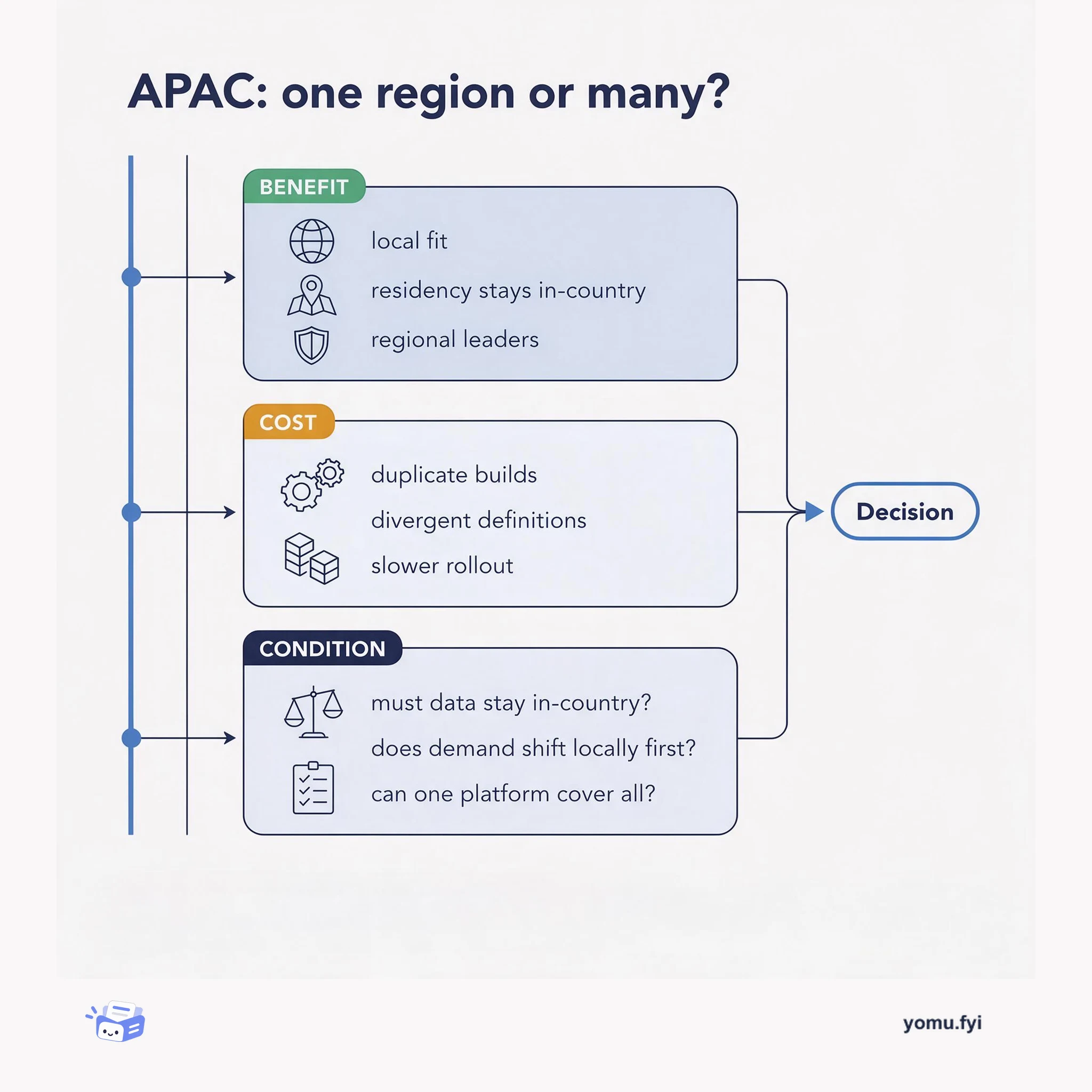
APAC is a federation of markets, not a single deployment region. This diagram maps the tradeoff between local autonomy and one shared platform, and the conditions that decide it.
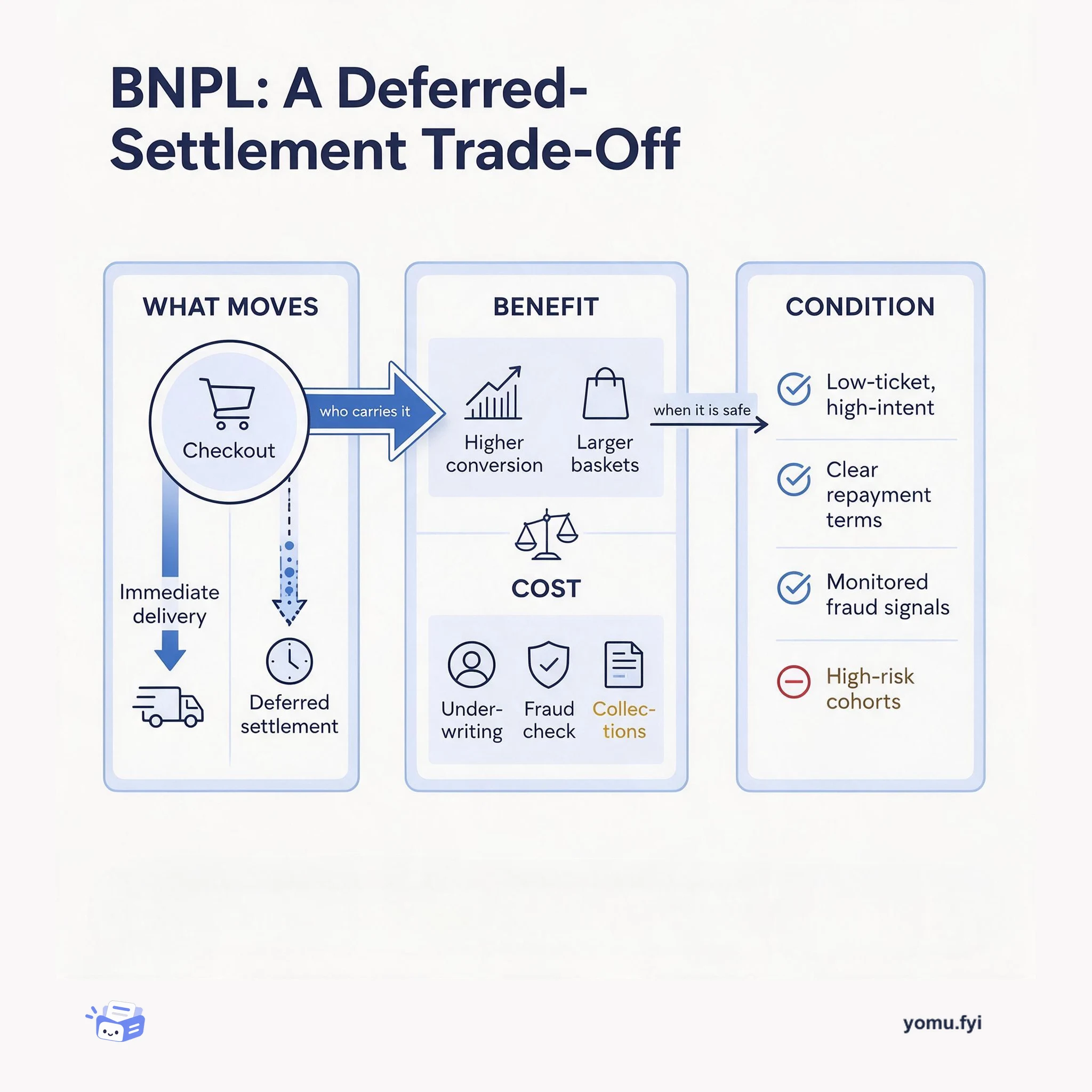
Buy Now, Pay Later is a deferred-settlement trade-off: merchants gain conversion while underwriting, fraud, and collections risk move elsewhere. This diagram maps the benefit, the cost, and the condition that decides.
The Good Stuff
Paid picks we use ourselves. Links carry a referral code — a subscription through one earns us a commission at no extra cost to you.
One useful email. Unsubscribe anytime.