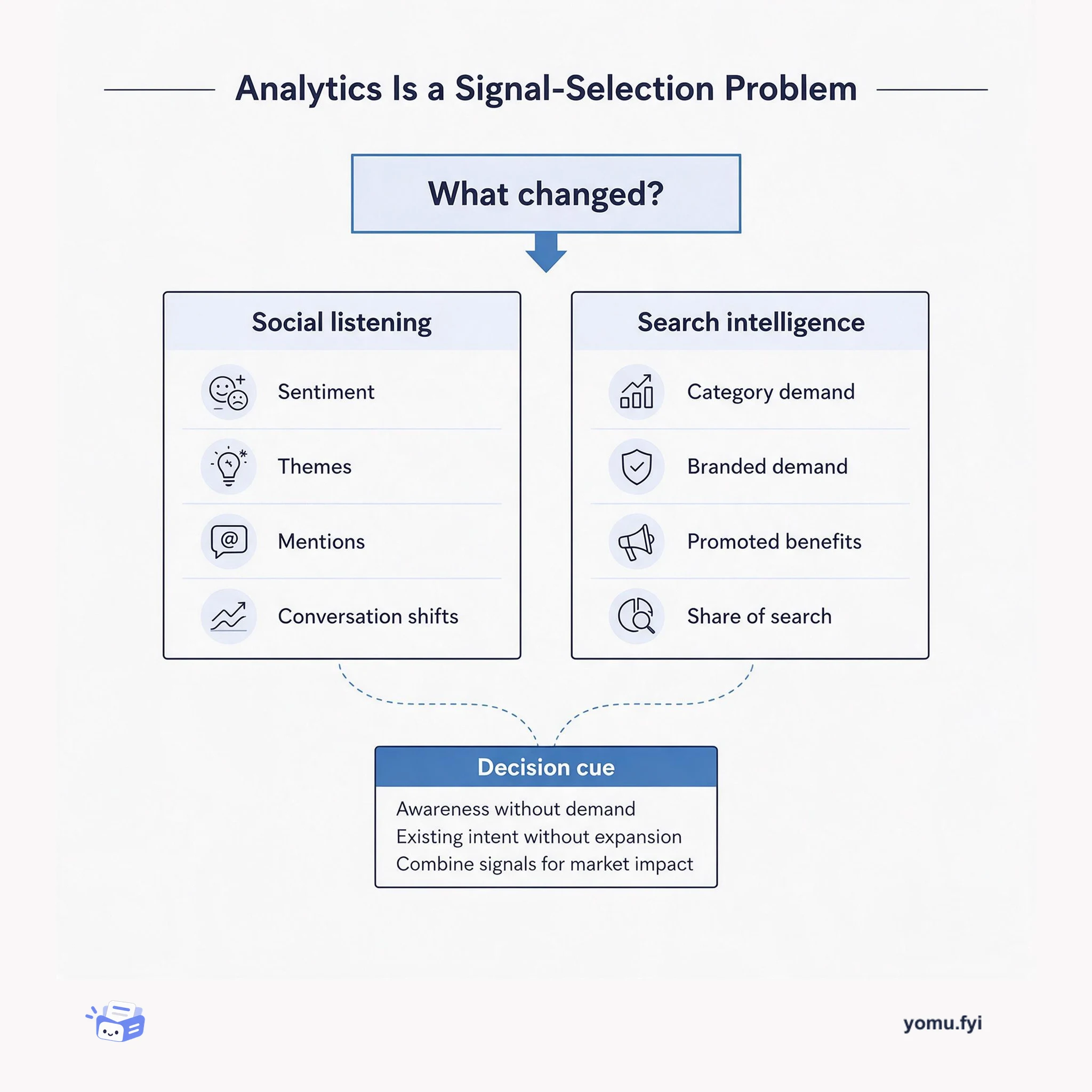
Analytics Is a Signal-Selection Problem
Compare social listening with search intelligence to see which signals answer questions about perception, demand, and campaign impact—and when combining them is more useful.
Loading…
Topic
66 posts about Data Analytics. Every summary links to the original.
See the idea
Compare social listening with search intelligence to see which signals answer questions about perception, demand, and campaign impact—and when combining them is more useful.
Apache Arrow is a columnar in-memory format that lets databases, analytics engines, and Python libraries share data without serialization overhead or format conversion, cutting memory peaks and speeding up common workflows.
The Good Stuff
Paid picks we use ourselves. Links carry a referral code — a subscription through one earns us a commission at no extra cost to you.
Newest first
The guide presents dashboards as automatically updated collections of visualisations or metrics for monitoring business questions and argues they should be built with a product-thinking approach. It first recommends deciding whether a dashboard is appropriate, then defining one clear goal, a specific audience, and metrics that reflect their needs before sketching the layout with stakeholders. Implementation guidance covers readable and efficient queries, version control, peer review, visual hierarchy, restrained content, business and data context, refresh frequency, technical reviews, and user sign-off. After launch, teams should market the dashboard, make it discoverable, monitor usage and outcomes, iterate when it falls short, and assign ownership for maintenance. The intended outcome is a dashboard that stays useful and delivers business impact by keeping users front and centre.
Correlation does not establish causation, so the post presents causal inference as a way to determine why product metrics change and to validate or invalidate business strategies. The proposed evidence ladder places randomized A/B tests first, quasi-experiments such as fixed-effects regression and difference-in-differences second, and counterfactual estimation third, with descriptive statistics providing no direct causal evidence. It explains that quasi-experiments use non-random treatment and control divisions, while difference-in-differences depends on a parallel-trends assumption and fixed-effects regression assumes relevant dividing factors were collected. For a security update released to everyone, the team trained a time-series model on unaffected feature usage and global activity trends, then found no lift versus actual usage, indicating no negative effect on usage. Because observational methods bring greater uncertainty and frequent false positives, the post recommends stating assumptions, relaxing them through robustness checks, and using DAGs and Dagitty to test causal hypotheses.
Application databases often retain only current values in Type 1 dimensions, limiting analysis of historical settings such as feature adoption, retention, and switching behavior. The post explains Type 2 dimensional models through Shopify’s need to track users’ admin languages over time, contrasting application-model changes, scheduled database snapshots, and event logging. Its selected implementation uses Rails after_commit callbacks to send created or updated records to Kafka, then transforms that event history into records with valid_from, valid_to, and is_current fields using ETL recipes involving PySpark and dbt. The approach provides the required granularity but can miss changes or events, requires delete handling and data-quality checks, and is presented as an iterative solution; MySQL binlogs are described as a more reliable future source.
An analysis of 1.6 million social-media mentions from January 1 to June 30, 2020 examines consumers’ “unpopular opinions” and compares Reddit with Twitter. Overall mentions rose 34% from March through June versus the preceding four months, while Reddit’s r/unpopularopinions posts increased 105% during that period. Across online sources, pop-culture characters generated 63,000 mentions, followed by TV shows at 55,000, fandoms at 45,000, and books at 44,000; Friends was criticised for aspects considered unacceptable today. Reddit contributed 958,000 mentions, including 19,000 about subreddits, while Twitter contributed 554,000, led by 15,000 movie and TV opinions. The platform breakdown also surfaces differences such as Reddit’s meta discussions and Twitter’s opinions about money, chocolate, and ice.
Shopify’s Data Science & Engineering team describes the foundations it uses to provide daily insights to internal teams, merchants, and partners across a rapidly changing commerce ecosystem. Its data warehouse follows a shared dimensional-modelling philosophy, with modelled data built on Spark in a single GitHub repository and made broadly queryable through Presto, while ETL jobs are unit tested and prevented from failing silently. Centralized dashboards, reproducible vetted data points, peer review, product-aligned sub-teams, accessible communication, and cross-team collaboration extend those foundations into analysis and decision-making. Together, these practices let team members reuse existing work, produce trusted and understandable metrics, address the specialist gap through collaboration, and derive new metrics with fewer than 50 lines of SQL.
Shopify’s 2019 bug bounty review describes experiments and process improvements intended to increase program speed, while reporting changes in response, resolution, disclosure, and bounty metrics. Shopify-Experiments, a private program launched in mid-2019 for high-signal, high-impact hackers, tested expanded scope, full payment after triage, disclosure requirements, self-closing false positives, and collaboration with third-party developers. Using registration data, HackerOne API exports, and a Slack chatbot, the team improved program analytics and automated report-state changes, assignments, comments, bounty suggestions, and common invalid-report closures. Average first response fell to 16 hours, triage to 2 days and 13 hours, bounty payment to 7 days and 1 hour, and post-triage resolution to 20 days and 3 hours; disclosures rose to 74 bugs. For 2020, Shopify announced full bounty payment within seven days of triage, a $50,000 maximum bounty, higher payouts for several vulnerability classes, and added visibility for duplicate reports.
The best engineering reads, once a week.