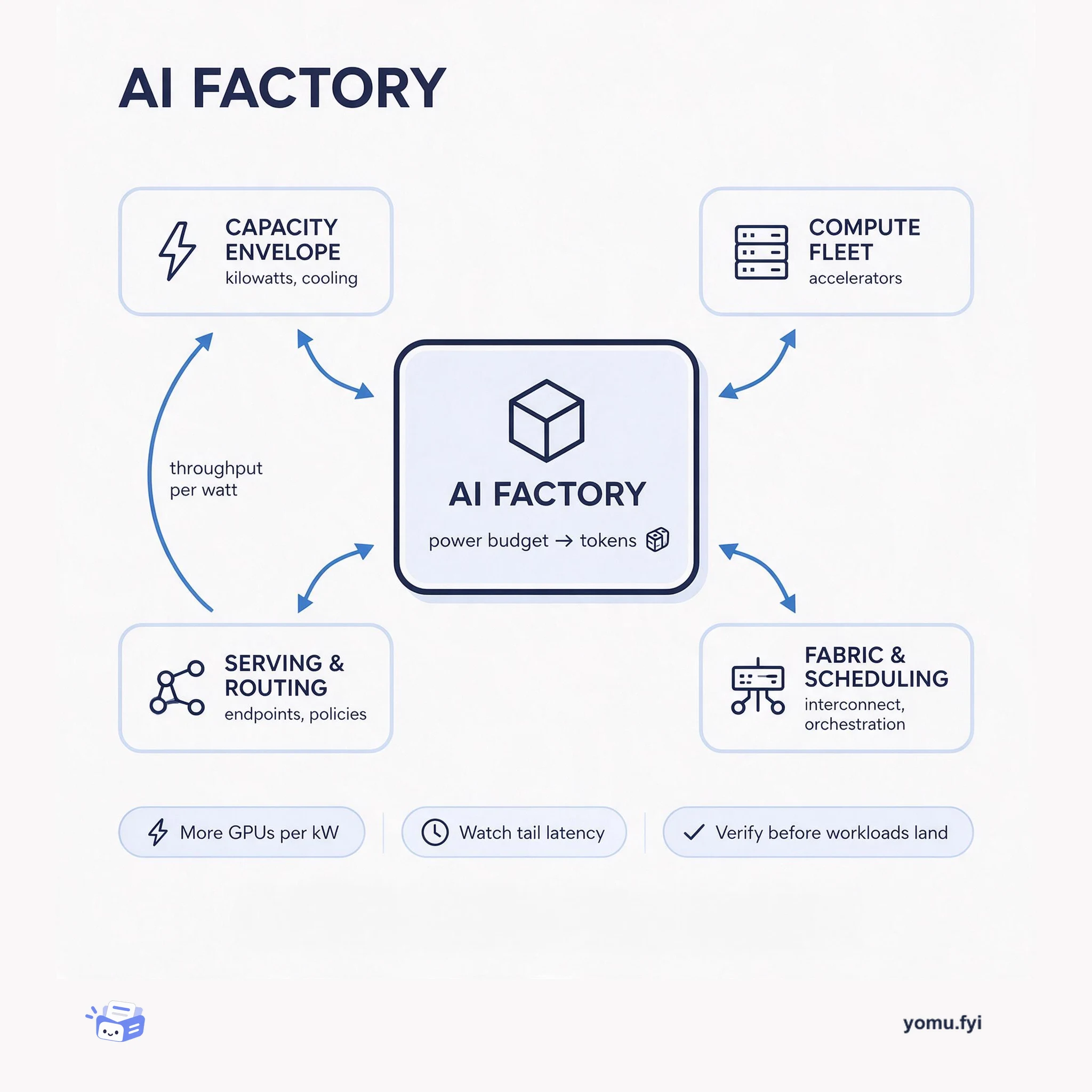
What Is an AI Factory? Power In, Tokens Out
An AI factory is a fixed power and cooling budget converted into model output. This explainer maps its four parts and the throughput-per-watt trade-offs that connect them.
Loading…
Topic
4 posts about Data Centers. Every summary links to the original.
See the idea
An AI factory is a fixed power and cooling budget converted into model output. This explainer maps its four parts and the throughput-per-watt trade-offs that connect them.
The Good Stuff
Paid picks we use ourselves. Links carry a referral code — a subscription through one earns us a commission at no extra cost to you.
Newest first
Anthropic announces a $50 billion investment in American computing infrastructure, with data centers being built by Fluidstack in Texas and New York and additional sites planned. The facilities are custom built for Anthropic, with efficiency for its workloads intended to support continued frontier research and development. Sites are expected to come online throughout 2026, creating approximately 800 permanent jobs and 2,400 construction jobs, while the project is described as supporting goals in the Trump administration’s AI Action Plan and domestic technology infrastructure. Anthropic says the investment is needed to meet demand from hundreds of thousands of businesses using Claude; it reports more than 300,000 business customers and nearly sevenfold growth in large accounts over the past year. Fluidstack was selected for its ability to deliver gigawatts of power rapidly, and Anthropic says it will continue pursuing cost-effective, capital-efficient ways to scale.
Anthropic says it will cover electricity price increases that consumers face from its data centers as AI infrastructure expands in the United States. Training a single frontier model will soon require gigawatts, while the US AI sector may need at least 50 gigawatts of capacity over the next several years, creating costs through grid upgrades and tighter electricity markets. The company commits to pay 100% of grid interconnection upgrades, bring net-new generation online, cover estimated demand-driven price effects where necessary, and reduce peak demand through curtailment and grid optimization. It also describes jobs, water-efficient cooling, local partnerships, and support for permitting and transmission reforms, while noting that these commitments are an initial effort and that leased capacity requires further work.
Anthropic plans to open an office in Sydney in the coming weeks, making it the company’s fourth Asia-Pacific office alongside Tokyo, Bengaluru, and Seoul. The expansion responds to strong demand in Australia and New Zealand and is intended to support their distinct AI ecosystems, with initial attention on enterprise, startup, and research customers. Anthropic says it will hire locally, deepen engagement with Australian institutions, pursue partnerships in national-interest and priority sectors, and explore additional compute capacity through third-party infrastructure already in place, partly to address data-residency requirements. Australia and New Zealand rank fourth and eighth globally in Claude.ai usage relative to population, while reported usage is especially strong for computer and coding tasks, educational instruction, and research.
Shopify outgrew its ability to scale by buying larger database servers, so it introduced database sharding in 2015. Sharding improved performance and horizontal scalability but made actions dependent on every shard, increasing the risk of platform-wide unavailability. In 2016, Shopify reorganized its runtime around pods: each pod groups shops on isolated datastores, while shared workers, application servers, and load balancers are restricted to one pod at a time. Sorting Hat assigns each request to a pod and location, while every web request and delayed job is kept within one pod; paired data centers and Pod Mover support recovery without dropping requests or jobs. The design makes a pod the unit for scalability, resiliency, and disaster recovery, and simplifies evacuating an entire data center.
The best engineering reads, once a week.


