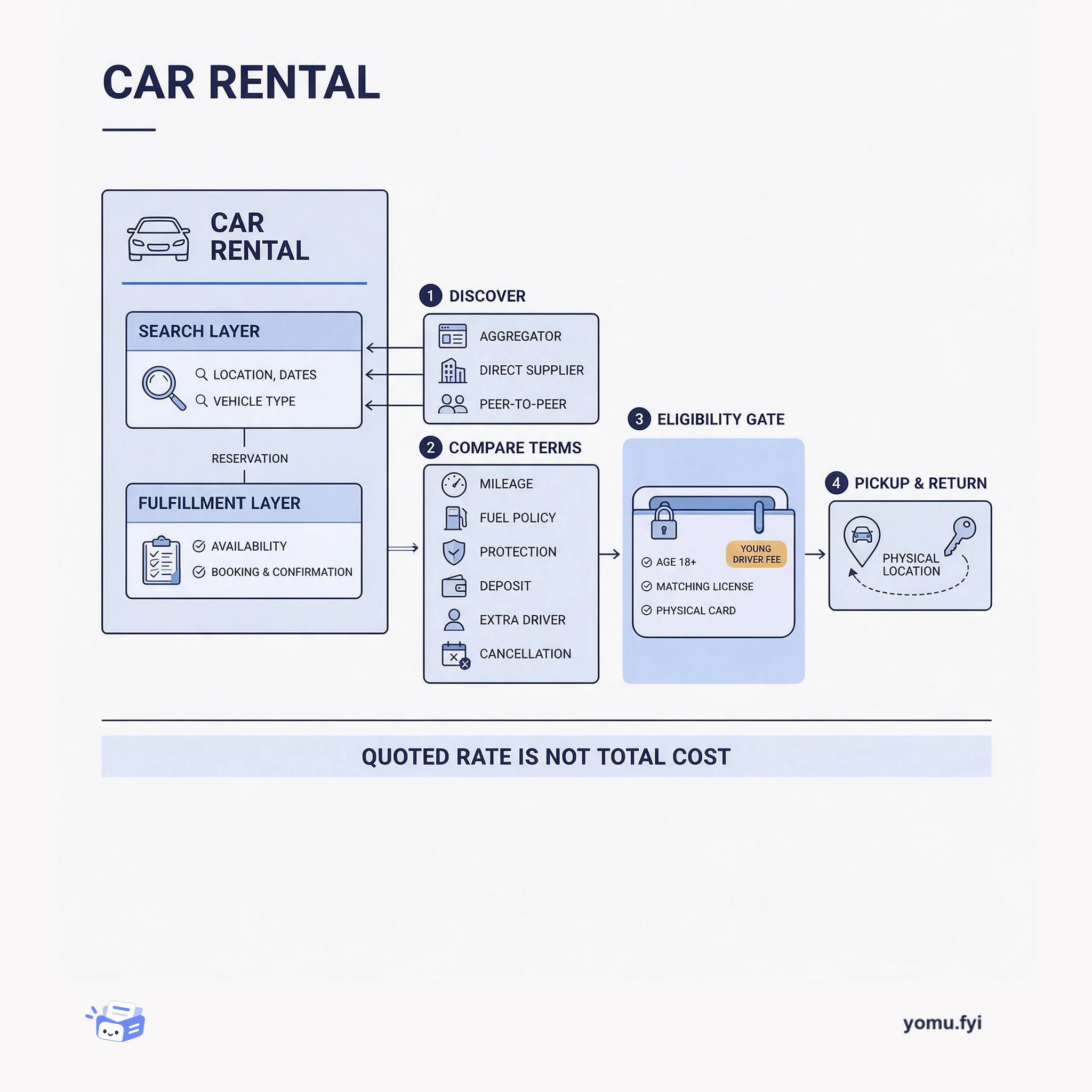
Car Rental: A Search Layer, a Contract, and a Handover
A car rental is a search layer over many fleets plus a contract enforced at the counter. This explainer maps its four parts and why the advertised daily rate never equals the total cost.
Loading…
Topic
29 posts about Pricing. Every summary links to the original.
See the idea
A car rental is a search layer over many fleets plus a contract enforced at the counter. This explainer maps its four parts and why the advertised daily rate never equals the total cost.
The Good Stuff
Paid picks we use ourselves. Links carry a referral code — a subscription through one earns us a commission at no extra cost to you.
Newest first
The post compiles insights from Intercom’s 50th podcast episode, featuring product leaders Bob Moesta, Julie Zhuo, Michael Pryor, and Jason Fried on topics from customer jobs to pricing and product overhaul. Bob Moesta explains that new products always replace existing consumption; understanding what customers stop doing reveals the job to be done, as there is no new time in the world. Julie Zhuo describes a hierarchy where utility is foundational, then ease of use, and finally emotional appeal differentiates products when utility is equal. Michael Pryor shares that Trello initially avoided charging but user fear of shutdown forced them to introduce a simple pricing model, and they debated per-user versus flat fees. Jason Fried advocates for periodic ground-up rebuilds when new ideas cannot be retrofitted, supporting old versions indefinitely and not forcing upgrades.
At the first Inside Intercom World Tour stop in London, startup founders Bridget Harris, Will Swannell, and James Blackwell shared insights on building great products. On pricing, James advised setting it at the high end you think you can get away with, while Bridget regretted offering a free product that forced later price increases; Will argued simplicity is key, with the cost answer in two words. For hiring, Bridget uses a process of elimination to avoid bad hires and recommends remote options; Will noted HR’s importance is often underestimated. On funding, Will said crowdfunding builds a community of buyers, while Bridget warned VC funding changes priorities. The panel also stressed measuring customer acquisition through each interaction to profit, treating every interaction as a sales opportunity, and ensuring the product solves a real problem; James added that great products create moments of delight when things just work.
The update explains how drivers can be compensated when pickups, additional stops, route changes, or road delays make a trip take longer than expected. At the first pickup, wait-time and no-show fees may apply, with the pickup screen showing elapsed wait time and potentially applicable amounts; at an additional stop, stop-time fees now begin after one minute rather than two, and the app displays both waiting time and earnings. If a rider adds a stop or changes the destination, the app shows the new drop-off address and fare change. For eligible trips running at least five minutes longer than estimated from pickup to drop-off, Delayed Ride Guarantee can automatically increase the fare, with higher potential earnings for trips exceeding 15 extra minutes; receipts explain the adjustment, reason, and amount, while eligibility varies by location and trip type.
Uber Eats grocery orders combine item prices with Delivery, Service, and possible add-on fees, while taxes are estimated at checkout and finalized on the receipt. Delivery Fees typically range from $0 with Uber One on eligible orders to $7.99 for standard orders, and Service Fees typically range from $2.85 to $7.75 depending partly on basket size. Customers can order without a membership; participating stores may offer in-store pricing, while other stores may mark up item prices. Uber One costs $9.99 monthly or $96 annually, provides $0 Delivery Fees on eligible grocery orders, and is described as breaking even after approximately two grocery orders per month. It also extends benefits to restaurant delivery and other Uber services, while listed savings options include promotions, No Rush Delivery, larger consolidated orders, EBT payments, and discounted gift cards.
Lyft’s Neighborhood Reachability Signals dataset supplies precomputed travel-time estimates between geohash-6 cells and a vocabulary of usable cells for pricing, driver heatmaps, and marketplace features. Production ETAs had remained largely based on 2018–2019 data, systematically underestimating travel times and omitting genuinely matchable pairs, while consumers maintained separate allowlists and denylists. The FORTOP team redesigned the Airflow-generated files by rebuilding the geohash universe from demand and supply history, estimating dense pairs from trip history, using Routing Simulation System (RSS) fallbacks for sparse pairs, and blending partial observations. In the second half of 2025, the refreshed dataset was adopted by Pricing after validation, with reported improvements in accuracy and completeness, a six-month refresh cadence, and plans for nine time-category files per region to represent traffic patterns.
These terms set out region-specific September 2026 promotions for new riders using Uber’s Weixin mini-program, with eligibility tied to first-time use and +86 registration. For Hong Kong, three trips receive 50%, 60%, and 70% discounts capped at HK$70, HK$80, and HK$90; Japan covers five trips, beginning with JPY ¥300 off and continuing with capped 15% and 20% discounts. Australia offers 20%, 25%, and 30% discounts across five trips, while the Canadian Chinese terms state 20% off the first trip capped at CA$5; a separate English listing states CA$15 maximum savings and extra restrictions. Codes are automatically applied, non-transferable, and limited to one per trip; the highest-value eligible code takes priority, and unused discounts do not carry over. Excess charges remain payable, suspicious account activity may trigger suspension, and Uber reserves the right to change, cancel, or terminate offers without notice.
An Uber page dated September 2, 2026 is titled “Grab your up to HK$100 ride offer.” It is categorized under Promotions and Ride, indicating that the page concerns a ride-related promotional offer. The visible content does not state the offer’s eligibility requirements, validity period, locations, redemption process, number of trips, or other terms. It also does not provide a result, such as the number of riders reached or the savings delivered. The surrounding page identifies Uber ride services and links to related ride content, including a car seat FAQ, comparisons among Uber Black, chauffeur, and limo services, and city-specific rental guides, but none of those entries adds conditions or details to the HK$100 offer.
The guide compares 10 websites and apps for booking rental cars in 2026, grouping them into aggregators, direct rental companies, peer-to-peer marketplaces, and hybrid platforms. It matches services to needs such as price comparison, member discounts, unusual vehicles, loyalty rewards, bundling, coupon savings, and international coverage. The entries describe concrete differences: Kayak searches hundreds of providers, Costco Travel uses negotiated member rates, Turo lists vehicles from private owners, and Uber Rent combines traditional agencies with Turo listings in one search. Other examples include Priceline’s Express Deals, Expedia’s trip bundling, AutoSlash’s coupon and price-tracking tools, and direct programs from Enterprise and Hertz. It advises comparing total cost, cancellation terms, mileage limits, fuel policy, protection options, deposits, pickup and drop-off locations, and additional-driver fees because advertised daily rates do not capture every booking condition.
Delayed Ride Guarantee is launching in selected cities to increase a driver’s fare when a ride takes longer than the estimate shown in the offer card. After pickup, a ride that runs at least five minutes beyond the original estimate receives an automatic adjustment for driving time from pickup to drop-off, shown on the trip receipt. Wait-time fees, tips, and trip-change rules remain separate: rider-added stops are recalculated using time and distance rates, while unnecessary long detours do not qualify. The policy is intended to protect drivers from delays outside their control, but it excludes New York City, Washington state, Oregon state, and the listed products, including Hourly, Intercity, Connect, Rentals, High Capacity Vehicles, specified Taxi rides, and Matched Share Rides.
Cursor has launched Cursor Start, a monthly plan for developers in India priced at ₹649, with tax included and payment through UPI or card. The plan responds to requests for India-specific pricing and UPI support, and follows a reported tripling of Cursor’s Indian user base to more than 3M developers, making India its third-largest market globally. Start provides generous access to Grok 4.5 and Composer, more agent requests than the Free plan across desktop, web, iOS, and CLI, plus always-on cloud agents, Cursor for iOS, and workflow extensions through plugins, MCP servers, hooks, and skills. It sits between Free and Pro, offering everyday building capabilities while Pro adds broader model access and features such as Bugbot, Auto mode, Automations, and the Cursor SDK.
Modal’s engineering blog presents a cost model comparing serverless and reserved GPU pricing for AI workloads, centered on the peak-to-average demand ratio. Serverless GPUs charge only for usage, while reserved GPUs require long-term contracts for fixed capacity, often achieving under 30% utilization. The model shows that when the peak-to-average ratio exceeds the reservation discount rate (typically 2-5x), serverless GPUs become cheaper despite higher base rates, with real workloads like inference and training having ratios of 5-10x, making serverless an obvious cost win. An interactive tool allows teams to estimate costs using preset workloads or custom traffic patterns, defaulting to current B200 GPU rates on Modal and hyperscaler reservations. The post discusses model limitations, including assumptions of perfect prediction and instant allocation, and notes that serverless also reduces engineering costs through faster development and reduced dev/prod skew, while mixed strategies can combine baseline reservations with serverless bursting for high peak-to-average bursts.
AI spending has moved from experimental pilots into a recurring operating expense, reaching $1.5 trillion globally in 2025, while only 39% of organizations in a cited McKinsey study could trace AI investment to enterprise-level EBIT impact. The launch introduces the Cursor CFO Council, a quarterly forum for finance leaders that will develop shared frameworks for AI productivity, returns on intelligence, model allocation, and cost management. Analyses using Cursor data found higher token usage associated with higher median year-over-year revenue growth, while usage rose after model improvements, especially for high-complexity work. Yet adoption and benefits are concentrated: p99 developers produced 46x more AI-assisted lines per day than median active users, and agent-request costs varied nearly ninefold across model families. With usage-based pricing making intelligence a less predictable variable cost, the council will meet beginning in August to advance measurable and efficient AI economics.
Uber’s Summer Weekly Deal distributes up to 100 promo codes per phase through its Weixin service account to eligible users of the Uber mini-program. Phase 1 offers 20% off the next trip, while Phase 2 offers 30% off each of the next two trips, with market-specific local-currency caps and validity windows in June 2026. The Chinese terms also list a Phase 3 on June 24 offering up to 100% off one trip, but the supplied English terms omit that phase and state that English prevails if the versions conflict. Codes expire without rollover, cannot be transferred or exchanged for cash, and require a +86-registered account with the code applied; one code may be used per trip. Uber may modify or end the Offer without notice and may suspend suspected fraudulent accounts.
Bugbot has been updated to run over three times faster, cost 22% less, and find 10% more bugs per review; 90% of runs now finish in under three minutes. The /review command lets users run Bugbot or Security Review before pushing code, while /review-bugbot and /review-security invoke those agents directly. Reviews run through /review sync with Bugbot on GitHub and GitLab, allowing a matching pull-request diff to skip a duplicate review, and Bugbot can now be configured to inspect only changes since its last review. The gains come from harness improvements and training Composer 2.5, which powers Bugbot; organizations opting out of that model use the next best available model, with speed and performance varying by configuration.
Teams plan changes increase included usage, add a Premium seat for heavy agent users, and give administrators more visibility and control over spending. Standard seats now separate included usage into a First-party models pool for Auto and Composer 2.5 and a Third-Party API pool, with no cost change: $32 per seat monthly on annual plans or $40 on monthly plans. Premium seats provide five times Standard usage at three times the price—$96 annually or $120 monthly—and can be mixed with Standard seats; the post says the first-party pool should cover a full month of heavy agent usage for 99% of users. The dashboard reports usage by pool and can recommend seat types, while rebuilt alerts support dollar thresholds delivered through Slack or email. Changes apply immediately to new customers and to renewing customers whose billing cycles start July 1, 2026.
Databricks introduces Always-On pricing for Lakebase, offering a lower rate for baseline compute while retaining elastic autoscaling. On any Lakebase Postgres Autoscaling project, operators turn off scale-to-zero and set an autoscaling range; the minimum capacity becomes the baseline, which receives the lower rate after 24 hours of continuous use. Capacity above the minimum continues to autoscale up to the configured maximum and is billed at standard Autoscaling rates, while users can re-enable scale-to-zero later. The pricing targets established workloads with a consistent activity floor; intermittent or new workloads can retain scale-to-zero to avoid paying for idle hours and uncertain baseline estimates. The announcement says the baseline price is 25% lower, and an additional 50% promotional discount runs through January 31, 2027.
Pricing and packaging at Fin is treated as a cross-functional research, forecasting, and strategic problem rather than a finishing step. When new monetization is needed, the process starts with qualitative buyer research to define a pricing model and metric; for Fin, that produced value-based pricing tied to “outcomes,” each defined as the AI Agent successfully handling a customer service query. Quantitative willingness-to-pay studies using Gabor-Granger and Van Westendorp then indicate demand across price points, but do not establish a perfect price. Modeling combines those signals with discounting, usage, segment variation, attach rates, margins, sales capacity, competitor pricing, and finance forecasts to recommend a price alongside ARR and adoption scenarios before executive sign-off. The approach is iterative and applied selectively, while expanding products and capabilities create an ongoing need to review whether the pricing system remains coherent and aligned with delivered value.
Uber’s pilot, now ended, tested an estimated earnings per active hour badge on trip requests for some drivers in select cities. The badge appeared on Trip Radar and Exclusive requests, while drivers still received upfront fares and were paid per trip, not by the hour. Active time covered driving to pickup, waiting for the rider, and completing the trip, excluding time spent online between requests. The estimate divided the upfront fare by estimated pickup, one-minute average pickup wait, and trip time, then scaled the per-minute amount to 60 minutes. Uber described it as a comparison benchmark, but noted that timing estimates use historical data and traffic conditions, actuals can vary, and the figure is not a guarantee.
Bugbot is replacing its $40-per-seat monthly subscription with usage-based billing for Teams and Individual plans. Existing customers move to the new model at the first billing renewal after June 8, 2026; an annual subscription purchased in May 2026, for example, changes in May 2027, while earlier switching is available in the Cursor dashboard. Teams are billed from on-demand spend, Individuals from included usage, and an average run costs $1.00–$1.50 depending on pull request size and complexity. Usage billing also adds configurable effort levels, including deeper reviews and custom logic for selecting effort: the default retains an 80% bug-resolution rate by merge time, while high effort finds 35% more bugs in internal runs with that rate unchanged.
Retail markdown optimization addresses the gap between changing demand signals and delayed merchandising action. The post defines it as strategically reducing prices on slow-moving or end-of-life inventory, using demand forecasts, sell-through rates, weeks of supply, and price-elasticity models to choose which SKUs to mark down, when to start, how deep to discount, and where to act. It presents Databricks Genie as a natural-language interface across e-commerce, store, and wholesale data, with supplier, margin, and historical-pattern context; one example is Coop’s Microsoft Teams assistant, AskCap, which reported a 30% retention rate among internal users. Earlier detection of sell-through deceleration can give merchants more time to protect margin, adjust open-to-buy, and reallocate capital, while Genie supports decisions rather than making them.
The best engineering reads, once a week.