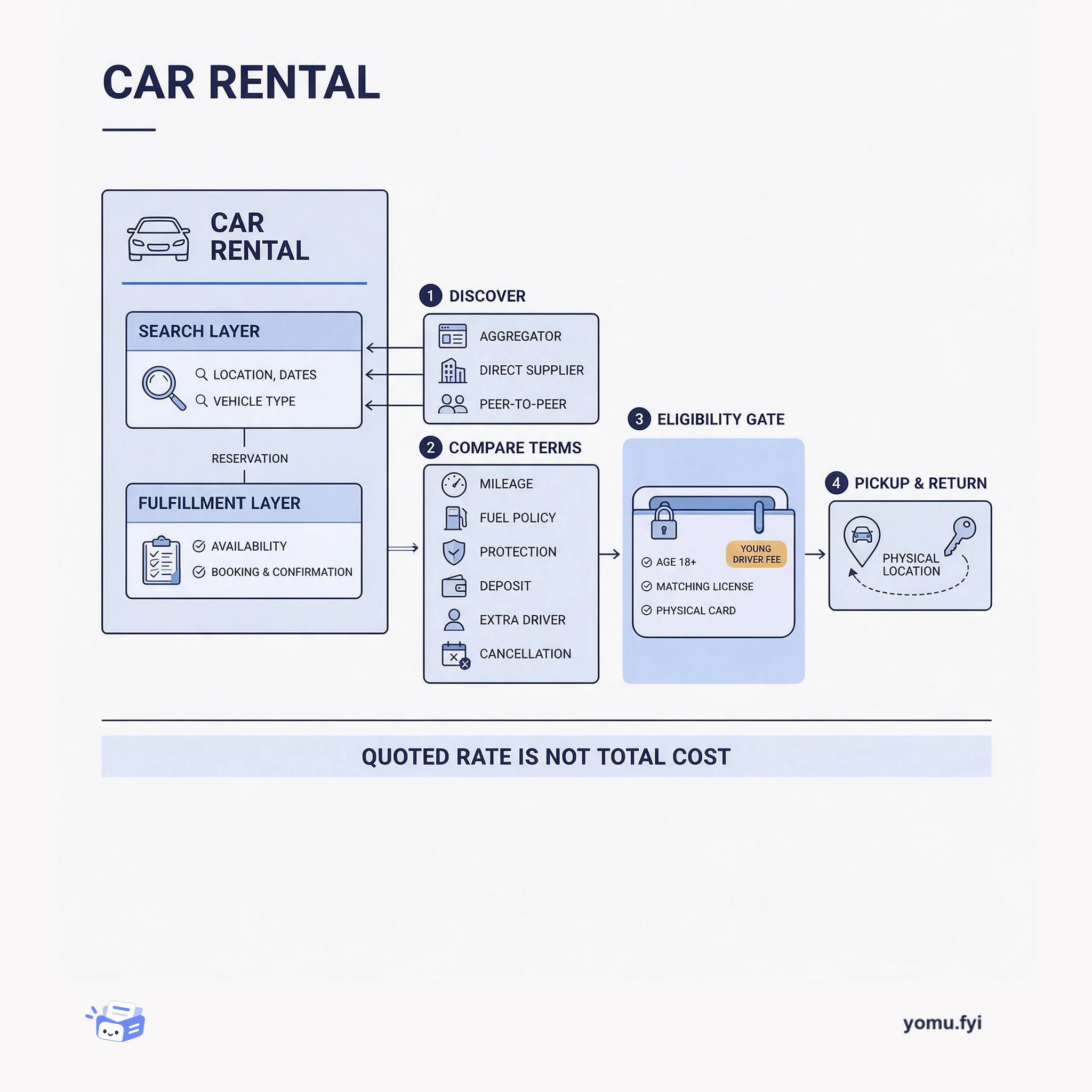
Car Rental: A Search Layer, a Contract, and a Handover
A car rental is a search layer over many fleets plus a contract enforced at the counter. This explainer maps its four parts and why the advertised daily rate never equals the total cost.
Loading…
Topic
17 posts about Marketplace. Every summary links to the original.
See the idea
A car rental is a search layer over many fleets plus a contract enforced at the counter. This explainer maps its four parts and why the advertised daily rate never equals the total cost.
An app store is a distribution surface, a versioned contract, and a health loop between a platform and its developers. Here is how those parts fit together and why each one fails loudly if ignored.
The Good Stuff
Paid picks we use ourselves. Links carry a referral code — a subscription through one earns us a commission at no extra cost to you.
Newest first
Origin’s App Marketplace now integrates with over 20 apps from partners including Cloudflare, Linear, Sentry, and Socket Security, covering deployments, CI, code review, security, monitoring, and project management. The marketplace is open to public submissions, allowing any team building developer tools to publish an app. To submit, developers create an app in their namespace, where it stays private while they build against the Origin API, and authenticate using an app JWT and installation access tokens. Apps receive webhook events and can write back check runs, pull request comments, and reviews. After making the app public, developers submit it with a slug, suggested tags, and a demo video showing install, uninstall, and core product flows; Origin reviews and lists approved apps.
JetBrains Marketplace now provides UI freeze reports for plugin authors, accessible from the Freezes tab after enabling Marketplace reporting via the JetBrainsMarketplaceErrorReportSubmitter handler in plugin.xml. Reports are grouped by error type, with each pile showing a representative report and a thread-dump excerpt that identifies threads involved, such as the event dispatch thread (EDT), helping spot recurring patterns. Full thread dumps captured every five seconds during the freeze are available, along with optional CPU snapshots and performance metrics, and comparing dumps across samples can reveal persistent operations. The analyze-freeze skill guides AI agents through investigating IntelliJ Platform thread dumps, focusing on the EDT, coroutine behavior, and common patterns like non-cancellable read actions blocking the UI, with suggestions for fixes. Before fixing, authors should check the plugin version, keep blocking I/O outside read actions, and test changes by repeating the operation and examining fresh diagnostic evidence.
The post compares building a developer ecosystem to creating a new country’s economy, requiring infrastructure, fair rules, and an efficient marketplace for trade. It cites a 2015 Deloitte report estimating Facebook’s 2014 platform effect at $29 billion and 660,000 jobs created by companies like King and BlaBlaCar, noting Facebook Platform launched in 2007. Intercom released its first developer APIs in June 2014 and has since added webhooks, OAuth, Bulk APIs, and SDKs for Ruby, PHP, Go, Java, Node, and Cordova. The company introduced new developer guidelines that emphasize innovation opportunities rather than restrictions, and built a new developer hub to simplify building integrations and apps. Intercom is exploring a marketplace to connect developers with customers who use Intercom, and over 50 integrations have been built; developers can join the Developer Program to get listed.
Grab built sim-rs, a self-contained simulator that models its fulfillment marketplace to enable rapid experimentation with dispatch strategies. The simulator processes a city-day of marketplace activity in tens of minutes, using historical data and configurable components for batching, allocation, and cancellation. Agents connected through an autoresearch loop propose changes, run reproducible experiments, and receive computed verdicts, with safeguards against specification gaming such as immutable core data and scoped changes. The simulator also supports A/B/n comparisons within a single run, exposing all arms to the same demand and dynamics to improve translation to production. By making each attempt take minutes instead of weeks, sim-rs allows agents to test thousands of ideas cheaply and receive honest feedback, accelerating research while keeping the simulator faithful through automated translation of production logic and behavioral modeling.
The guide compares 10 websites and apps for booking rental cars in 2026, grouping them into aggregators, direct rental companies, peer-to-peer marketplaces, and hybrid platforms. It matches services to needs such as price comparison, member discounts, unusual vehicles, loyalty rewards, bundling, coupon savings, and international coverage. The entries describe concrete differences: Kayak searches hundreds of providers, Costco Travel uses negotiated member rates, Turo lists vehicles from private owners, and Uber Rent combines traditional agencies with Turo listings in one search. Other examples include Priceline’s Express Deals, Expedia’s trip bundling, AutoSlash’s coupon and price-tracking tools, and direct programs from Enterprise and Hertz. It advises comparing total cost, cancellation terms, mileage limits, fuel policy, protection options, deposits, pickup and drop-off locations, and additional-driver fees because advertised daily rates do not capture every booking condition.
Stagwell built a Databricks Marketplace App to let brands match first-party records against its Identity Spine without sending raw customer data outside their own workspaces. It combines Databricks Clean Rooms, Unity Catalog, Jobs and Notebooks, Delta Sharing, and a React/Express interface. Workspace OAuth and On-Behalf-Of authorization enforce the user's Unity Catalog permissions, while separate service principals and a scoped personal access token support app and clean-room operations. Within the clean room, a packaged notebook joins brand data with the Identity Spine, resolves multiple identifiers, and computes match rates, coverage metrics, and household and consumer IDs; results include aggregated audience insights for activation, while raw customer data and proprietary matching code remain separated.
Databricks describes a year of expanding its partner ecosystem for independent software vendors and data providers, responding to requests for stronger go-to-market support, technical guidance, and Marketplace transactions. It says it introduced partner tiering, the Partner Well-Architected Framework, a Marketplace Commit Drawdown pilot, and the ability to list Databricks Apps and Genie Agents. Under the pilot, customers with a Universal Commit can submit invoices for eligible solutions that run on or share data to Databricks; validated purchases reduce their commitment obligation, while Databricks compensates its sales team. OpenSharing is presented as an open-source, vendor-agnostic protocol for cross-cloud, cross-platform sharing of structured and unstructured data, volumes, agent skills, AI models, and semantics. The post says Apps adoption has grown fivefold since last year's summit, with more than 5,000 accounts running Apps in production weekly, and that more than 20,000 customers rely on Databricks.
Databricks announces the Public Preview of Apps on Databricks Marketplace, allowing customers to discover, install, and run third-party data and AI applications inside secure Databricks workspaces. The offering addresses procurement challenges involving data movement, lengthy security reviews, custom integrations, and fragmented identity management by bringing applications to the customer’s data. Installed apps run in isolated sandboxes within the consumer’s Databricks account, inherit Unity Catalog governance, and use dedicated serverless compute with consumer-controlled external access through Serverless Egress Gateway policies. Providers can publish closed-source containerized apps once for no-egress distribution without maintaining per-customer infrastructure, while applications connect natively to services including SQL Warehouse, Lakebase, Model Serving, and Foundation Model APIs. The Public Preview launches with 20 partners, and planned additions include bundled assets, provider analytics, and commercial monetization.
Databricks announces new OpenSharing and Marketplace capabilities aimed at sharing data, AI assets, and partner applications without moving data. OpenSharing, a Linux Foundation project and evolution of Delta Sharing, adds vendor-neutral sharing for Agent Skills, AI models, unstructured data, Iceberg clients, Lakebase tables and change data feed, plus governed multi-cloud connectivity and agentic sharing through Genie Agent Sharing. The release also introduces identity resolution in Databricks Clean Rooms, where partners such as LiveRamp and Acxiom can work against protected first-party data without seeing raw customer records. Third-party apps are now available through Databricks Marketplace, allowing customers to deploy them in their workspaces without separate infrastructure, while providers gain distribution. Marketplace Commit Drawdown lets customers use existing Databricks universal commits to acquire Marketplace data and AI solutions.
Databricks announces ready-to-use Model Context Protocol (MCP) servers for healthcare and life sciences through Databricks Marketplace, addressing the need to combine curated biomedical knowledge, timely data, specialized tools, and private records. Listings include services for drug and target intelligence, literature, clinical trials, FDA information, Medicare coverage, ontologies, real-world evidence, clinical semantics, and interoperability, while Climb connects live public sources with private Gold-layer data under Unity Catalog governance. Marketplace and custom MCP servers are centralized in the MCP Catalog and governed by Unity AI Gateway, with Genie Spaces, AI Search, Unity Catalog functions, and SQL Warehouses available as managed MCP servers. Users can assemble agents in AI Playground, Agent Bricks, or notebooks, then deploy endpoints or apps with MLflow tracing, evaluation, human feedback, and AI guardrails; examples span molecular-property lookup, clinical questions, and drug research.
Databricks and Google Cloud are presenting their partnership at Google Cloud Next ’26 as a route from governed enterprise data to production AI, including autonomous agents and modernized workloads. In 2025, Databricks became a first-party provider of Gemini models, giving users direct API access to build, customize, and deploy agentic AI on governed data across all three Databricks clouds without moving data or managing infrastructure. The post reports more than 55% quarter-over-quarter growth in Gemini adoption, 85% year-over-year growth in Google Cloud consumption, and 4,000-plus Marketplace sign-ups, alongside support for Google Axion processors. Customer examples include Databricks SQL Serverless savings for Digital Turbine, faster Marketplace procurement for Dun & Bradstreet, regional compliance in Saudi Arabia and Brazil, and 30% faster analytics delivery through Lakeflow-powered pipelines. At the event, Databricks is offering demos, talks, expert sessions, and a free $400 trial through Google Cloud Marketplace.
eBay is joining Facebook’s affiliate partnerships as a beta partner, allowing creators across Facebook’s global ecosystem to feature eBay inventory directly in content. Creators can access and embed listings in Reels, photos, and text posts, and earn a commission when followers click a linked listing and complete a purchase on eBay. The integration is intended to make discovery more direct within Facebook, helping sellers reach engaged buyers, expand market reach, and generate incremental demand through creator-led storytelling. The beta is scheduled to begin in the coming months, offering sellers a new visibility channel and creators an additional monetization stream as social commerce and the creator economy continue to evolve.
Cursor is adding more than 30 plugins to its Marketplace, including integrations from Atlassian, Datadog, GitLab, Glean, Hugging Face, monday.com, and PlanetScale. The plugins extend Cursor across infrastructure and productivity workflows: users can query observability data, manage GitLab repositories and pipelines, work with PlanetScale schemas and queries, handle Atlassian issues and backlogs, search company knowledge in Glean, and manage monday.com boards and tasks. Each plugin bundles capabilities such as MCPs with skills that instruct an agent how to use them, and those tools can support manually started or automatically invoked cloud agents. Cursor also supports community-built plugins, while Teams and Enterprise admins can create private team marketplaces. Automations can run agents on schedules or events with custom instructions.
eBay describes how its AI tools aim to reduce holiday-season friction for sellers and improve discovery and trust for buyers. More than 10M unique sellers have used its AI features, while sellers create more than half a million new listings daily using Generative AI. The simplified listing experience can start with an image, background enhancement adds festive professional-grade backgrounds, and AI Assistant for messaging drafts replies to common questions about item specifics or shipping. For shoppers, an AI shopping assistant pilot, LLM-powered fashion recommendations, and access to eBay’s inventory through third-party agents including OpenAI partnerships support personalized discovery. Trust features include Authenticity Guarantee expert verification for handbags, jewelry, and trading cards, plus Certilogo’s digital IDs and authentication for apparel, while eBay says these measures support safer participation in the circular economy.
At eBay Open 2024, eBay announces tools and services intended to help sellers streamline operations and connect with buyers. Recent additions include generative AI-powered descriptions, image background enhancements, social media promotion methods, mobile-friendly product research, and combined international shipping. The simplified listing flow is rolling out across all categories in the United States and United Kingdom, while an AI-powered bulk listing tool in Seller Hub lets US sellers create multiple listings quickly; it currently supports Sports Trading Card listings and may expand to more categories and markets. The redesigned Seller Hub adds an improved interface, more efficient business management, and better data visualization, and eBay is developing a dedicated Sell Mode for its mobile app.
eBay has unveiled its magical bulk listing tool, an AI-powered feature that helps sellers create product listings from batches of uploaded images. The tool generates draft listings with suggested categories, titles, and item specifics in seconds, allowing sellers to review details for accuracy before publishing. It can process hundreds of photos per batch and create numerous drafts simultaneously; it is currently available to U.S. Seller Hub users listing in Sports Trading Card, with expansion to more categories and countries planned in the coming months. Early data showed that the tool significantly reduced listing time among users creating trading-card listings, and the rollout follows other recent AI features for sellers and buyers across eBay's marketplace.
eBay Chief AI Officer Nitzan Mekel-Bobrov discusses his role, artificial intelligence’s changing landscape, and eBay’s position in ecommerce. He says the company’s powerful private cloud, combined with integration with public cloud providers, supports AI at scale and in real time. As a two-sided marketplace, eBay can apply AI to sellers and buyers through a magical listing tool for complex specifications, assistance finding hard-to-find items, and image generation that improves and expands user-provided visuals. For buyers, it can also interpret a vehicle problem, identify needed items and options, and present them without requiring a search through listings. Looking ahead, Mekel-Bobrov describes AI shopping assistants as category-informed chatbots that may act autonomously toward desired outcomes rather than merely execute assigned tasks.
The best engineering reads, once a week.








