Apple Integration Is a Boundary, Not a Feature
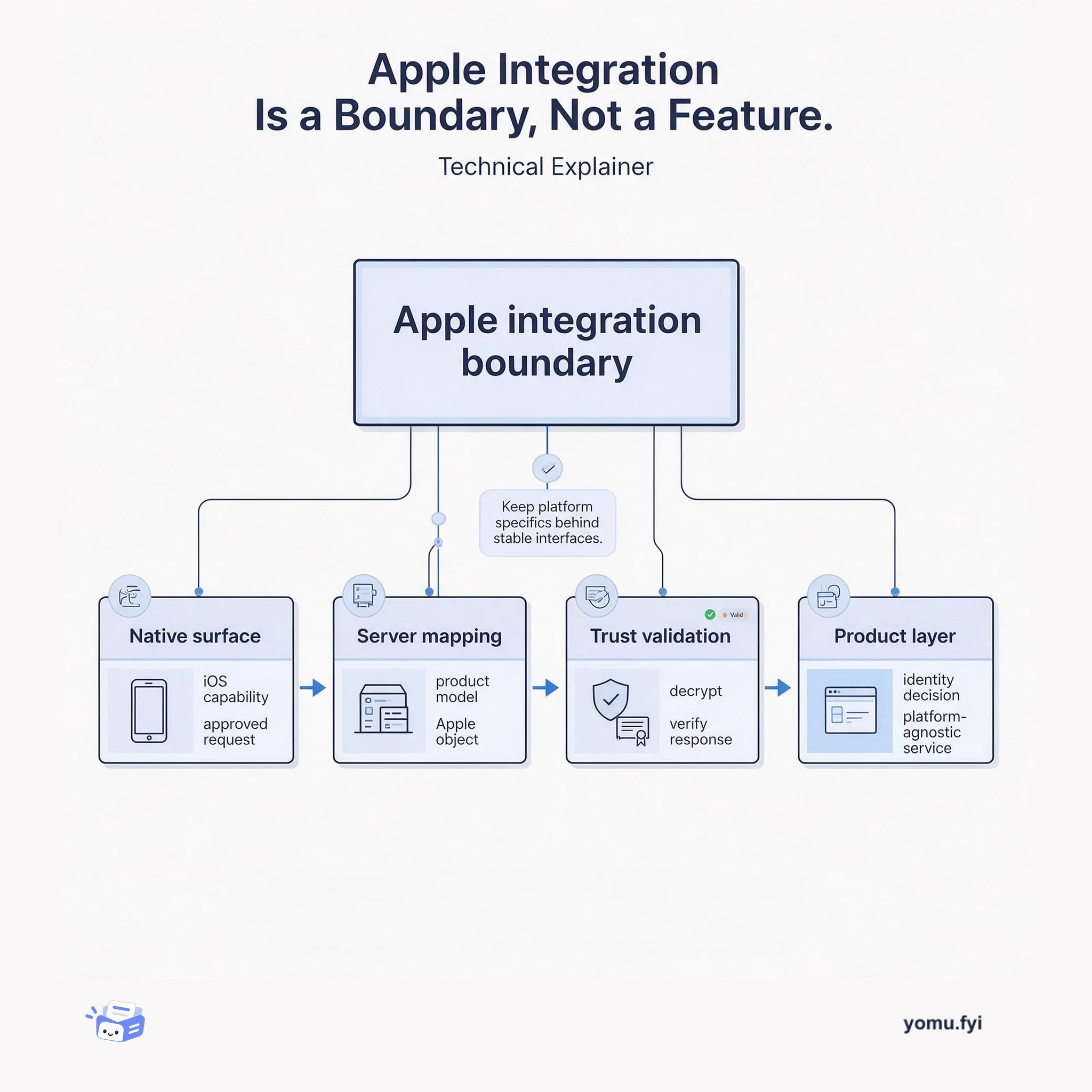
Apple integrations are boundary designs: native capability, server-side mapping, and trust checks must meet a platform-agnostic product layer. See where each responsibility belongs.
Loading…
Topic
74 posts about iOS. Every summary links to the original.
See the idea
Apple integrations are boundary designs: native capability, server-side mapping, and trust checks must meet a platform-agnostic product layer. See where each responsibility belongs.
The Good Stuff
Paid picks we use ourselves. Links carry a referral code — a subscription through one earns us a commission at no extra cost to you.
Newest first
Running competitive models like RedNote's 3B parameter dots.ocr on-device provides zero-cost, network-free optical character recognition while leveraging power-efficient hardware like Apple's Neural Engine. Because the Neural Engine requires Core ML, converting the 1.2B parameter NaViT vision encoder from PyTorch requires resolving multiple graph tracing incompatibilities. The initial conversion pipeline targets FLOAT32 execution on GPU by capturing the execution graph with torch.jit.trace and compiling it via coremltools. Simplifying the model for single-image inference eliminates dynamic sequence masking, dynamic tensor iteration, and multi-attention complexity. Although the resulting Core ML model accurately matches PyTorch baseline numerical precision, the unoptimized artifact spans over 5GB and takes over one second per forward pass.
swift-transformers has released version 1.0 to provide a stable foundation for running local models on Apple Silicon platforms. The library supplies components missing from Core ML and MLX, focusing heavily on tokenization, chat templates, and Hugging Face Hub integration. In this major release, Tokenizers and Hub become standalone top-level modules, enabling developers to import only the components they require. The update also integrates an updated swift-jinja library for faster template processing, adopts Modern Core ML stateful models and MLTensor APIs, removes unnecessary CLI dependencies, and adds full Swift 6 support. Future development will prioritize deeper integration with MLX frameworks and agentic workflows like MCP.
The post presents a gym membership access system that replaces plastic cards, fobs, and physical keys with Apple Wallet and Google Wallet passes scanned by an NFC reader. It uses Stripe Checkout and subscriptions for payment, PassNinja as a single API layer for issuing passes, and a DotOrigin VTAP100 connected to a Raspberry Pi Zero 2W, relay, and door strike for entry control. After Checkout, the website verifies that the Stripe subscription is active, creates a pass whose nfc-message contains the Stripe subscription ID, and redirects the member to add it to a wallet. A Linux gate process reads that identifier from the reader's virtual serial port, retrieves the subscription from Stripe, and activates the relay for five seconds when the status is active; otherwise it denies access.
This tutorial shows how to add secure authentication and backend authorization to an iOS app using Okta’s BrowserSignIn module from the Okta Swift SDK. It registers a native OIDC client with Authorization Code Flow and PKCE, configures redirect URIs and authorization-server policies, and recommends phishing-resistant MFA factors such as Okta Verify with biometrics and FIDO2 with WebAuthn. The implementation uses Swift Package Manager, an Okta.plist configuration file, a testable AuthService protocol, and SwiftUI views for login, token handling, user information, and authenticated state. It then demonstrates authorized API requests by attaching an access token to a URLRequest, calling a backend endpoint, decoding its response, and displaying a returned message, concluding that OAuth 2.0 and JWT validation provide integrated authorization verification.
React Native WebGPU and React Native Skia are presented as a graphics stack for advanced 2D, 3D, and general-purpose GPU workloads in native applications. The work uses Skia Graphite with Dawn, Google’s open-source WebGPU implementation, to replace separate OpenGL and Metal backend implementations with a unified architecture, while enabling Three.js, React Three Fiber, TensorFlow.js, and compute shaders. Three.js Shading Language lets the same shaders target WebGPU and WebGL, and Shopify’s Black Friday globe prototypes run natively with identical results to the web version. Architectural changes in React Native Skia moved from a mutable SkiaDOM to an immutable fabric reconciler, producing reported animation gains of up to 50% on iOS and nearly 200% on Android, plus 98% of reported Android crashes fixed. Graphite remains experimental, but adds dedicated-thread canvases and bidirectional 2D/3D composition, while Skia also supports macOS, tvOS, and headless Node.js rendering.
Tinder faced significant agility and build performance challenges caused by an iOS codebase monolith containing over 1,000 files and 150,000 lines of code. Manual extraction efforts risked creating massive, unmanageable pull requests that would require constant rebasing against the main branch. To systematically decompose the target into Swift sub-modules, the team mapped declarations and references via the Swift compiler into a directed graph. They iteratively extracted leaf nodes with an in-degree of zero across sequential phases and automated common code adjustments, including module dependencies, imports, access control levels, and dependency injection. The automated decomposition completed in under six months with zero P0 incidents, reducing monolith build times by 78% and disallowing future additions to the monolith target.
Stripe’s Sessions 2025 developer track recap presents new products, APIs, and enhancements for building and managing financial infrastructure. Stripe’s Workflows provides visual automation for real-time events, with more than 600 triggers, branching logic, dynamic fields, and built-in error handling, while the MCP server and agent toolkit connect AI tools and agents to Stripe documentation, account data, APIs, and financial capabilities. Accounts v2 unifies connected-account management, and fully localized Connect Mobile Embedded Components bring onboarding to iOS and Android; the Payment Element also gains support for the Checkout Sessions API. New Stripe Apps UI components, generally available Sandboxes, Organization-wide sharing of customers and payment methods, and conversational documentation extend customization, testing, and collaboration.
Tinder developed an on-device AI Photo Selector to recommend compelling profile photos directly from a user's camera roll without exposing private assets. To establish a reference face, the system extracts facial landmarks via Apple's Vision framework and normalizes the crop using affine transformations. To prevent funnel drop-offs from mandatory selfies, the architecture includes a fallback mechanism that detects a single recognizable face in existing profile photos. Processing workflows execute concurrently across thousands of local assets while downloading and initializing TensorFlow Lite models in parallel using Combine. A dedicated analytics queue synchronizes operation counts with DispatchGroup to ensure accurate metric capture before the global rollout.
Shopify’s mobile app has about 600 screens, but building every non-critical screen natively or in React Native was costly and slowed development, while conventional WebViews felt slow, disconnected, and out of place. Mobile Bridge addresses this hybrid-app problem with native iOS and Android modules that preload, authenticate, cache, and reuse WebViews, reducing P75 load time from 6 seconds to 1.4 seconds, including network latency and rendering. Built on @remote-ui/rpc, the framework uses JavaScript, CSS, Polaris overrides, title and action APIs, TransportableView, snapshots, and native modal transitions to preserve state and align web screens with native navigation and appearance. WebViews can also invoke native features such as date pickers, barcode scanning, and Add to Wallet; Shopify says the standalone library is being adopted across other products while critical features remain native or React Native.
Supporting over 50 languages across numerous statically linked targets led to a substantial build size footprint in Tinder's iOS application. Because Apple's code signing mandates a minimum 4KB per file, shipping dozens of localized files per target inflated the final application package. Tinder addressed this by stripping comments and whitespace, merging localized strings into a single file per language via custom Bazel rules and Aspects, and compressing the strings using Emerge's SmallStrings tool into LZFSE files. The runtime decompresses these files dynamically through existing code-generated string accessors. Consequently, Tinder reduced download size by 10.7MB and install size by 51.3MB with no impact on developer workflows.
Tinder open-sourced several iOS development repositories, including Layout, Nodes Architecture Framework, and CombineUI, to share the engineering patterns supporting its iPhone application. As the app expanded across diverse device profiles and scale, engineering teams faced reliability, consistency, and memory challenges under their legacy architecture. In response, Tinder developed Nodes, a plugin-based architecture framework using compile-time dependency injection and lifecycle hooks that enforce complete memory release upon feature dismissal. For interface construction, Tinder created Layout, a domain-specific Auto Layout wrapper offering declarative syntax for UIKit views to eliminate storyboard merge conflicts while preserving native capabilities. The resulting stack enables isolated testing of business logic, native reactive event binding, and incremental adoption of SwiftUI across the codebase.
Shopify reviews five years of using React Native (RN) as its mobile strategy, adopted to avoid duplicating features across iOS and Android, improve talent portability, and ship more value. Over that period, all of its apps migrated to RN through team-led, non-uniform plans, while native code remained part of the architecture rather than an alternative to eliminate. The company reports sub-500ms P75 screen loads in the Shopify app, similar performance across its apps, and more than 99.9% crash-free sessions, while noting that performance depends on applying sound patterns. Its experience credits hot reloading and TypeScript with developer productivity and cross-platform staffing, but identifies debugging, RN upgrades, and third-party dependency maintenance as costs. Shopify now emphasizes shared libraries, native expertise for platform-specific work, continued New Architecture adoption, and collaboration with the RN ecosystem.
Grab designed an equivalent to iOS Live Activities for Android to provide real-time order tracking outside the app. Because Android lacks Apple's native ActivityKit push token system, the team substituted push tokens with placeholder values to maintain technical consistency across platforms and preserve backend push targeting via their Hedwig service. For the user interface, engineering selected custom notifications over floating views because custom notifications avoid intrusive screen usage and do not require the 'Draw over other apps' permission. The client implementation separates responsibilities across dedicated classes: LiveActivityIntegrationManager handles token registration across business verticals, LiveActivityAttributes encapsulates UI configuration, and LiveActivityManager maps payloads to Android NotificationManager instances. The solution launched for Food, Mart, Express, and Transport verticals.
Stripe’s August 2024 developer update announces that Workbench is available to everyone across every Dashboard surface, addressing developers’ request for in-context guidance and debugging tools during API integration work. Workbench is a developer home in the Dashboard that provides an at-a-glance view of integration behavior, lets users inspect API and event history, prototype integrations, and receive critical account alerts. As developers build, it highlights errors, helps resolve them, and recommends ways to improve integration efficiency; it can be opened with a single keystroke. The update also places Sandboxes and Event Destinations in public beta, expands Tap to Pay on iPhone with Stripe to seven countries, and notes community resources for Stripe Tax, the Stripe CLI, Payment Links, and related integrations.
Shopify built Tophat to reduce the time and friction involved in manually testing mobile pull requests, where switching branches, stashing changes, and waiting for Xcode or Android Studio builds slowed review. The macOS menu-bar application links GitHub pull requests to iOS and Android artifacts produced by CI and stored in Google Cloud Storage, allowing contributors to install builds on simulators or real devices with one click. Tophat parallelizes tasks such as downloading applications and booting devices, and its Quick Launch feature retrieves builds with up-to-date native code for React Native development. The project also addressed real-device iOS installation and signing challenges, integrated with Shipit Mobile, and provided automated setup guidance. After the latest improvements, daily usage doubled, and Tophat was later made open source.
eBay’s Product Research, formerly called Terapeak, brings three years of sold-items data into its mobile app so sellers can research products and create listings from anywhere. The service reports actual sold prices, including accepted Best Offer prices, along with average and range, free-shipping share, average shipping cost, and the number of sellers who sold a product. Sellers can search, sort, filter, inspect a price-trend graph, and use “Sell one like this” to start a listing pre-populated from a sold listing. Product Research is available in the latest eBay app for iOS and Android, while desktop sellers can use it through Seller Hub; planned additions include sell-through rate, more trend graphs, and active-listing views.
React Native Skia exposes Google’s cross-platform Skia 2D graphics engine to React Native, giving developers a canvas for custom shapes, visual effects, and dynamic interactions. The article explains when to choose it over react-native-svg or standard React Native Views: SVG is optimized for static SVGs, while Skia supplies primitives such as shaders, path operations, and image filters for animated experiences. It introduces the Cartesian canvas, basic Circle, Rect, and RoundedRect shapes, and custom paths created with SVG notation or imperative commands including addCircle, lineTo, and addPoly. Examples then combine Skia with react-native-reanimated shared values for UI-thread animation and react-native-gesture-handler for panning, before adding Blur and DashPathEffect; the article also notes web support through React Native Web and points to further examples.
Etsy extended its iOS Wall View experience into an AR measuring tool that represents listings as scaled 3D boxes, allowing shoppers to judge an item's size and fit in their space. The work addressed the difficulty of creating models for millions of customizable, often handmade items by improving dimension extraction instead. A server-side regex parser reads titles, descriptions, customization information, overviews, and variations, handling unit variants, localization, special characters, fractions, conversions, complex imperial measurements, and duplicate values while prioritizing structured fields and caching results. In iOS, the measuring box uses SceneKit’s SCNBox and SCNNode labels, supports movement and rotation, and uses LiDAR-derived meshes for environment occlusion. The resulting feature adds real-size AR functionality to nearly a million Etsy items, viewed by tens of thousands of users weekly.
This tutorial shows how to add Google authentication to a cross-platform Flutter application using the Supabase SDK for Flutter. It explains OpenID Connect as a protocol built on OAuth 2.0, then configures Google Cloud client IDs for iOS, Android, and web, with Supabase using the web client ID to verify the supplied identity token. The sample initializes Supabase, starts Google sign-in through google_sign_in, passes the resulting access and ID tokens to signInWithIdToken, and listens for signed-in events to navigate from LoginScreen to ProfileScreen. The profile reads avatar_url and full_name from Supabase userMetadata, while a sign-out action returns the user to the login screen, producing a basic personalized app.
Supabase has expanded its authentication support for native Apple and Google sign-in on iOS and Android, addressing a flow that previously required developers to send users through a web browser. Native apps built with Flutter or React Native can use OS-provided authentication dialogs across Apple platforms including iOS, macOS, tvOS, and watchOS, while Android support covers all Android variants. Behind these methods, ID tokens issued by Apple or Google are validated by Supabase Auth to create accounts or link existing accounts based on email similarity. The same signInWithIdToken() method also enables Sign in with Apple JS, Google One Tap, and authentication in Chrome extensions; the Google One Tap example passes the provider’s credential and a matching nonce when one is supplied via data-nonce.
The best engineering reads, once a week.









