Apple Integration Is a Boundary, Not a Feature
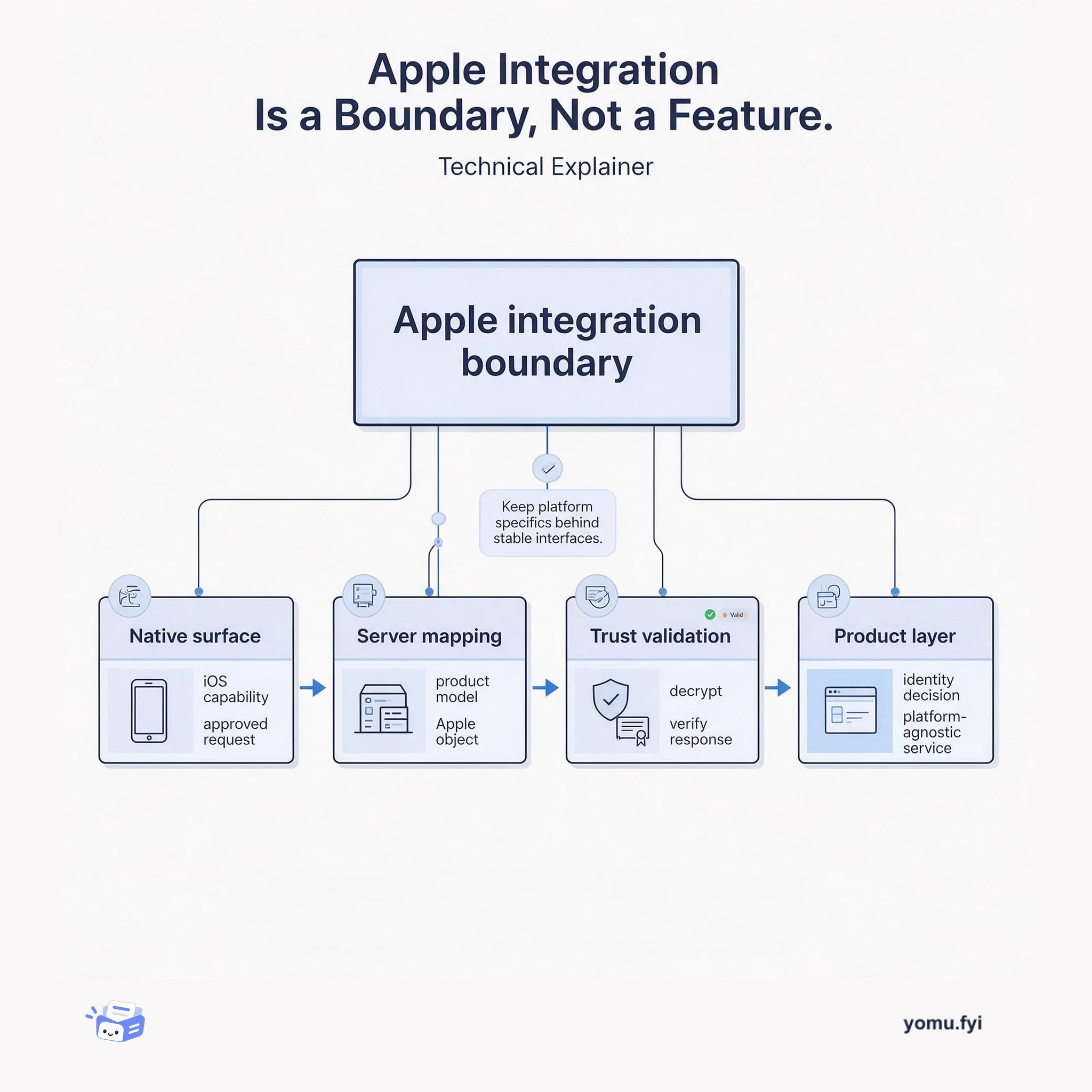
Apple integrations are boundary designs: native capability, server-side mapping, and trust checks must meet a platform-agnostic product layer. See where each responsibility belongs.
Loading…
Topic
73 posts about iOS. Every summary links to the original.
See the idea
Apple integrations are boundary designs: native capability, server-side mapping, and trust checks must meet a platform-agnostic product layer. See where each responsibility belongs.
The Good Stuff
Paid picks we use ourselves. Links carry a referral code — a subscription through one earns us a commission at no extra cost to you.
Newest first
Shopify is moving forward with React Native for new mobile apps after years of native development, driven by mobile purchasing volumes and a desire to consolidate iOS and Android work. It describes React Native as a framework that uses JavaScript and React’s declarative model to translate virtual DOM structures into native platform views through native bindings. Experiments with Arrive, Point of Sale, and Compass reported twice the productivity on Arrive, an estimated 80% code sharing target, and observed sharing of 95% for Arrive and 99% for Compass, while testing lowered the considered Android CPU threshold from 2GHz to 1.5GHz. The policy does not require rewriting existing native apps, leaves low-level libraries native and native hiring in place, and calls for dedicated React Native tooling, foundations, and open-source partnerships.
Grab undertook an initiative to reduce startup time and improve time to interactive (TTI) on its passenger mobile app. Because local benchmarks failed to simulate real device and network conditions, the team instrumented code in production across 8–9 million daily users to capture p50 and p95 metrics. Initial gains came from caching service tiles between sessions and removing a startup animation, saving four seconds. Architectural changes followed, including converting iOS dynamic frameworks to static linking and merging others, while Android initialisation was refactored with Kotlin coroutines. Replacing a heavy third-party analytics library with an internal experimentation platform yielded further startup reductions.
Following the release of the GrabPay Merchant App, Grab adopted React Native inside the Grab Passenger app to maintain a single cross-platform codebase across iOS and Android. Integrating the framework into native applications required establishing bridge communication guidelines and incorporating React Native modules into the Grablet architecture. To streamline network communication, API calls were migrated from axios to native bridges returning promises, which eliminated the need to pass access tokens into JavaScript. The team also established a shared internal library of approximately 20 UI components alongside Redux for state management and react-navigation for routing. Modules like BillPay and Transaction History successfully launched across Southeast Asia while maintaining the performance and feel of native software.
Shopify built Shipit Mobile to replace error-prone, manual mobile app releases with a shared platform for creating, viewing, and managing releases. The process creates a release branch from master, builds a candidate for each commit, increments build numbers, and starts separate CI pipelines for testing and release builds. Shipit Mobile uploads the same binary and metadata to distribution channels including Google Play, the App Store, and internal support access, using store APIs and Fastlane, while Slack notifications make release status visible beyond the release captain. Developers can bypass CI when necessary for emergencies, and configuration favors convention over configuration for project metadata. After more than six months in production, the platform reduced release complexity, shortened the release cadence from three weeks to one week, and helped more people become release captains.
Shopify describes an iOS testing strategy for a monorepo containing multiple app projects and evolving through hundreds of weekly commits. The approach covers Models, Views, ViewModels, View Controllers, and user workflows with tests matched to each component’s role: regular unit tests for business rules, snapshot tests for visual behavior, and XCUITest UI automation for user-facing flows. UI automation selects elements through accessibility labels or strings, which can also improve accessibility for visually impaired users, while manual testing remains necessary for some animation and rendering issues. The article recommends a test pyramid because slower tests require more human effort and maintenance, and says suites must evolve as business requirements change.
Shopify requires developers to test features because it has no QA team, and its manual “tophatting” means running changes locally before merge. Mobile tophatting was slow because switching branches could invalidate Xcode/Android Studio caches, with builds taking up to 15 minutes. The new process skips compilation by exporting CI-built iOS and Android binaries into disposable PR environments, exposing them through the CI API and GitHub commit statuses, then extending the dev command to authenticate, find and filter artifacts, select an app and simulator or emulator, install it, and launch it. Developers can target pull requests, repositories, branches, or build URLs, while iOS apps are zipped .app folders and Android apps retain APK names. The team reports a positive response and lists local artifact caching, real-device support, and simpler commit or branch inputs as improvements.
Shopify needed a unified CI/CD system that could give iOS developers the same reliable, disposable build environments already used for Linux and Android projects. An earlier VMware ESXi setup used a shared storage area network, but its maintenance burden and write throughput limit created stability and scalability problems. The replacement uses Anka, a Docker-like macOS virtualization layer built on Apple’s Hypervisor.framework: one Core i7 Mac Mini runs one VM with local storage, while layered images are pushed to registries and pulled across two MacStadium data centers. Buildkite agents clone temporary snapshots, boot suspended VMs in under a second, run steps, upload artifacts, and delete the VMs afterward. Shopify reports about 350 iOS build jobs per hour for roughly 60 iOS developers, with easier Xcode and macOS upgrades, no shared-storage single point of failure, and horizontal scaling, although capacity remains manually adjusted and spiky demand can increase queue times.
Shopify interns and a former intern describe how they approached interviews, daily work, and growth across backend, development, solutions engineering, iOS, and application security roles. Their routines include stand-ups, pull-request review, coding, meetings, pair programming, production monitoring, and regular breaks, with some teams organizing work around three-week release cycles. Interview advice centers on completing the application, explaining non-traditional backgrounds, demonstrating passion and adaptability, communicating technical solutions to different audiences, and being honest about knowledge gaps. Inside Shopify, contributors say success depends on asking questions early, seeking feedback and mentorship, taking initiative, talking beyond one’s team, and holding strong opinions weakly. The post also announces Fall 2018 intern hiring, with applications due May 11, 2018, at 9:00 AM EST.
Kickstarter hosted the fourth Functional Swift Conference on April 15th, marking the third time the event had been held at its office. The all-day gathering brought together 10 speakers, including four Kickstarter engineers, and 90 attendees to discuss what functional programming can contribute to better Swift code. Sessions covered recursive enums and KD-trees, testing side-effects, domain-specific languages with GraphQL, algebraic laws, monoids, predicates, sorting functions, applicative functors, parsing, and type inference. Examples included using value types and recursive data structures to describe complicated objects and live-coding an applicative parsing API that generates its own documentation. The closing type-system talk examined why inference is hard and described the Swift compiler team’s use of graph theory to address inference problems practically.
Grab manages continuous delivery for its iOS applications using four build configurations per target: Adhoc QA, Hot Dogfood, Dogfood, and Testflight. The engineering team moved away from Fastlane in favor of custom bash scripts under 100 lines that execute clean builds and archives via xcodebuild. To eliminate manual logins for build execution, Grab developed a server-side Swift application integrating SlackKit and a bot named Iris. Incoming Slack commands are parsed and scheduled onto a serial DispatchQueue to trigger the appropriate build scripts. Deployment and rollback of updates to Iris and its build scripts are handled through Capistrano.
Grab replaced third-party cloud CI services with an in-house Xcode Server pipeline to run automated iOS integration tests across an expanding engineering team. Instead of performing fresh repository clones on shared cloud instances, Xcode Server pulls code incrementally and mirrors local developer configurations. The team automated testing bots through Ruby scripts and Arcanist hooks tied to Phabricator code reviews, dynamically provisioning bots on diffs and deleting them after merges. This architecture preserves step-by-step UI test execution logs and screenshots for easier failure diagnostics. To maintain stability on on-premises hardware, pre-integration scripts clear application cache states using simctl commands.
Xcode projects with unit tests commonly separate implementation and test files into two directories, often mirroring the source structure in the tests directory. The post argues that this arrangement creates maintenance overhead, slows navigation, obscures how well-tested a codebase is when browsed or reviewed, and can leave tests with lower coding standards. It proposes co-locating each unit-test file beside its implementation file while retaining the test target association, accepting more files per directory in exchange for clearer relationships and easier movement between code and tests. The same SwiftLint configuration is used for implementation and test code, treating tests as first-class code. Tests without a single-file correspondence, including integration or UI tests, should remain in separate directories and may warrant separate targets; the authors say their codebase has adopted the style.
Grab announced its first Grab Vietnam Careers Week, held in Ho Chi Minh City from 22 to 26 October 2016, aimed at hiring engineers to improve regional transportation and reduce congestion. At the time, Grab operated on 23 million mobile devices supported by 460,000 drivers across Southeast Asia. The announcement features an interview with Singapore-based iOS engineer Hai Pham and Android engineer Son Nguyen discussing team culture, regular hackathons termed "Grabathons", and relocation to Singapore. Technical candidates undergo a Codility test and are evaluated on clean mobile architecture, testing, and performance maintenance. The engineers also offer advice on apartment hunting through online community forums and adapting to life in Singapore.
The best engineering reads, once a week.