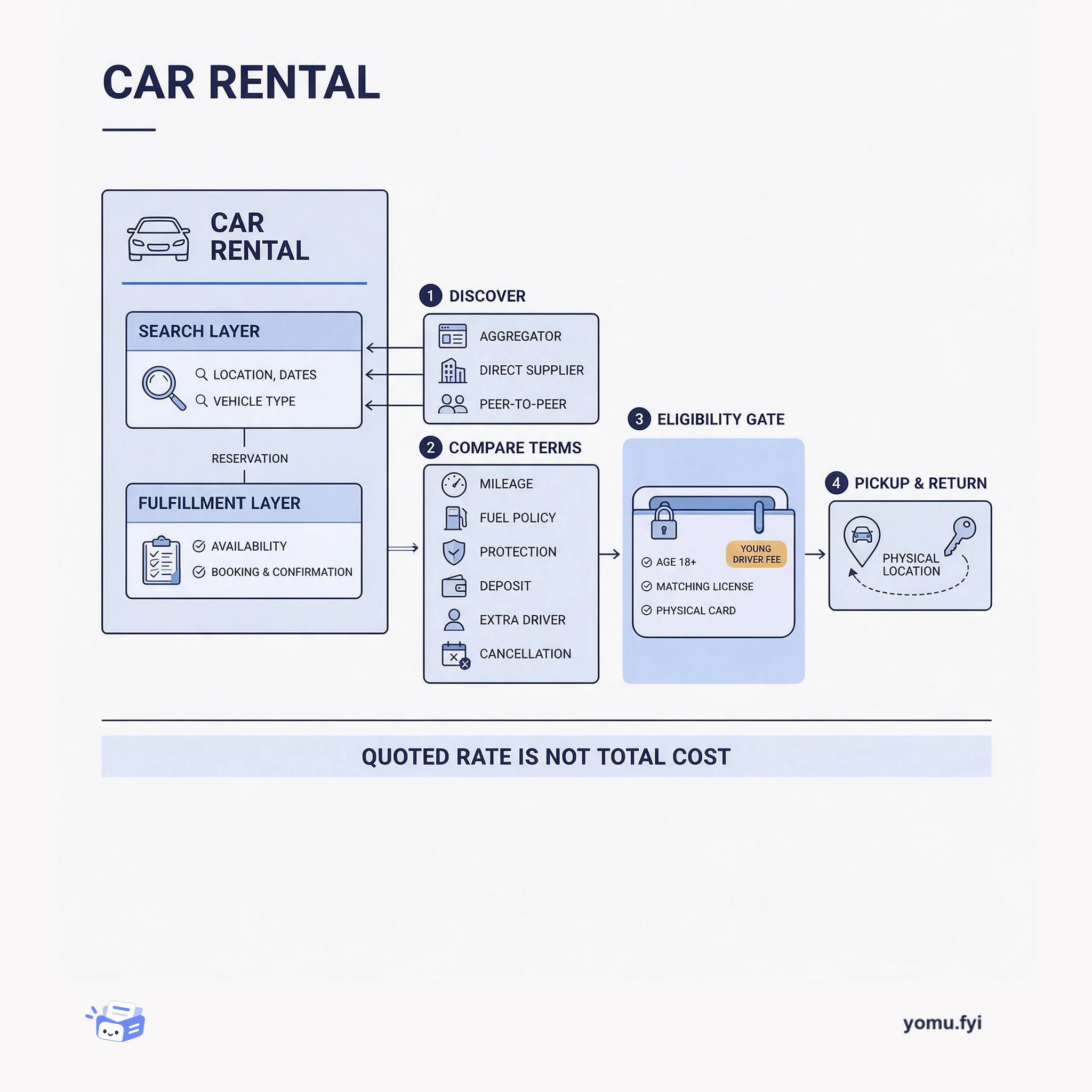
Car Rental: A Search Layer, a Contract, and a Handover
A car rental is a search layer over many fleets plus a contract enforced at the counter. This explainer maps its four parts and why the advertised daily rate never equals the total cost.
Loading…
Topic
29 posts about Pricing. Every summary links to the original.
See the idea
A car rental is a search layer over many fleets plus a contract enforced at the counter. This explainer maps its four parts and why the advertised daily rate never equals the total cost.
The Good Stuff
Paid picks we use ourselves. Links carry a referral code — a subscription through one earns us a commission at no extra cost to you.
Newest first
Fin for Sales uses outcome-based pricing built around qualified pipeline rather than activity: customers pay $10 per qualified lead, with qualification criteria defined by the customer. The model reflects Fin’s role in engaging prospects, gathering information, evaluating them against those criteria, and routing high-intent buyers to sales representatives. The team rejected revenue-share pricing because attribution would include factors outside Fin’s control, while measuring closed revenue would require deep CRM integrations and slow implementation. Disqualifications and support queries are priced at $1, matching the stated service pricing, while the higher qualified-lead price represents pipeline creation. The company says customer research across several pricing models favored outcome-aligned pricing, and cites early customer feedback reporting at least ten times the value.
Fin is changing its pricing metric from “resolutions” to “outcomes” as its capabilities extend beyond fully autonomous support conversations. Historically, a resolution meant Fin solved an issue end to end without human involvement; the model gave teams a clear ROI comparison, and Fin’s average customer resolution rate now stands at 76% across more than 7,000 teams. Customers increasingly deploy Fin on complex, multi-step work involving external systems, policy constraints, and human oversight, where Fin may gather context and act before handing off for confirmation. An outcome counts when Fin successfully completes the action it was configured to perform, including a full resolution or a Procedure. The change keeps pricing simple while recognizing collaborative workflows, supporting compliance, and providing a metric that can scale as Fin takes on more roles beyond service.
Cursor has raised limits for Auto and Composer 1.5 for all individual plans. The update introduces separate first-party models and API usage pools: first-party usage is increased for Auto and Composer 1.5, while API pricing and plan allowances remain unchanged. Composer 1.5 has a standard limit of three times Composer 1’s, with a temporary increase to six times through February 16. Cursor says this supports developers moving from autocomplete toward daily agentic coding while accommodating different preferences for speed, intelligence, and affordability. Composer 1.5 is described as scoring above Sonnet 4.5 on Terminal-Bench 2.0 but below the best frontier models, and both pools reset with the monthly usage cycle; the limits are live for Pro, Pro Plus, and Ultra plans.
Two billing updates will apply at the next renewal after September 15 for monthly and yearly plans. Teams is moving agent usage from fixed request costs to variable request costs, so charges rise or fall with the amount of work performed; a simple syntax question costs less than implementing a full pull request. This change extends the credit system already used by individual plans and unifies billing across tiers. For individuals, Auto will count toward included monthly usage at competitive token rates at the next renewal after September 15, replacing its unlimited status since June 2025; the post says Auto had previously matched premium-model pricing for individuals from December 2023 through June 2025 and for teams since June 2025.
Cursor acknowledges that its individual-plan pricing changes were communicated poorly and says the rollout damaged user trust. The revised Pro plan includes unlimited Tab and Auto usage, $20 of monthly frontier-model usage at API pricing, and the option to buy additional frontier usage at cost; a spend limit is available for users who do not want Auto. The company says it replaced a 500-request monthly allowance with usage credits because token costs vary substantially across models and tasks, while Auto routes requests among frontier models based on capacity. It clarifies that unlimited usage applies only to Auto, estimating the included Pro pool covers about 225 Sonnet 4, 550 Gemini, or 650 GPT 4.1 requests at median usage. Users with unexpected charges from June 16 through July 4 can request full refunds, alongside promised clearer notices, documentation, and dashboard visibility.
Public cloud billing can turn accidental deployments, configuration errors, runaway VM allocation, or leaked CI/CD environments into unexpectedly enormous charges, making teams hesitant to experiment. Fly.io announces an initial “Accident Forgiveness” policy: customers with any support contract can request refunds for unexpected charges, almost without questions, while the company reserves the right to cut off abuse. The longer-term goal is an automated billing system with line-item vetoes, but fraud—especially cryptocurrency mining—requires an incremental rollout; the first version uses manual follow-up reminders to investigate incidents. A rebuilt billing system is intended to support future accident protection, including detecting month-over-month spikes, flagging unusual deployments before billing, and identifying opportunities for reserved pricing and backdated reservations.
Intercom announces a startup program aimed at fast-growing, venture-backed Seed and Series A companies, working with venture capital, accelerator, incubator, and technology partners. The program provides its main customer communication solutions at no cost in the first year, 50% off in the second, and 20% off thereafter, covering tools for bots and content, in-product messaging, onboarding, and conversational engagement. It extends Intercom’s early-stage program, which offers a 95% discount and has helped thousands of pre-seed startups, while focusing more closely on companies scaling with venture backing. Intercom says more than 5,000 startups from leading incubators use its products and cites Spendesk, Notion, Monzo, Frame.io, and Aircall among startup customers; it also plans webinars and events and invites partners to apply.
Fly.io introduces new virtual-machine configurations after developers shifted attention from CPU-intensive workloads such as image processing, machine learning predictions, and video transcoding toward databases, which need higher RAM-to-CPU ratios. Shared-cpu VMs offer up to 2GB of RAM, while dedicated-cpu VMs reach 64GB across configurations with one, two, four, or eight dedicated CPUs. Shared-cpu-1x pricing starts at $1.94 per month for 256MB and reaches $10.70 for 2GB; dedicated-cpu-1x with 2GB costs $31 per month. The pricing model combines dedicated hardware with shared CPU capacity, averaging 12 shared VMs per CPU and using cgroups priorities and relocation to manage contention. Persistent storage remains unavailable, so the post says ephemeral VMs are unsuitable for database applications and that Fly.io should offer storage.
Fly.io announces lower outbound data-transfer pricing for apps running in its Firecracker VMs: $0.02 per GB from North America and Europe, and $0.04 per GB almost everywhere else. The December 1, 2020 change follows dramatically increased volume, reducing bandwidth costs by 75% from the March launch prices of $0.085 per GB in North America and Europe and $0.14 in Asia Pacific. Rather than use graduated tiers or regional rates, Fly.io uses one blended price for all customers, accepting that some traffic is more expensive and some use cases may pay too much. A 70% target margin underpins the model, while a 160GB monthly free allowance covers low-volume projects; India is an exception at $0.12 per GB, and large-transfer customers can request lower prices if they commit to substantial monthly usage.
The best engineering reads, once a week.



