What Is an AI Factory? Four Stages From Data to Served Answer
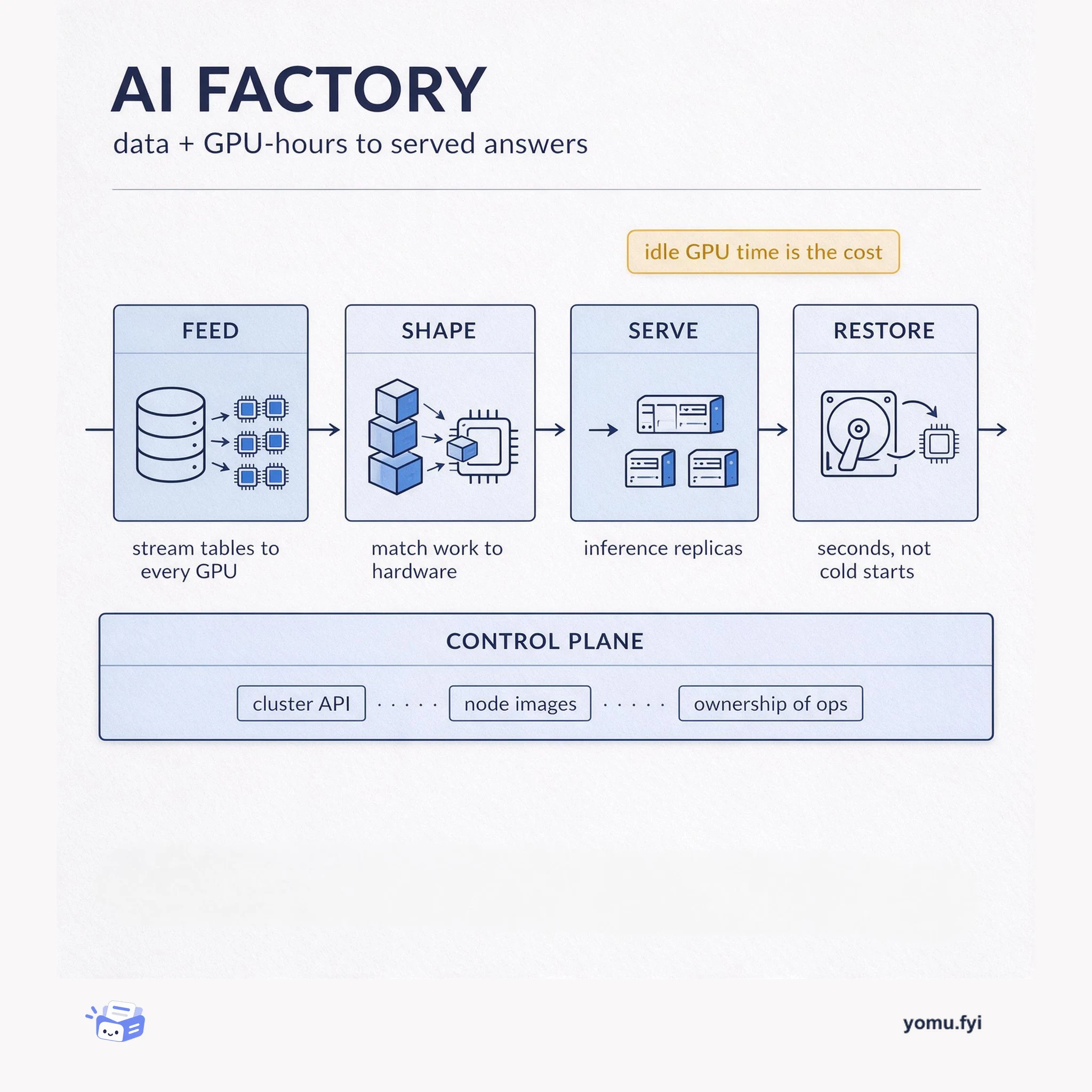
An AI factory turns raw data and GPU-hours into served model output. This diagram breaks it into four stages — feed, shape, serve, restore — plus the control plane that owns them.
An audit is a provenance chain: what was stored, where each fact came from, and what was used for each decision. This explainer maps the three links that keep agent behavior traceable and fixable.
An audit is not a log file; it is a provenance chain that answers three questions about any automated decision: what was stored, where each fact came from, and what was actually used. In an AI agent, that means memory entries carry source, conversation identifiers, and revision history, and each response can be tied to the specific retrieved items behind it. The same pattern shows up in agent operations, where read-only tools and transparent reasoning let an SRE trace a recommendation back to evidence. The payoff is not just compliance: a complete chain lets a team explain, correct, and reverse behavior instead of guessing at it.
What the agent stored, where each fact came from, and what it used for a given answer. Twilio's Conversation Memory attaches provenance such as source, conversation IDs, and revision history to traits, observations, and summaries, so each response can be traced back to the specific retrieved memories behind it.
Logs record that something happened, but not which stored fact or retrieved item drove a decision. Cloudflare's Agent Audit Logs tie an agent request back to the specific user behind it, and NVIDIA's operations agents pair read-only tooling with transparent reasoning so a recommendation can be traced to cross-layer evidence.
The chain has to support correction and reversal, not only inspection. Twilio's guide covers fixing or deleting wrong memories and exporting memory events, Dropbox binds agent changes to conversations so they can be undone, and Omi Health Tech had to update audit trails and consent flows when Vietnam's data protection law changed.
The posts behind it
 Cloudflare · · Problem & solution
AI agents acting for users on the web create an intermediation problem for websites, which lose direct visibility into the user behind the agent. Cloudflare introduces the Intermediation Principle: the business relationship between users and sites must be preserved regardless of intermediation. Agents can scale human access without the limits that hold humans back, making challenges like account sharing, friendly fraud, and compliance harder when sites only see the agent. Cloudflare proposes a collaborative framework including the AI Agent Disclosure API to enable structured identification of agents across the ecosystem. Cloudflare has already shipped Agent Audit Logs, access policies, and Account Abuse Protection features that can tie an agent request back to the specific user.
 Stack Overflow · · Explainer
Premature abstraction in frontend incurs higher coding and coordination costs because a wrong abstraction is harder to undo than duplication. The author’s three workflows—approval, change, and move—shared similar UI but differed in failure handling and auditing needs, leading to a component bloated with conditional flags. Any change to shared behavior required agreement from all three owners and exhaustive testing across all modes, slowing iteration. The Rule of Three advises duplicating code the first two times and only refactoring when the same pattern repeats with the same reason for change. Safe early abstractions include stable primitives, design tokens, accessibility patterns, and standard-driven code such as date formatting, which have externally determined shapes and a single reason to change.
 Dropbox · · Explainer
Two Dropbox engineers, Daniel Reiter Horn and Rich Chan, independently built prototypes giving coding agents controlled access to Dropbox files while retaining oversight. Daniel created a sandbox with Ubuntu and specialized software, using rclone to let the agent work with online files as if stored locally. Rich built a graphical interface inside the Dropbox desktop app with permission controls and connections to folder pickers, live previews, and revision history. They combined these approaches into a system where an agent runs in an isolated workspace on Dropbox servers, bound to existing permissions, version history, and rollback capabilities. The resulting experience lets customers ask questions about files and request tasks like organizing folders, with changes traceable to conversations and reversible through undo.
 Jetbrains · · Explainer
Omi Health Tech, a Vietnam-based company, builds the Omi Health Platform (OHP) and Omi LGSP, which standardize clinical data from hospitals and connect it to the Ministry of Health and the National Data Exchange Platform. The company transitioned from a service-based model to a product-based model, a shift that required aggressive refactoring and ownership of architecture. Vietnam’s new data protection law and AI law necessitated updates to data-access layers, audit trails, and consent flows across multiple repositories on a tight timeline. The Java core of the platform, which maps and transforms clinical data, is schema-heavy and refactor-intensive, making IntelliJ IDEA’s refactoring depth such as multi-file refactors and Find Usages critical. For example, a regulatory update requiring explicit consent capture for patient data reads was implemented in days rather than weeks using IntelliJ IDEA’s Change Signature and Find Usages.
 Twilio · · Tutorial
To audit what an AI agent knows about a customer, three questions must be answered: what the agent stored, where facts came from, and what it used for each answer. Twilio Conversation Memory stores customer knowledge as traits, observations, and conversation summaries, each with provenance including source, conversation IDs, and revision history. Agent Connect passes retrieved memory to the developer’s code on every message, enabling logging of which memories were used per response, including relevance scores. The guide also covers correcting or deleting incorrect memories and building a persistent audit trail by exporting Memory events via Twilio Event Streams, tied together with conversation IDs. This approach gives human agents and compliance teams the ability to trace, explain, and fix agent behavior, with Agent Copilot displaying knowledge sources.
 NVIDIA · · Tutorial
NVIDIA developed the AI Factory Operations Agent to streamline internal DGX SuperPOD operations, using specialized AI agents that communicate through Model Context Protocol (MCP) to reduce manual effort for SREs managing GPU clusters. The architecture centers on a NemoClaw agent runtime that routes queries to domain-specific agents for job recovery, hardware triage, observability, research, Kubernetes awareness, and cluster management, all using locally served Nemotron open models for inference. The system runs as a Kubernetes control-plane application with Helm deployment, using OpenShell for sandboxed shell execution and read-only kubectl tools with RBAC for security. In production, agents detect training failures and goodput degradation, correlate root causes across scheduler, application, hardware, and network layers, and surface recommendations through a chat interface with full auditability. NVIDIA shares five lessons from production use: clear agent boundaries, read-only first approach, cross-layer correlation, precise MCP tool definitions, and transparent reasoning for SRE trust.
More like this
An AI factory turns raw data and GPU-hours into served model output. This diagram breaks it into four stages — feed, shape, serve, restore — plus the control plane that owns them.
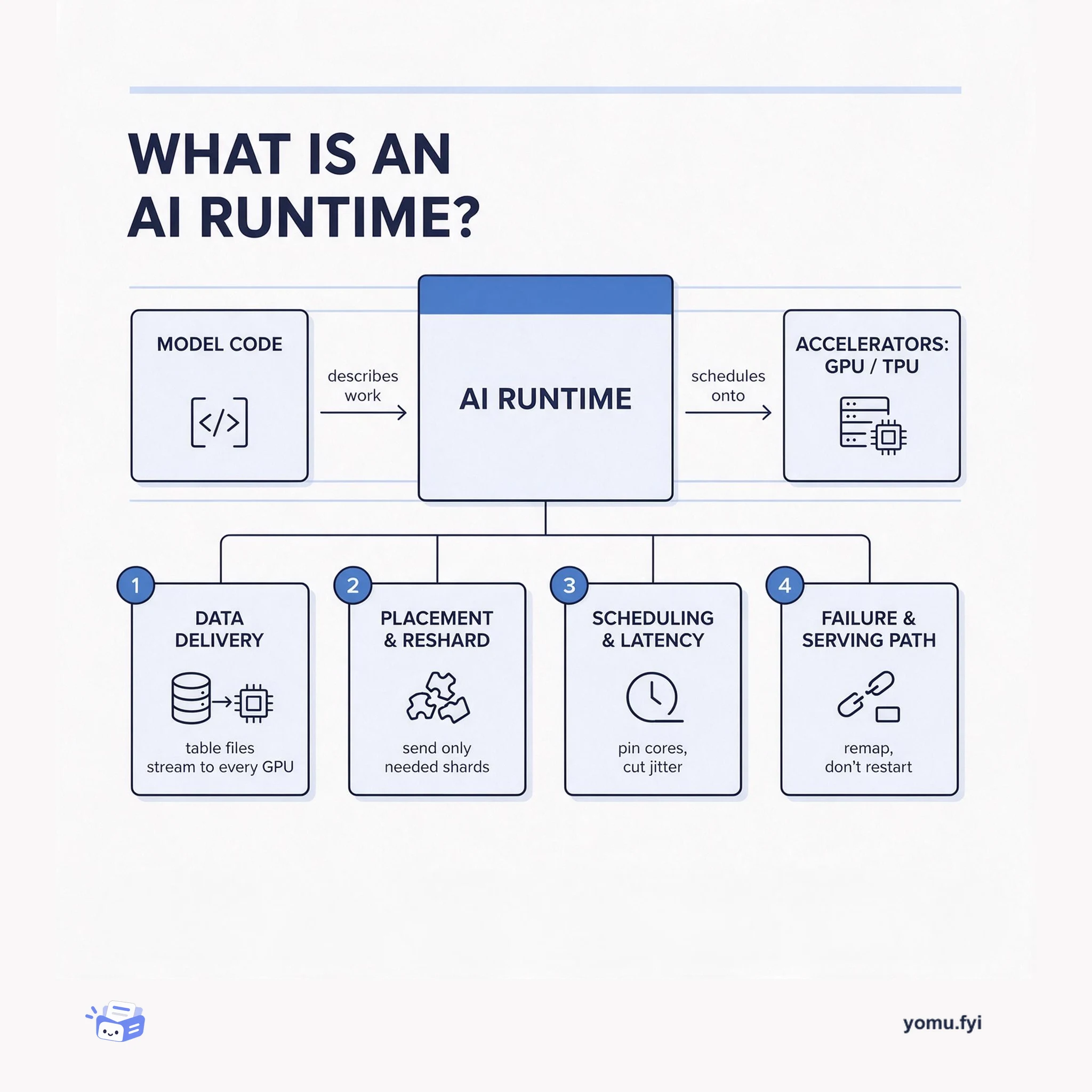
An AI runtime is the execution layer between model code and hardware: it feeds data to accelerators, places and reshards tensors, schedules work, and holds latency steady. Here are its four core jobs.
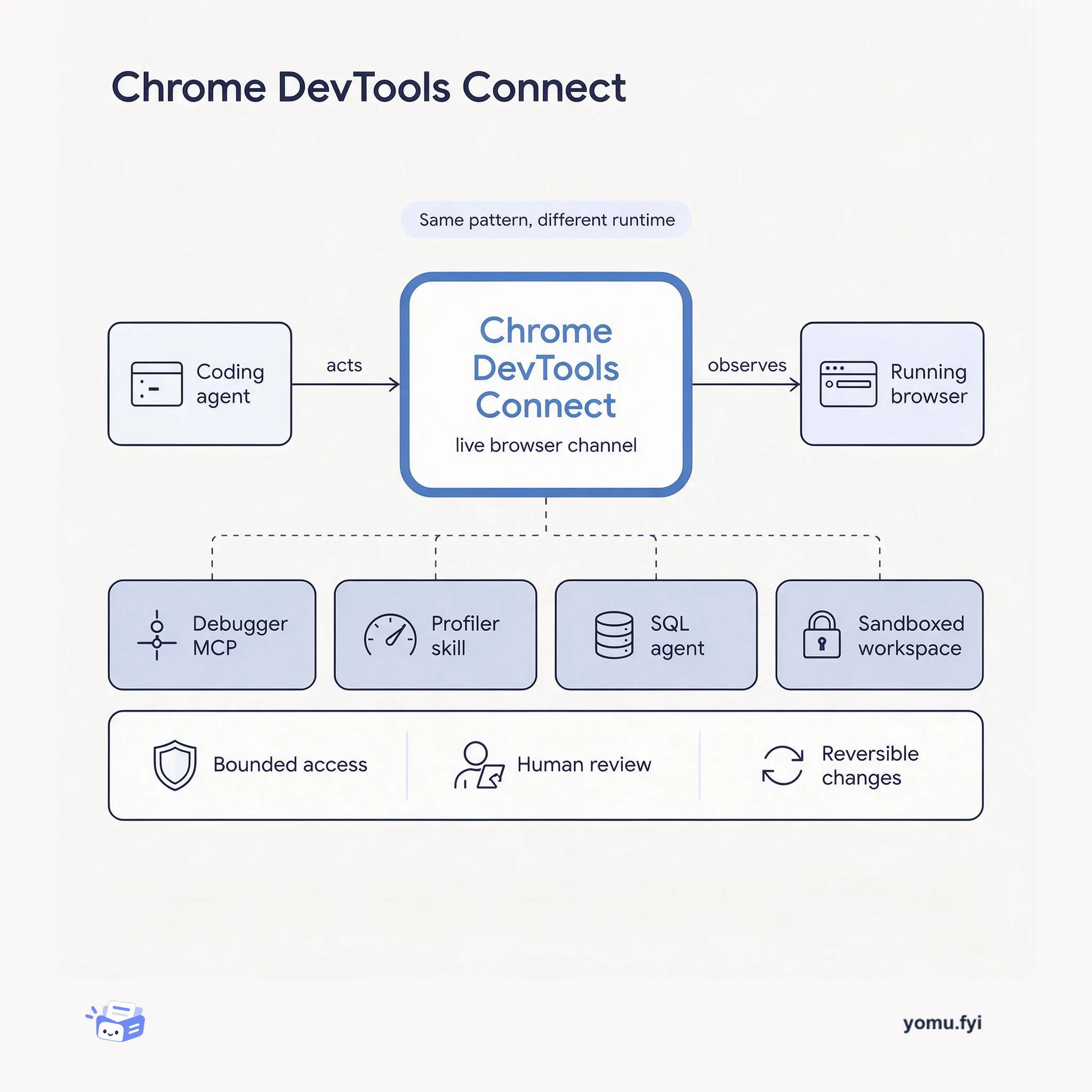
Chrome DevTools Connect gives coding agents a live channel into the browser's DevTools so they can run browser tests and drive fix cycles instead of reasoning from source alone.
The Good Stuff
Paid picks we use ourselves. Links carry a referral code — a subscription through one earns us a commission at no extra cost to you.
One useful email. Unsubscribe anytime.