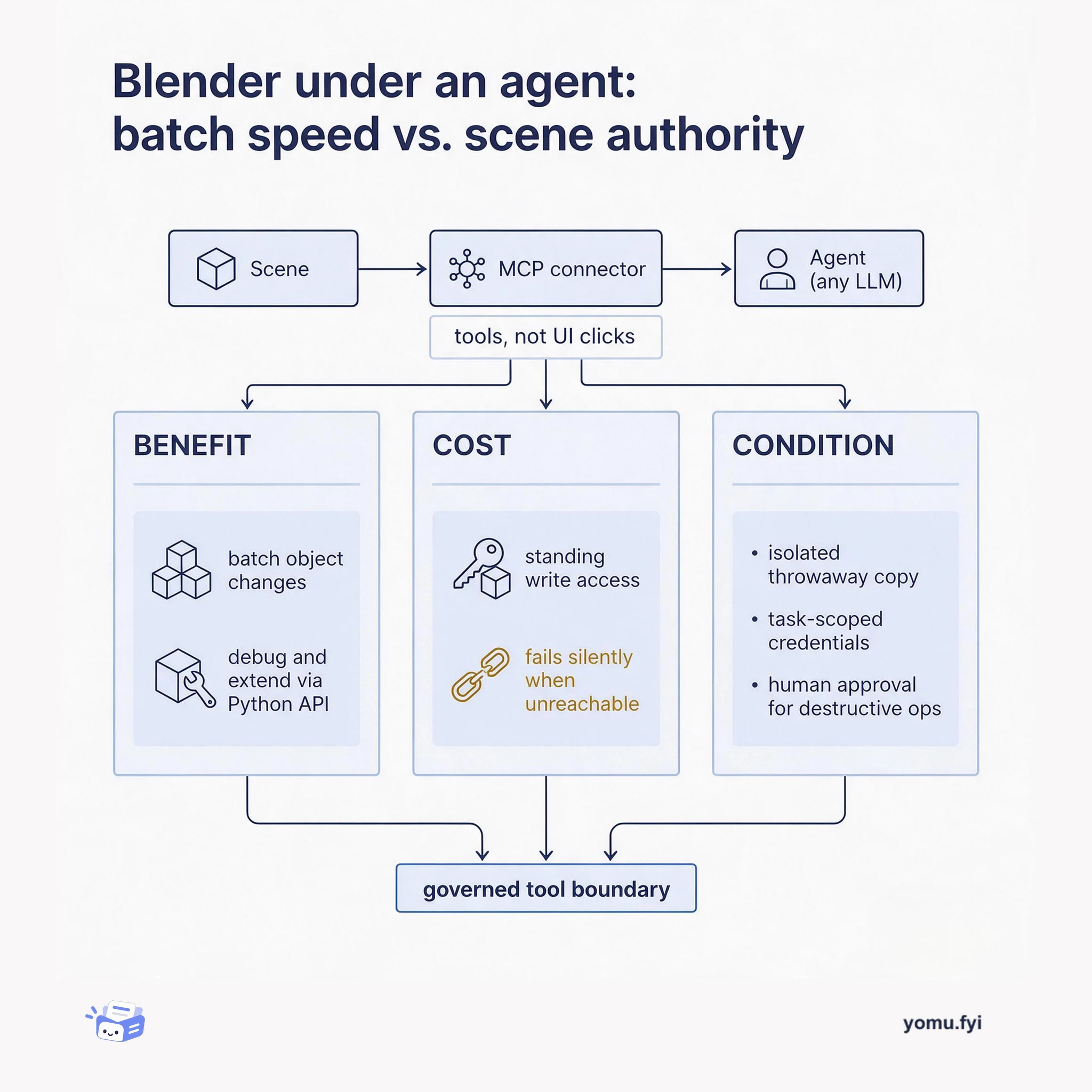
Blender's MCP Connector: Batch Speed vs. Authority Over the Scene
Blender's MCP connector lets an LLM analyze and batch-edit scenes through Blender's Python API. This trade-offs view weighs that speed against the authority and isolation it requires.
 SalesforceScott NybergAnnouncement
Agentforce Health Monitoring (AHM) addresses silent availability failures in production AI agents that traditional monitoring misses because agents can appear healthy even when unreachable. The team unified telemetry from approximately five or six locations across sessions, reasoning steps, tool calls, errors, and escalations into a coherent representation. End-to-end alerting latency was reduced from roughly 20 minutes to several minutes by converting Data 360 ingestion to streaming and simplifying query complexity. AHM provides 16+ built-in metrics including agent availability, error rate, response/escalation rate, engagement, and latency, with a drill-down interface connecting alerts to session context. The roadmap includes cost, TTFT/TTLT, toxicity, feedback metrics, RAG Quality Monitoring integration, and eventually a runtime insight agent for root-cause analysis and automated remediation.
Traditional monitoring fails for production AI agents because an agent can appear healthy (green metrics) even when requests never reach it, upstream connections fail, or an LLM gateway outage leaves it unresponsive. AHM was built to detect those silent availability failures that conventional monitoring misses.
Agentforce Health Monitoring (AHM) combines telemetry from across agent sessions, reasoning steps, tool calls, errors, and escalations into a coherent representation, computes agent availability, error rate, response/escalation rate, engagement, and latency metrics, and provides configurable alerting and a drill-down interface that connects alerts to session context for root-cause analysis.
AHM detects silent availability failures where agents appear healthy but do not respond, a gap left by conventional monitoring.
Telemetry is unified from about five or six locations (sessions, reasoning steps, tool calls, errors, escalations) into a single coherent representation before deriving metrics.
Alerting latency was reduced from ~20 minutes to several minutes by switching to streaming ingestion and simplifying query complexity.
Because the telemetry for a single agent session is spread across approximately five or six locations (interactions, reasoning steps, tool calls, errors, escalations). No single event can explain what happened, and no single system provides enough context for a meaningful alert. AHM had to combine those signals into one coherent representation of the agent journey before deriving metrics.
This was achieved by changing Data 360 ingestion to streaming, simplifying query complexity so evaluations could run more frequently, and reducing end-to-end latency from around 20 minutes to several minutes. The north star metric is under 120 seconds from clicking an alert to viewing the relevant session page.
Because detection alone does not tell administrators which sessions failed, what happened inside them, or what to do next. AHM provides a drill-down experience that lets administrators identify affected sessions and examine the steps and fields related to a failure, supporting root-cause analysis instead of just announcing a problem.
Summaries are generated from the original by a language model. Check the original before relying on it.
See the idea
Blender's MCP connector lets an LLM analyze and batch-edit scenes through Blender's Python API. This trade-offs view weighs that speed against the authority and isolation it requires.
Keep reading
The Good Stuff
Paid picks we use ourselves. Links carry a referral code — a subscription through one earns us a commission at no extra cost to you.
One useful email. Unsubscribe anytime.
