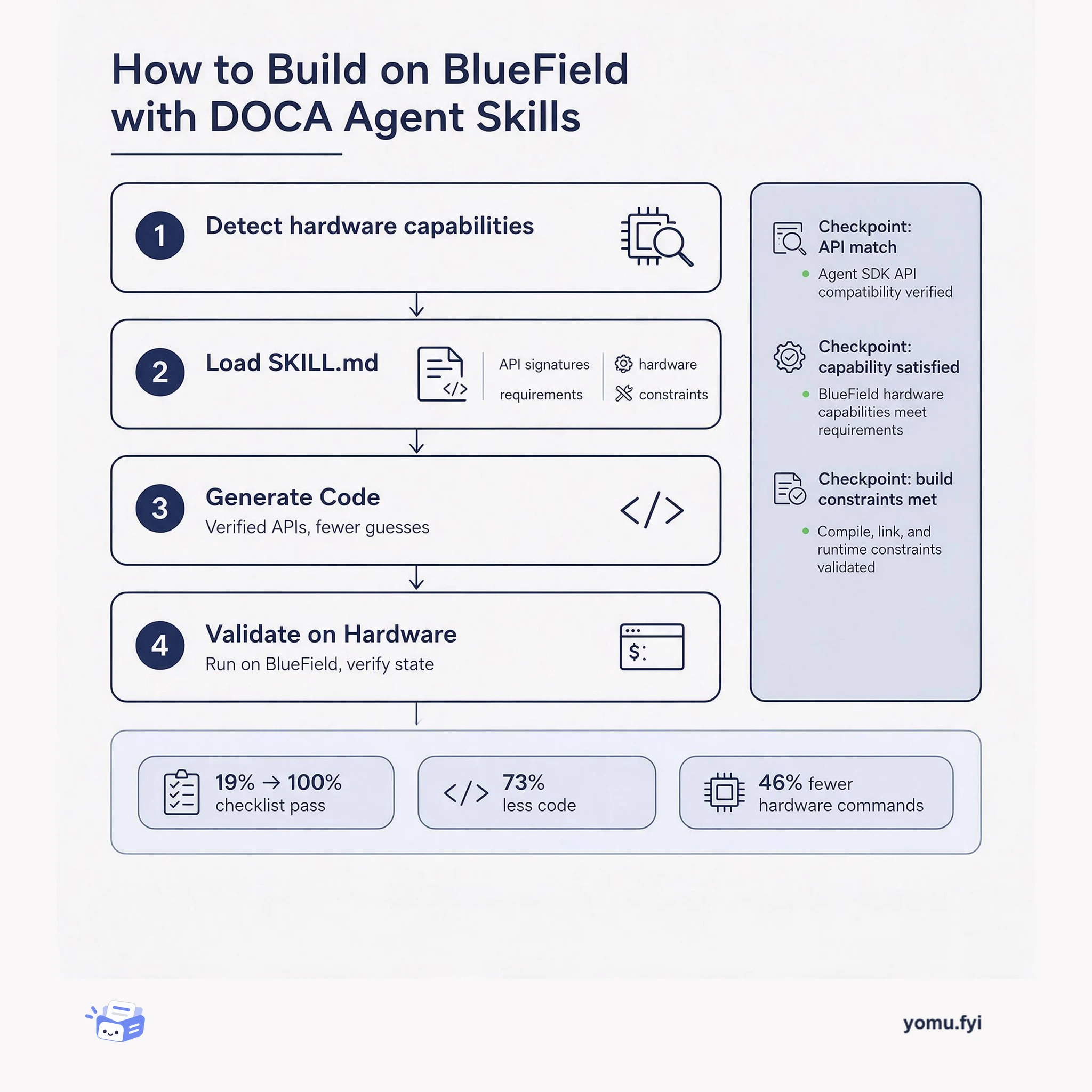
How to Build on BlueField with DOCA Agent Skills
A practical how-to for using NVIDIA DOCA Agent Skills to generate BlueField code with verified APIs and hardware checks, reducing correction cycles and failed builds.
 Red HatDr. Rob Geada, Dr. Mac Misiura, Shelton CyrilBenchmark
Enterprise generative AI applications require guardrails that balance flexibility with reliability. Decision models such as TypeSafe AI’s Jev produce fixed decisions with guaranteed schema and type safety, operating faster and cheaper than LLM-as-a-judge approaches. The Red Hat AI Safety team benchmarked nine guardrails across four methodologies for prompt injection and content safety tasks: pre-trained CPU-scale classifiers like Red Hat’s DeBERTa-v3 and Granite Guardian HAP-125m, older zero-shot models like BART-large-mnli, modern LLM-as-a-judge safety models including Shieldstral and Nemotron-3.5, and Jev-style decision models including Laya and DiffusionGemma. Each guardrail was evaluated using stock and custom risk policies, with Jev and DiffusionGemma using zero-shot questions. The results highlight trade-offs: Jev provides zero-shot flexibility and low latency, but purpose-built classifiers often match its speed and cost while delivering superior task-specific performance, and LLM-as-a-judge models can be tuned for higher accuracy.
Enterprise generative AI applications moving to production require guardrails that balance flexibility and reliability, with platform engineers choosing between LLM-as-a-judge approaches and traditional classifiers.
The Red Hat AI Safety team benchmarked nine guardrails across four methodologies: pre-trained CPU-scale classifiers, BART-large-mnli, modern LLM-as-a-judge safety models (Shieldstral, Nemotron-3.5, Qwen3.6), and Jev-style decision models (Laya, DiffusionGemma, Jev). Each guardrail was evaluated on prompt injection and content safety tasks using stock and custom risk policies, with Jev and DiffusionGemma using zero-shot questions.
Decision models output fixed decisions with guaranteed schema and type safety, making them safer to plug into applications than free-text LLM responses.
Jev is zero-shot and can handle novel problems without explicit training, reducing the barrier to entry compared to classical text classifiers that require fine-tuning on labeled data.
For well-defined guardrail tasks with abundant labeled data, purpose-built classifiers can match or exceed the speed and cost of decision models while providing superior task-specific performance.
Jev offers zero-shot classification without fine-tuning, but traditional classifiers trained on labeled data can provide superior task-specific performance at similar speed and cost.
Decision models produce fixed, type-safe outputs and are significantly faster and cheaper than LLM-as-a-judge approaches, while claiming similar performance.
Zero-shot models like Jev offer flexibility for novel problems, but task-specific classifiers can be tailored to known risks and may achieve higher accuracy with comparable efficiency.
Summaries are generated from the original by a language model. Check the original before relying on it.
See the idea
A practical how-to for using NVIDIA DOCA Agent Skills to generate BlueField code with verified APIs and hardware checks, reducing correction cycles and failed builds.
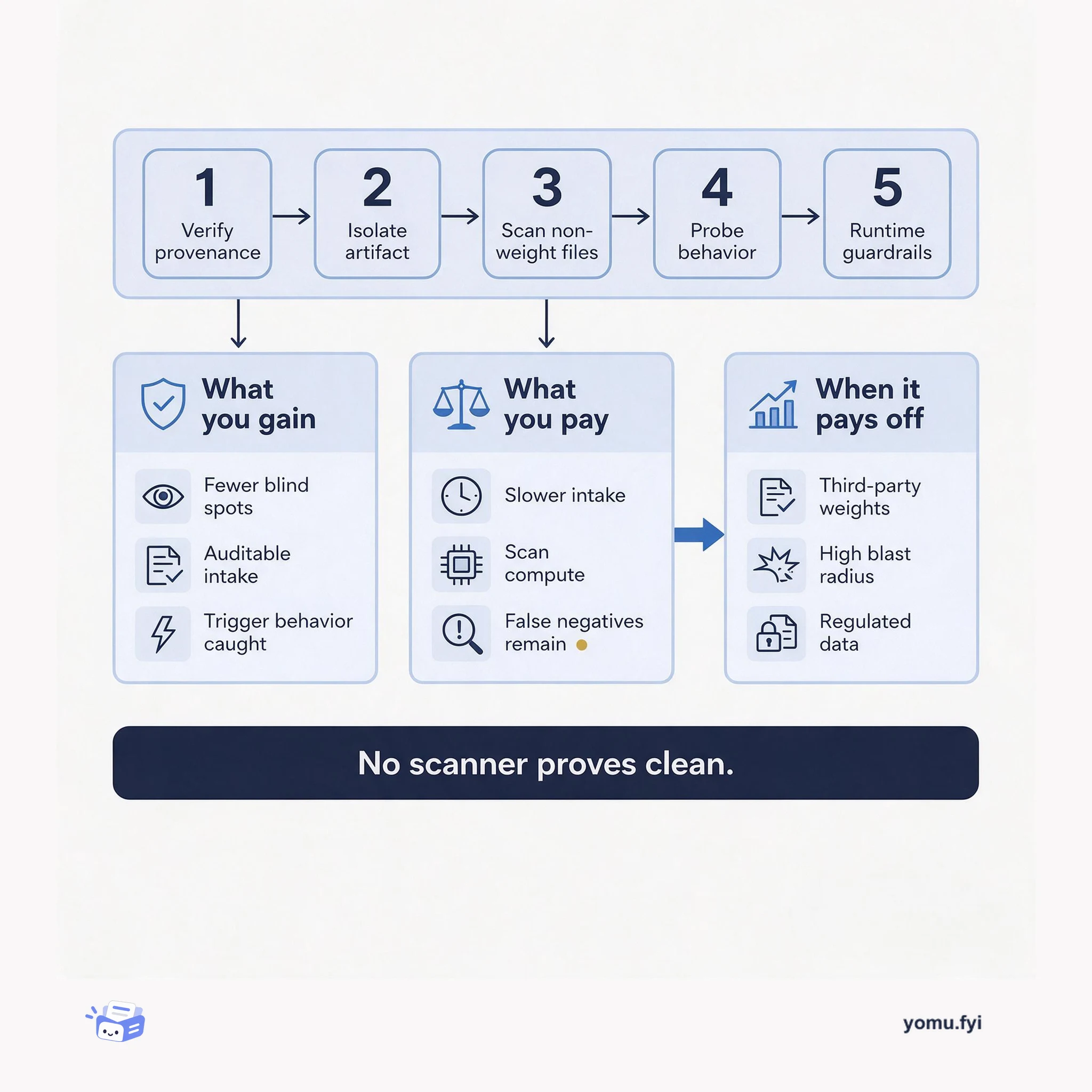
A model that passes benchmarks can still defect only on a trigger. This explainer maps the trade-off between deeper backdoor verification and the friction, latency, and cost it adds.
Keep reading
The Good Stuff
Paid picks we use ourselves. Links carry a referral code — a subscription through one earns us a commission at no extra cost to you.
One useful email. Unsubscribe anytime.