User-defined functions (UDFs) in Apache Spark break the declarative abstraction, forcing GPU-accelerated pipelines to fall back to CPU execution and incur data transfer overhead. NVIDIA cuDF addresses this with GPU parallelism, but UDFs remain a bottleneck due to their opaque code. The post describes three approaches to rewrite UDFs into GPU-accelerable forms: SQL expressions, the RapidsUDF interface using cuDF columnar operations, or custom CUDA kernels via JNI. The cuDF skills for Apache Spark automate this process with four agent-guided feedback loops for testing, conversion, benchmarking, and optimization, providing a project template and best practices. A production deployment converted over 30 UDFs, achieving a 22x speedup on a 600-billion-row workload, reducing operator time from 274.55 to 12.78 hours.
Context
Apache Spark UDFs break the declarative abstraction, causing GPU-accelerated pipelines to fall back to CPU execution and incur data transfer overhead. Rewriting UDFs into GPU-accelerable forms can yield over 20x speedups, but the process is laborious. The post introduces cuDF skills for Apache Spark, a set of agent-guided skills that automate the rewrite process through four feedback loops: testing, conversion, benchmarking, and optimization.
Approach / What changed
The cuDF skills for Apache Spark decompose UDF rewriting into four feedback loops: testing, conversion, benchmarking, and optimization. Each skill defines the work and evidence required before proceeding. The skills provide a project template with test and benchmark harnesses, encoded routines for output verification, and build configuration. Agents use these skills to iterate on rewrites, selecting from SQL, cuDF, or CUDA approaches based on correctness and performance measurements.
Takeaways
1
UDFs force GPU-accelerated Spark pipelines to fall back to CPU execution, incurring data transfer overhead and forgoing compute speedup.
2
Three approaches exist for rewriting UDFs: SQL expressions (simplest), RapidsUDF interface with cuDF columnar operations (moderate), and custom CUDA kernels via JNI (maximum flexibility).
3
Using cuDF skills for Apache Spark with AI agents, a production deployment converted over 30 UDFs and achieved a 22x speedup on a 600-billion-row workload, reducing operator time from 274.55 to 12.78 hours.
FAQ
What are the drawbacks of using UDFs in GPU-accelerated Spark pipelines?
UDFs break the declarative abstraction, forcing the GPU accelerator to convert data from columnar to row-wise format, fall back to CPU execution, and convert back. This incurs data transfer overhead and forgoes potential compute speedup from GPU primitives.
What are the three approaches to rewrite UDFs for GPU acceleration?
SQL expressions for simple logic, the RapidsUDF interface with cuDF columnar operations for moderate complexity, and custom CUDA kernels via JNI for performance-critical logic.
How do the cuDF skills for Apache Spark help automate UDF rewrites?
They decompose the rewrite into four feedback loops—testing, conversion, benchmarking, and optimization—each with defined work and evidence. They provide a project template with harnesses and best practices, allowing AI agents to iterate quickly.
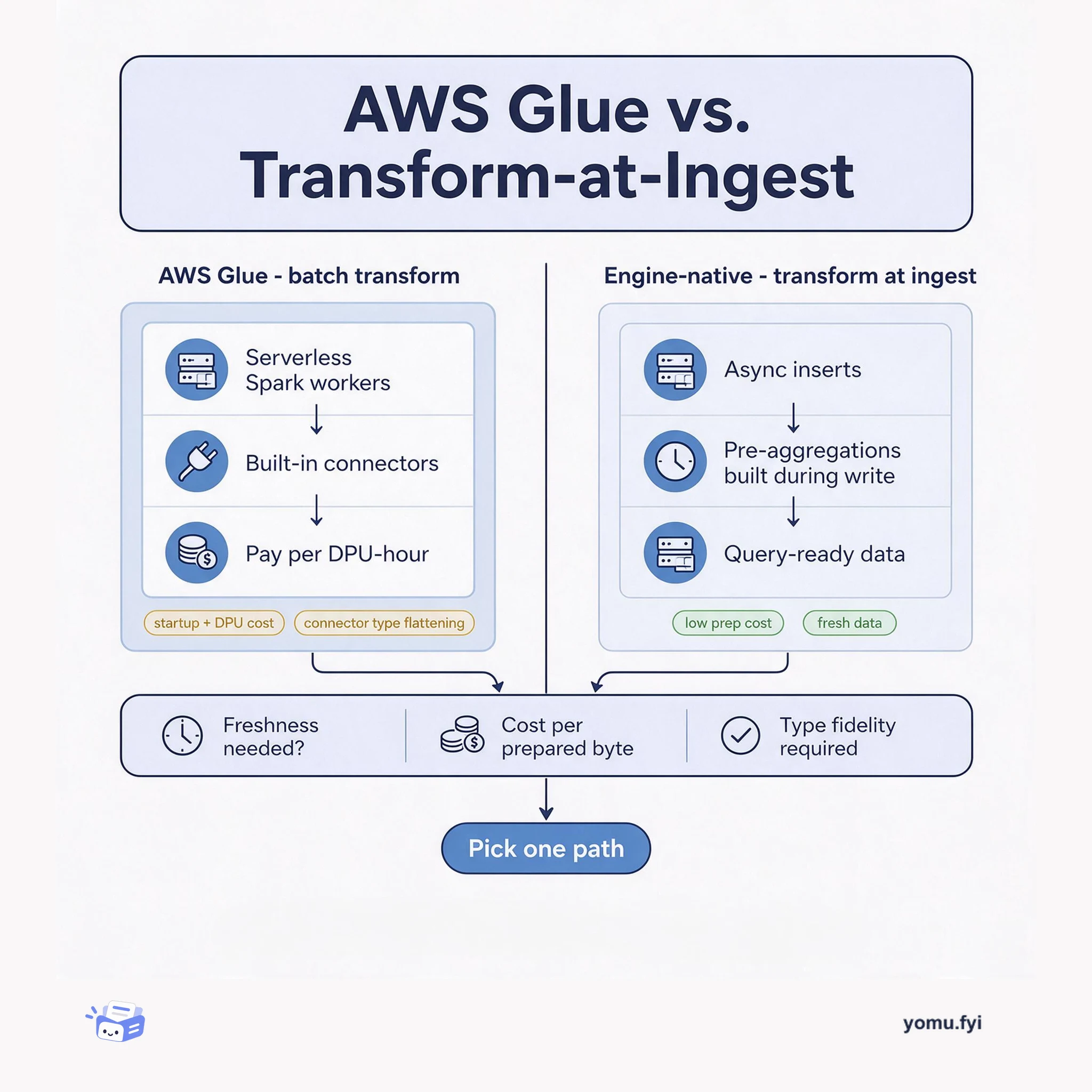
AWS Glue runs serverless Spark jobs that transform data in batches; engine-native pipelines transform during ingestion. This comparison shows how to pick between them by freshness, cost, and data fidelity.
Apache DataFusion is an embeddable query engine: SQL goes in, runs as columnar Arrow batches inside your own process, and results come out without a separate service.
A four-checkpoint how-to for agent loops: name a measurable job, bound the tool surface, refresh sandbox fixtures from real traffic, and verify at agent speed.
Keep reading
Related reading
The Good Stuff
Paid picks we use ourselves. Links carry a referral code — a subscription through one earns us a commission at no extra cost to you.