BYOC in Five Checkpoints: Name, Split, Land, Govern, Operate
A five-checkpoint walkthrough of BYOC: name the control you need, split control and data planes, build the landing zone, govern data in place, then operate inside your own tenant.
A four-checkpoint how-to for agent loops: name a measurable job, bound the tool surface, refresh sandbox fixtures from real traffic, and verify at agent speed.
Agent loops fail in predictable places: the job is vague, the tool surface is unbounded, the test fixture has drifted from production, or the merge queue cannot keep up with the agent's output. This explainer walks four checkpoints in order. First, define a measurable outcome and the checkpoint that proves it, the way a Spark UDF rewrite was judged by converted functions and runtime. Second, bound what the agent may call and touch. Third, refresh simulations from upstream deployments rather than from test failures. Fourth, scale verification so it keeps pace with generation.
In the Spark UDF work, the agent-guided process ran four separate feedback loops for testing, conversion, benchmarking, and optimization, and the outcome was judged on converted functions and runtime. Without a measurable target you cannot tell a fast loop from a useful one. The checkpoint is what makes the loop falsifiable.
Sandbox and production change on different schedules, so simulated upstream responses drift until tests pass while production fails. The teams that handle this tie simulation updates to upstream deployment events and capture real traffic to keep the behavioral contract current. Parity is not the goal; accuracy at the boundary the tests actually cover is.
Source control and merge throughput. Anthropic's monorepo grew from 2,500 to over 30,000 daily merges and git became the bottleneck, so they moved to a server-side, horizontally scalable system with cheap lock-free commits. Verification capacity, not generation capacity, is usually the limit.
The posts behind it
 NVIDIA · · Tutorial
User-defined functions (UDFs) in Apache Spark break the declarative abstraction, forcing GPU-accelerated pipelines to fall back to CPU execution and incur data transfer overhead. NVIDIA cuDF addresses this with GPU parallelism, but UDFs remain a bottleneck due to their opaque code. The post describes three approaches to rewrite UDFs into GPU-accelerable forms: SQL expressions, the RapidsUDF interface using cuDF columnar operations, or custom CUDA kernels via JNI. The cuDF skills for Apache Spark automate this process with four agent-guided feedback loops for testing, conversion, benchmarking, and optimization, providing a project template and best practices. A production deployment converted over 30 UDFs, achieving a 22x speedup on a 600-billion-row workload, reducing operator time from 274.55 to 12.78 hours.
 AWS · · Tutorial
AWS Resilience Hub’s Next generation, announced September 18, 2026, adds three capabilities to align workload scope and resilience requirements with running environments. Amazon EKS label support selects Kubernetes resources using existing labels with AND logic, establishing precise resource boundaries without reorganizing namespaces. Generative AI-powered Dependency Insights summarizes discovered dependencies and highlights patterns warranting resilience review, such as cross-Region dependencies questioning recovery design. Resilience policy sharing through AWS Organizations lets a central team define requirements once and make them available to member accounts, with policy events tracking adoption. The post walks through scoping a checkout service on EKS using labels, examining dependencies via synthetic traffic, and applying a shared tier-1-critical policy with a 99.9% availability SLO, 5-minute multi-AZ RTO, 1-minute RPO, 15-minute multi-Region RTO, and 60-minute backup intervals.
 Databricks · · Announcement
Databricks debuted as a Visionary in the 2026 Gartner Magic Quadrant for Analytics and Business Intelligence Platforms, achieving the highest debut performance in the report’s 20+ year history. The company also received one of the highest Completeness of Vision scores among all vendors evaluated. Databricks attributes this recognition to its ability to deliver on three major trends reshaping businesses: data and AI platform convergence, agentic analytics, and semantics at the core. The Databricks lakehouse integrates BI directly, eliminating data silos and the need for extracts, so agents can reason over complete, governed context. With Genie and AI/BI, the platform automates complex workflows and provides a unified semantic layer through Unity Catalog Business Semantics and Genie Ontology.
 Hugging Face · · Announcement
LFM2.5-24B-A2B is a 24-billion-parameter reasoning model with only 2 billion active parameters per token, designed for fast, private on-device agents. It uses a Mixture-of-Experts architecture with 40 layers, 64 experts per block, and top-4 routing, combined with gated short convolutions and GQA. The model produces an explicit chain of thought before answering and supports tool calling and multi-step tasks. Pre-training scaled to 33 trillion tokens, followed by mid-training and a five-stage post-training pipeline including supervised fine-tuning, multi-domain distillation, and agentic reinforcement learning. On benchmarks, it leads or matches larger models on tool use and instruction following, achieving 48.09 on LiveClaw and 96.75 on IFEval, while decoding 184 tokens per second on an Apple M5 Max.
 Stack Overflow · · Explainer
The gap between sandbox and production environments is structural and inevitable because they change on different schedules with different triggers. Infrastructure divergence rarely affects what integration tests catch, but behavioral contract drift—when simulated upstream responses no longer match real ones—causes tests to pass while production fails. The most effective teams connect simulation updates to upstream deployment events rather than to test failures, using observation-based tools like Keploy that capture real HTTP traffic to keep simulations current. Full production parity is not the goal; targeted accuracy for the specific behavioral contracts that integration tests validate is sufficient to catch the failures that matter most in distributed systems. The sandbox covers what it can, production reveals what it cannot, and the maintenance work is keeping the sandbox’s coverage accurate within its boundary, not expanding it to match production exactly.
 Anthropic · · Explainer
At Anthropic, Claude’s ability to iterate on code at high speed has caused git-based source control to become the bottleneck in their development workflow. To handle the growth from 2,500 to over 30,000 daily code merges, the team built Scion, an in-house version control system, fully migrating their monorepo from git in five months. Scion diverges from git by assuming clients are always online, shifting computation to the server, and using horizontally scalable data structures without any fully materialized copy of the repository. The system stores changes as entries in a write-ahead log, supports sparse and virtualized checkouts, and enables cheap, lock-free commits that scale with change size rather than repository size. Anthropic shares Scion’s design principles to help the broader ecosystem prepare for AI-driven scaling challenges, noting that similar pressure points will emerge for other organizations as AI coding tools become more common.
More like this
A five-checkpoint walkthrough of BYOC: name the control you need, split control and data planes, build the landing zone, govern data in place, then operate inside your own tenant.
A five-checkpoint workflow for making large-scale training runs bitwise reproducible: pick the guarantee, fingerprint the run, and trace divergence down to the kernel.
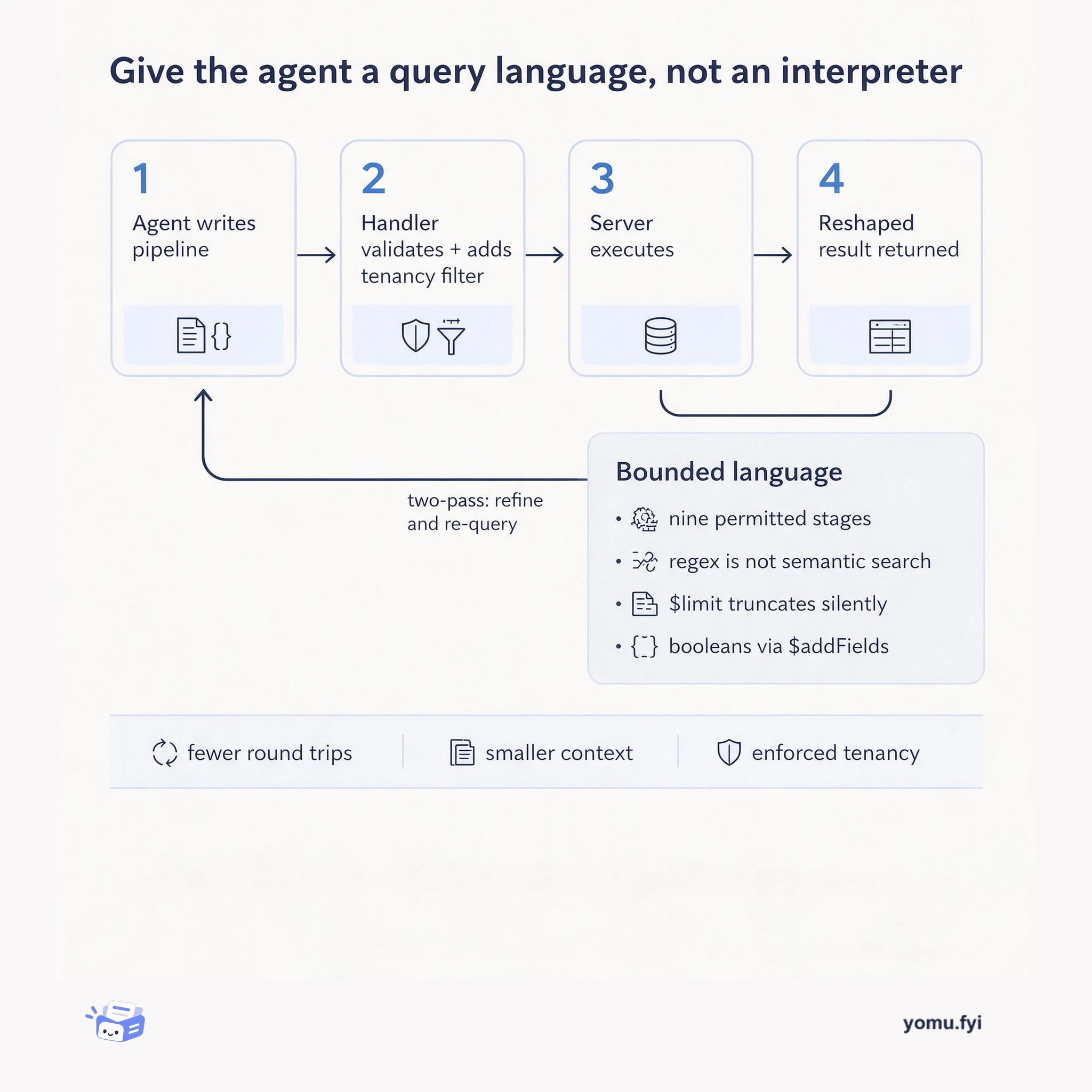
A four-step pattern for letting a document agent write validated aggregation pipelines instead of arbitrary code, so results come back shaped and tenancy stays enforced.
The Good Stuff
Paid picks we use ourselves. Links carry a referral code — a subscription through one earns us a commission at no extra cost to you.
One useful email. Unsubscribe anytime.