No single TensorRT scheduling strategy works best for every model: a heuristic that accelerates one network can slow another, and interactions between fusion, kernel choice, memory layout, and quantization are hard to predict. The Global Performance Tuner, released in TensorRT 11.1, automatically explores multiple customizable build routes, validates each candidate against a numerical accuracy tolerance, and selects the fastest feasible solution. This solves heuristic sprawl—where model-specific rules accumulate and interact in unmaintainable ways—and decouples performance optimization from accuracy constraints. The mathematical framework defines models, solution spaces, and build routes as compositions of compiler passes, assumes deterministic runtime under fixed conditions, and separates what executables can be constructed from how the compiler selects an optimal one. Among all solutions meeting the tolerance, the tuner picks the minimum-runtime feasible solution, rather than trying to encode every successful heuristic into a single universal strategy.
Context
TensorRT’s default scheduling strategy encodes heuristics from internal KPI models, but this approach leads to heuristic sprawl, performance-accuracy entanglement, and difficulty customizing scheduling for diverse models and hardware. The Global Performance Tuner, released in TensorRT 11.1, addresses this by exploring multiple customizable build routes with accuracy-aware tuning.
Approach / What changed
The Global Performance Tuner automatically explores a set of customizable build routes, each representing a different scheduling strategy. For each candidate solution, it validates outputs against a user-specified numerical accuracy tolerance and measures end-to-end inference performance. Among all solutions meeting the accuracy constraint, it selects the one with the lowest runtime.
Takeaways
1
TensorRT’s scheduling decisions—graph transformations, fusion, kernel selection, memory placement, and quantization—are interdependent, and a strategy that works well for one model may cause regressions for another.
2
The Global Performance Tuner treats accuracy as a constraint, not an objective; among all solutions that meet the specified tolerance, it selects the fastest one, rather than trying to encode heuristics into one universal strategy.
3
The mathematical framework defines models, solution spaces, and build routes (compositions of compiler passes), separating the question of what executables can be constructed from how the compiler selects an optimal one.
FAQ
What problem does the Global Performance Tuner address?
The tuner addresses the scaling limitations of heuristic-based scheduling in TensorRT. As models and hardware diversify, heuristics from internal models cause regressions for unseen models, and the logic becomes unmaintainable.
How does the tuner handle accuracy and performance trade-offs?
The tuner treats accuracy as a constraint: it only considers solutions whose numerical differences from the reference are within a specified tolerance. Among those, it selects the solution with the lowest runtime.
What is the mathematical concept of a build route?
A build route is the composition of compiler passes (graph transformations, fusion, kernel selection) that transforms a model into a solution. Each route produces one solution; the tuner explores multiple routes to get a larger solution space.
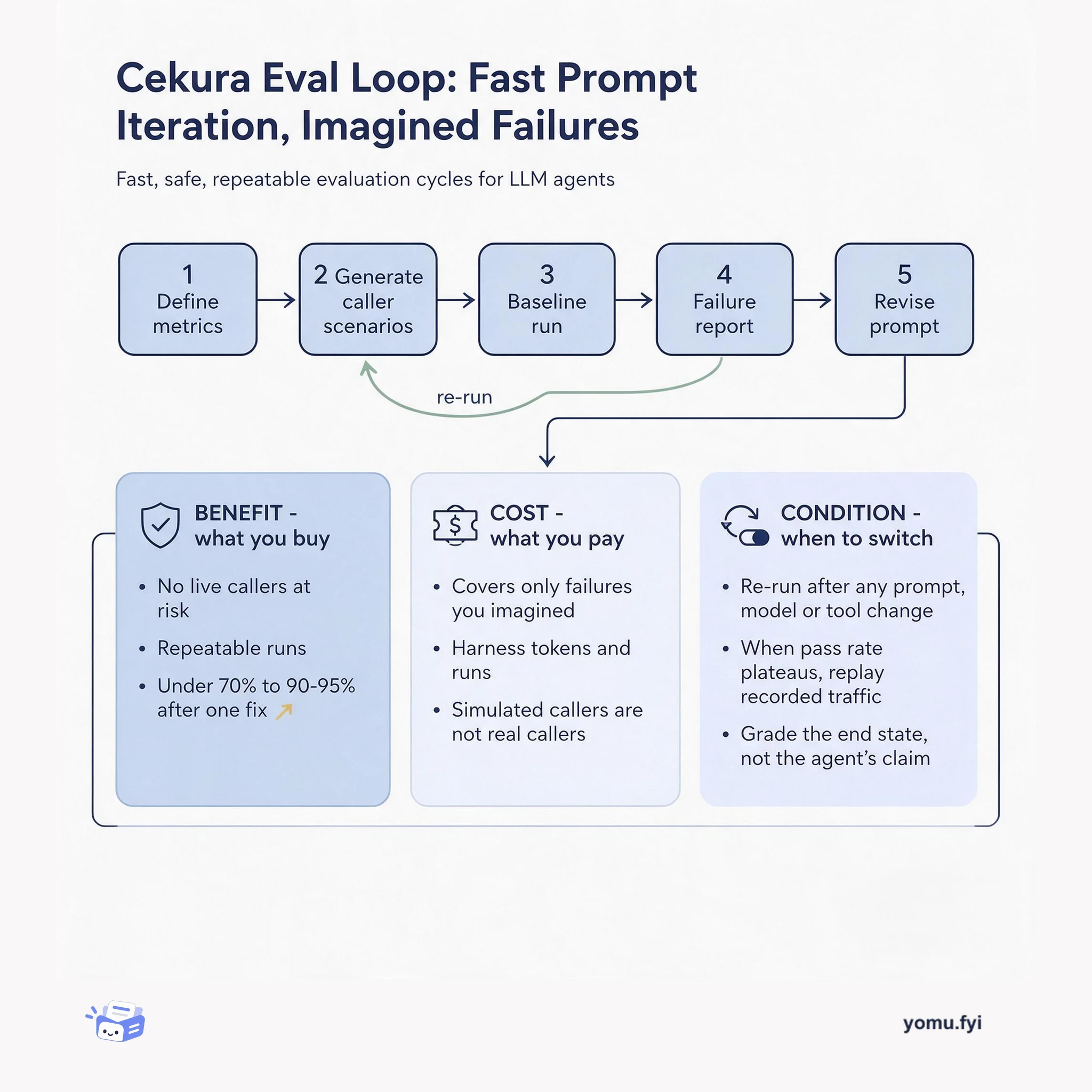
Cekura generates simulated caller scenarios to test voice-agent prompts, so failures surface before real calls. The trade-off: fast, repeatable iteration covers only the failures you thought to script.
A tradeoff map for synthetic audiobooks: natural-language style control buys character differentiation, but spends captioned data, tokens, and compute. See which lever to pull first and when plain narration is good enough.
Keep reading
Related reading
The Good Stuff
Paid picks we use ourselves. Links carry a referral code — a subscription through one earns us a commission at no extra cost to you.